



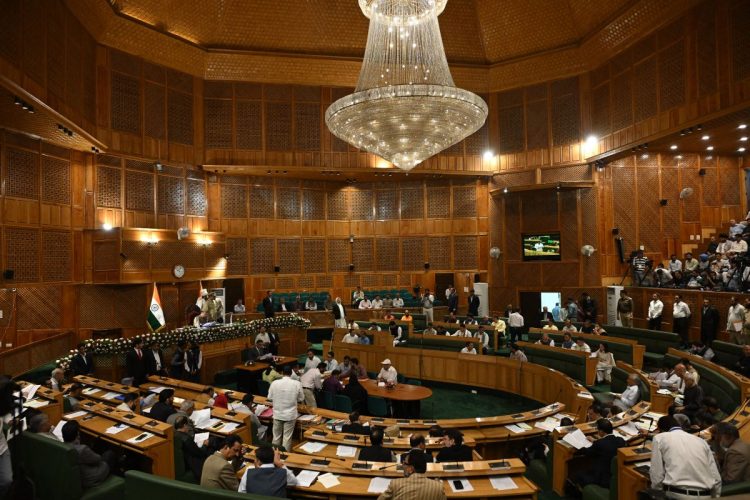
WAJAHAT SHABIR
SRINAGAR: The Jammu and Kashmir Legislative Assembly was adjourned sine die on Wednesday after a seven-hour sitting, with the House witnessing a detailed debate over alleged irregularities in the Jal Jeevan Mission (JJM), calls for targeted audits of flagged schemes and concerns over shortage of sand, stone and gravel affecting development works.
The 10-day Autumn Session, comprising seven working days and three days of break, saw 646 questions received, including 328 starred questions. Of the 625 questions listed, one was withdrawn and 25 disallowed, Speaker Abdul Rahim Rather said.
The JJM debate emerged as the key business of the final sitting, with House Committee Chairman Hasnain Masoodi presenting the committee’s report on the implementation of the mission across Jammu and Kashmir.
Masoodi said 3,253 schemes had been taken up under JJM, including around 1,400 ongoing schemes brought under the mission. The committee held nine sittings, obtained feedback from MLAs and beneficiaries and inspected 40 schemes across nine districts.
He said the committee was mandated to examine alleged irregularities rather than merely assess the performance of the scheme.
The committee flagged shortcomings in planning, pipe procurement and replacement, source testing, functional household tap connections and quality-control mechanisms. Masoodi said instances were found where GI pipes were replaced with HDPE pipes midway through implementation and some schemes were allegedly diverted without corresponding changes to their Detailed Project Reports.
He also raised questions over the storage and accountability of pipes, saying substantial quantities were found lying along roadsides and in streams.
Jal Shakti Minister Javid Ahmad Rana, however, cautioned against a blanket audit of all 3,253 schemes, saying it could further delay works intended to provide drinking water to households.
He proposed that only schemes specifically flagged by the House committee or individual legislators should undergo technical and financial audits. Such scrutiny, he said, could be conducted by Deputy Commissioners through designated teams, with payments withheld in cases where specific irregularities were under examination.
Rana also pointed out that pipe procurement had previously been examined by the Anti-Corruption Bureau and said there was no need for another high-level committee on the issue.
Speaker Rather intervened to make clear that complaints and irregularities flagged by the House committee and legislators could not simply be closed.
He directed the government to submit an Action Taken Report on the committee’s recommendations in accordance with Assembly rules.
At the same time, Rather clarified that JJM works against which there were no complaints should not be stopped.
Completed schemes should be made operational and legitimate payments should continue, while specific complaints and alleged irregularities should be investigated through an appropriate mechanism, he said.
The House also discussed the shortage of construction material, with MLA Javid Hassan Baig urging the government to address restrictions on the extraction and lifting of sand, stone and gravel.
Baig said the shortage had increased construction costs and was affecting development works in Baramulla, Sopore and other areas. Referring to earlier House committees on mining, he called for regulated extraction of natural resources while continuing action against illegal mining.
He also suggested that construction material could be transported by rail if adequate local supplies could not be made available.
Baig called for a balance between environmental protection and development requirements and questioned the multiple permissions required for government and private construction works.
Rather said the issue required a detailed discussion and would be taken up separately.
During the final sitting, Agriculture Production Department Minister Javid Ahmad Dar also laid two CAG reports before the House on behalf of the Chief Minister. These included the CAG Report No. 03 of 2026 for the period ended March 2023 and Report No. 04 of 2026 for the period ended March 2024.
Concluding the session, Speaker Rather said the Assembly had held seven sittings over 25 hours during the 10-day session.
The House received 79 calling attention notices, of which 56 were allowed and 23 disallowed. Two government resolutions were moved and both adopted.
Of 70 private members’ resolutions received, seven were listed and one was taken up but not adopted.
The government introduced eight Bills, six of which were passed and two withdrawn. Forty-nine private members’ Bills remained pending, while 23 fresh Bills were introduced.
Rather also referred to the BJP’s motion seeking his removal and said he had sought to ensure that the matter was dealt with strictly according to the rules.
With the Speaker’s concluding remarks, the Assembly was adjourned sine die.
NeVA goes live in LA,NC MLA congratulates Speaker
Srinagar: Senior National Conference leader and Zadibal MLA Tanvir Sadiq on Wednesday congratulated Jammu and Kashmir Legislative Assembly Speaker Abdul Rahim Rather and the Assembly Secretariat on the successful operationalisation of the National e-Vidhan Application (NeVA) during the Autumn Session of the House.
Speaking on the concluding day of the session, Sadiq appreciated the efforts of the Speaker and Assembly Secretariat in introducing the digital platform for legislative business, describing it as an important step towards making the functioning of the House more accessible and technology-driven.
He said the implementation of NeVA would bring questions, replies and other legislative business onto a single digital platform, enabling legislators and other stakeholders to access relevant information more conveniently.
“I congratulate the Hon’ble Speaker and the Assembly Secretariat for the successful operationalisation of NeVA. It is a significant step towards digitising the functioning of the House. The availability of questions, replies and other legislative business on the platform will make the proceedings more accessible and transparent,” Sadiq said.
The MLA also expressed appreciation for Speaker Rather’s efforts in taking the initiative forward and placed on record his gratitude to the Assembly Secretariat and officials involved in implementing the project.
He said the shift towards digital legislative processes would contribute to the broader objective of a paperless Assembly while improving access to parliamentary information.
The J&K Legislative Assembly has been working on the implementation of NeVA as a flagship initiative aimed at modernising legislative procedures and facilitating paperless functioning. Speaker Abdul Rahim Rather has previously chaired High-Level Apex Committee meetings to review and accelerate the implementation of the project.

