



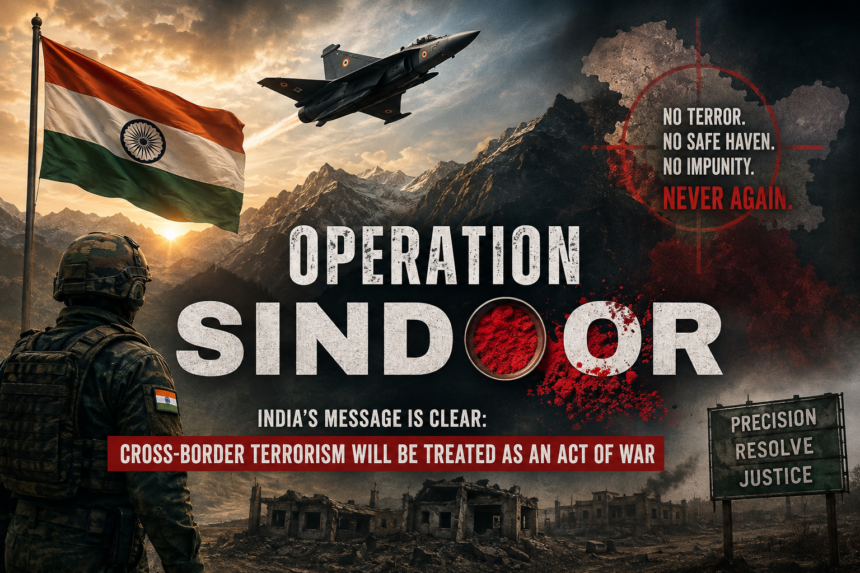
Pakistan’s Victory Parade Cannot Conceal the Lessons of Operation Sindoor
By Bharat Nanda
Pakistan has spent considerable political and military capital portraying the May 2025 confrontation with India as a historic victory. Its generals have spoken of strategic brilliance, its ministers have dismissed reports of Pakistani losses, and its propaganda machinery has repeatedly circulated claims of destroyed Indian airbases, neutralised S-400 systems and damaged BrahMos facilities. The official story emerging from Islamabad is one of overwhelming success achieved at little cost.
Yet armies reveal the truth about wars not through victory speeches, but through what they urgently change after the guns fall silent.
Pakistan’s actions after the May 2025 ceasefire tell a markedly different story from its public celebrations. Within months, it established a dedicated Army Rocket Force Command, inducted Chinese Z-10ME attack helicopters, strengthened its long-range conventional-strike posture and subsequently altered the constitutional structure of its military command. Authority over the armed forces was concentrated under a new Chief of Defence Forces framework, while the previous joint-services arrangement was dismantled.
These were not ceremonial changes. They addressed precisely those areas that become critical when a military discovers weaknesses in reach, coordination, battlefield aviation, command integration and escalation management. Pakistan may call its May operation a victory, but its subsequent conduct resembles a military establishment conducting a serious after-action review and preparing urgently for a more demanding future conflict.
The contradiction is impossible to ignore. If Pakistan’s forces had performed with the superiority claimed by Islamabad, why was a new rocket command required almost immediately afterwards? If its battlefield response was already integrated and effective, why was the induction of new attack helicopters presented as essential to strengthening that response? If coordination among the army, air force and navy had worked flawlessly, why was Pakistan’s command structure subsequently rewritten and greater authority concentrated in the hands of one officer?
Victorious militaries certainly modernise. No professional armed force stops acquiring equipment simply because it has performed well. Pakistan’s helicopter programme, in particular, had roots predating the May conflict. But the timing, combination and declared purpose of these measures matter. A new command dedicated to conventional rockets and missiles, modern battlefield aviation platforms and an unprecedented concentration of tri-service authority together point towards a military attempting to improve its ability to conduct future high-intensity operations against India.
The most revealing development was the creation of the Army Rocket Force Command in August 2025. Pakistan already possessed ballistic and cruise missiles before Operation Sindoor. The issue was not the absence of missiles, but the need for an integrated organisation capable of employing conventionally armed rockets and missiles against distant targets without immediately crossing the nuclear threshold.
Operation Sindoor demonstrated that India possessed both the political will and the military capability to strike terrorist infrastructure and associated targets deep inside Pakistan. It also showed that a limited conflict could rapidly expand geographically while remaining below the threshold of full-scale war. Pakistan therefore faced a difficult operational problem: how to produce a proportionate long-range conventional response without relying upon systems associated with its strategic nuclear forces and risking uncontrollable escalation.
The creation of a specialised rocket force is an institutional answer to that problem. It seeks to bring guided rockets, cruise missiles and multiple-launch systems into a more coherent structure capable of delivering conventional firepower at depth. In other words, Pakistan began building an organisation intended to close a strike gap that the May confrontation had exposed.
That is not evidence of confidence in the adequacy of its existing capabilities. It is evidence of a military preparing not to face the same disadvantage again.
The induction of Chinese Z-10ME attack helicopters in August 2025 fits the broader pattern. Pakistan had long sought to replace its ageing AH-1F Cobra fleet, and its earlier attempt to acquire Turkish T129 helicopters had run into difficulties. The Z-10ME acquisition was therefore not conceived overnight after Operation Sindoor. Nevertheless, its prominent post-conflict induction, overseen by Field Marshal Asim Munir and accompanied by a firepower demonstration, carried an unmistakable message.
Pakistan wanted to display improved battlefield mobility, precision engagement and close-air-support capability. It was signalling both domestically and externally that its army aviation arm was being strengthened for a more integrated battlefield. The requirement may have existed for years, but the urgency and symbolism acquired a new significance after May 2025.
The deepest change, however, occurred not in a missile battery or helicopter squadron but at the apex of Pakistan’s military establishment. Through the 27th Constitutional Amendment, Pakistan created the position of Chief of Defence Forces, abolished the office of Chairman Joint Chiefs of Staff Committee and formalised greater authority for the army chief over the country’s military structure. Field Marshal Asim Munir emerged with unprecedented institutional power, while a reorganised strategic command framework further tightened control over Pakistan’s most sensitive military capabilities.
This cannot be treated merely as bureaucratic housekeeping. Command structures are altered when existing arrangements are considered inadequate, politically inconvenient or insufficiently responsive to the demands of future crises. The May conflict would have tested Pakistan’s ability to coordinate air defence, offensive air operations, missile forces, intelligence, electronic warfare, conventional firepower and strategic signalling under enormous time pressure. The post-conflict centralisation suggests that Pakistan’s leadership did not want to enter another confrontation with the same division of authority.
It also reveals something darker about the nature of the Pakistani state. Rather than strengthening civilian control and demanding transparent institutional accountability after a dangerous conflict, Pakistan further concentrated national-security power around the army chief. The military did not merely draw operational lessons; it converted the conflict into an opportunity to reinforce its dominance over the state.
The elevation of Asim Munir, the centralisation of tri-service authority and the restructuring of strategic command were therefore as much about regime security as national security. By presenting the May confrontation as a grand victory, the military establishment created the public legitimacy required to expand its power. The victory narrative was politically useful even if the internal military assessment was far less celebratory.
This helps explain the extraordinary intensity of Pakistan’s information campaign. Islamabad claimed that numerous Indian military installations had been devastated, that S-400 air-defence systems had been destroyed and that BrahMos facilities had been struck. Yet the claimed destruction was not supported by independently verifiable evidence commensurate with the scale of the assertions. Prime Minister Narendra Modi’s visit to Adampur soon after the fighting, with the base visibly functioning, directly undermined one of Pakistan’s most heavily promoted narratives.
Pakistan’s claims were designed less to document verifiable battlefield outcomes than to create a domestic perception of parity and triumph. For a country whose military justifies its political authority through the permanent projection of an Indian threat, admitting operational shortcomings would have carried consequences far beyond the battlefield. It could have weakened the prestige of the army, raised questions about enormous defence expenditure and disrupted the elevation of its serving chief.
A victory narrative was therefore not optional. It was institutionally necessary.
Even the name “Bunyan-un-Marsoos,” conveying the image of a solid or firmly joined structure, formed part of this effort. It wrapped a military operation in religious imagery and presented the confrontation as a moment of national and ideological unity. Pakistan’s military establishment has repeatedly employed religious symbolism to legitimise its strategic choices and mobilise public emotion. In the aftermath of May 2025, this symbolism helped transform an inconclusive and damaging confrontation into a story of divinely inspired resistance.
But religiously charged branding cannot substitute for verifiable military results. Nor can televised speeches erase the evidence contained in Pakistan’s subsequent decisions.
Operation Sindoor changed the strategic equation because India demonstrated that a major terrorist attack could invite a calibrated but forceful military response against infrastructure inside Pakistan. New Delhi did not accept the old Pakistani assumption that nuclear weapons would permanently shield terrorism conducted through proxies. India showed that there was operational space between diplomatic protest and unlimited war.
This placed Pakistan in a difficult position. Its longstanding strategy depended upon maintaining escalation dominance: supporting or tolerating anti-India terrorist infrastructure while warning that any Indian retaliation could trigger a wider, potentially nuclear confrontation. Operation Sindoor challenged that model by imposing visible costs while controlling the ladder of escalation.
Pakistan’s post-May reforms should be understood as an effort to rebuild that lost space. The rocket force offers additional conventional options at longer ranges. Modern attack helicopters strengthen battlefield responsiveness. A centralised command structure may enable faster coordination across military services. The expansion of Asim Munir’s authority reduces institutional friction and places future crisis management under a single dominant centre.
Together, these measures indicate preparation for the next confrontation. Pakistan appears to have concluded that future hostilities with India could be faster, deeper, more technologically complex and more difficult to contain. It is reorganising accordingly.
India should neither dismiss these developments nor become distracted by Pakistan’s propaganda. The correct response is not rhetorical competition but sustained military preparedness. India must continue strengthening integrated air and missile defence, long-range precision strike, counter-unmanned systems, electronic warfare, hardened infrastructure, satellite surveillance and real-time tri-service coordination. It must also anticipate that Pakistan will study every Indian success from Operation Sindoor and develop ways to counter it.
Pakistan’s defeat should not be understood only in terms of aircraft, missiles, bases or physical damage. Its more consequential setback was the weakening of the strategic protection it believed terrorism enjoyed. Operation Sindoor established that India could respond directly and that Pakistan could not be certain of controlling the consequences through nuclear intimidation or international pressure.
Islamabad’s post-conflict conduct shows that it understood this message, even if its official rhetoric could never admit it.
The clearest evidence against Pakistan’s claim of an effortless victory comes from Pakistan itself. A state fully satisfied with its performance does not rush to fill gaps in long-range conventional firepower, showcase a strengthened battlefield-aviation capability, reconstruct its higher military command and centralise unprecedented power in one general without compelling reasons.
Pakistan’s victory exists primarily in speeches, television graphics and carefully managed domestic narratives. Its institutional behaviour tells another story: the May 2025 confrontation exposed limitations, disturbed established assumptions and forced the military to prepare for a future in which India may again strike decisively after a terrorist provocation.
Behind the celebration lies anxiety. Behind the claims of superiority lies reorganisation. Behind the manufactured triumph lies a military establishment attempting to ensure that the next war does not expose the same weaknesses.
Pakistan can continue declaring victory. Its preparations for the future reveal what it actually learned from the past.
The author is a technology professional, geopolitical analyst, newspaper columnist and author based in Jammu. He can be reached on [email protected] and x.com/bharatnanada_
