



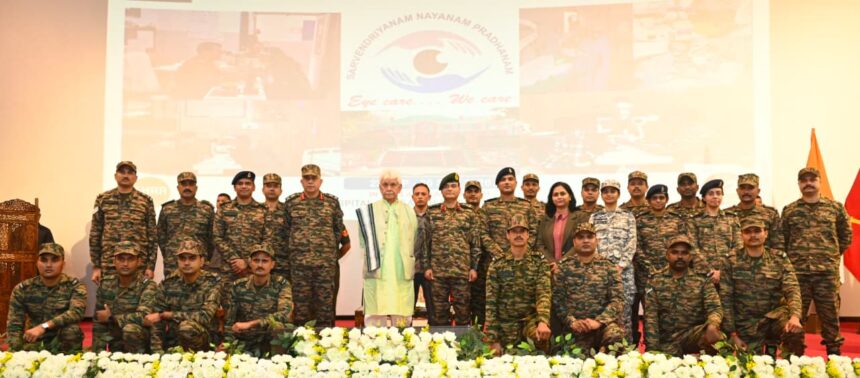
Srinagar: Lieutenant Governor Manoj Sinha on Wednesday said the Indian Army’s role extends beyond defending the country, describing its healthcare outreach as a source of “support, compassion and healing” for ordinary citizens in Jammu and Kashmir.
Sinha made the remarks while attending the closing ceremony of the 11th Mega Eye Surgery Camp organised under Operation Drishti in Srinagar.
Highlighting the impact of the initiative, the Lieutenant Governor said 364 patients underwent eye surgeries at the Srinagar and Tangdhar camps. He said the initiative was not merely about medical numbers but about restoring dignity, hope and confidence among beneficiaries.
“Indian Army is not only a force that defends the country from external threats, but also a source of support, compassion and healing for ordinary citizens of Jammu Kashmir in times of need. By restoring sight, the Army has given patients a new vision of peace, trust, and togetherness,” he said.
Sinha said 144 surgeries were successfully conducted at the Srinagar camp, while 220 patients received treatment at Tangdhar in Kupwara district, which he described as the first mega eye surgery camp conducted on the border.
He highlighted the difficult terrain and challenging conditions in Tangdhar, where doctors and soldiers created an underground operation theatre to conduct the surgeries. Modern surgical equipment was also airlifted to the area to facilitate advanced eye care.
“Those who have seen Tangdhar’s geographical conditions understand that reaching there with assistance is itself a challenge. One must cross mountains, traverse difficult terrain and at times advance even amidst the danger. Yet, in this very challenging and uncertain environment, our doctors and brave soldiers, under the leadership of Brigadier Sanjay Mishra, created a centre of hope,” Sinha said.
The Lieutenant Governor said patients from Khawarpora, Tangdhar, Bagbella and adjoining villages benefited from the camp, adding that the initiative demonstrated that difficult terrain need not prevent access to modern healthcare.
“This is true courage, dedication to duty and the real meaning of service. This entire effort has proven one thing beyond doubt that where resolve is firm, no difficulty, however great, can block the path of human service by Indian Army,” he said.
Sinha also expressed gratitude to Prime Minister Narendra Modi and Defence Minister Rajnath Singh and commended the Indian Army for its efforts under Operation Drishti. He particularly appreciated the service of Brigadier Sanjay Kumar Mishra and his team.
At the national level, Sinha said, more than 1.5 lakh people have undergone eye examinations and over 3,500 surgeries have been performed across 10 cities under Operation Drishti.
He said the initiative had strengthened trust between the Army and local communities, demonstrating that the force contributes not only to national defence but also to healthcare and humanitarian outreach.
The Lieutenant Governor also acknowledged the role of support staff, Air Force pilots and soldiers involved in transporting medical equipment, preparing the underground operation theatres and facilitating surgeries in difficult conditions.
Sinha said the Srinagar camp marked another step in the continuation of Operation Drishti and expressed confidence that the initiative would reach more villages and towns, ensuring that quality healthcare is not confined to major cities.
He said the experience of the Tangdhar camp could serve as an example for extending modern medical facilities to remote areas across the country.
“Operation Drishti gives us confidence that with determination, better planning and compassion, modern medicine can be delivered to every corner of the country,” he said.
During the ceremony, Sinha felicitated doctors and medical staff of the Defence forces for their services and distributed post-operative kits among beneficiaries.
‘Women artisans are ‘Heartbeat’ of Pashmina’
Srinagar: Lieutenant Governor Manoj Sinha on Wednesday described women artisans as the “silent creators, custodians and heartbeat” of Kashmir’s Pashmina tradition, saying their craftsmanship has played a central role in preserving the region’s cultural heritage and taking it to the world.
Sinha made the remarks while gracing the Pashmina Artisan Awards 2026, organised by the Pashmeena Entrepreneurs Makers and Artisans (PEMA) Foundation in Srinagar. He congratulated the award winners and appreciated the PEMA Foundation for recognising the contribution of artisans.
Highlighting the role of women in the Pashmina tradition, the Lieutenant Governor said their contribution extends across the production process, from refining raw fibre to intricate embroidery.
“Women artisans are not merely participants in this tradition but they are its silent creators, its custodians and its heartbeat,” he said.
Sinha said the awards celebrate not merely individual artisans but the wider artistic heritage associated with Jammu and Kashmir’s Pashmina tradition. Referring to the spirit of Bhagwan Vishwakarma, he said India has traditionally regarded artisanship as sacred knowledge.
He recalled the earlier editions of the Pashmina Artisan Awards held in 2023 and 2025, describing them as a source of encouragement for the artisan community. He said the 2026 edition marked a significant milestone by dedicating special attention to women artisans whose work has contributed to the global recognition of Kashmir’s Pashmina.
The Lieutenant Governor assured artisans of the Government of India’s commitment in four key areas—fair remuneration and protection of Geographical Indication (GI) tags; access to global markets through e-commerce, exhibitions and digital platforms; skill development and welfare measures, including healthcare, social security and modern design training; and financial inclusion through initiatives such as MUDRA, Credit Card Scheme and Karkhandar training programmes.
He said the handloom and handicrafts sector currently provides economic security to around 4.60 lakh artisans and their families in Jammu and Kashmir. He also noted that 18 crafts have been granted GI tags, while a QR-based system has been developed to help establish the authenticity of products.
Urging artisans to adopt modern opportunities while preserving traditional craftsmanship, Sinha said the administration and PEMA Foundation would continue working together to strengthen the sector.
“You should never feel that your work is ordinary. What you are doing is a form of devotion, an act of creation and a noble effort to keep India’s cultural memory alive,” he said.
The Lieutenant Governor said an original Pashmina product from Jammu and Kashmir carried more than artistic value, adding that when worn anywhere in the world, it also represented a part of India’s culture and history.
Sinha felicitated the award-winning artisans during the ceremony and reiterated the importance of ensuring dignity, fair remuneration and wider recognition for the people engaged in traditional crafts.
Commissioner Secretary, Industries & Commerce Department, Vikramjit Singh; former Chairperson, J&K Khadi Village Industries Board, Dr Hina Shafi Bhat; Director, Handloom & Handicrafts Kashmir, Masrat-ul-Islam; President, PEMA Foundation, Tariq Dar; senior officials, members of the foundation and artisans attended the ceremony.

