



Pakistan’s decision to conduct air strikes inside Afghanistan has intensified a confrontation that the supplied material links to three overlapping pressures: renewed violence along the Afghan border, Pakistan’s obligations under a regional defence agreement and growing political tensions at home.
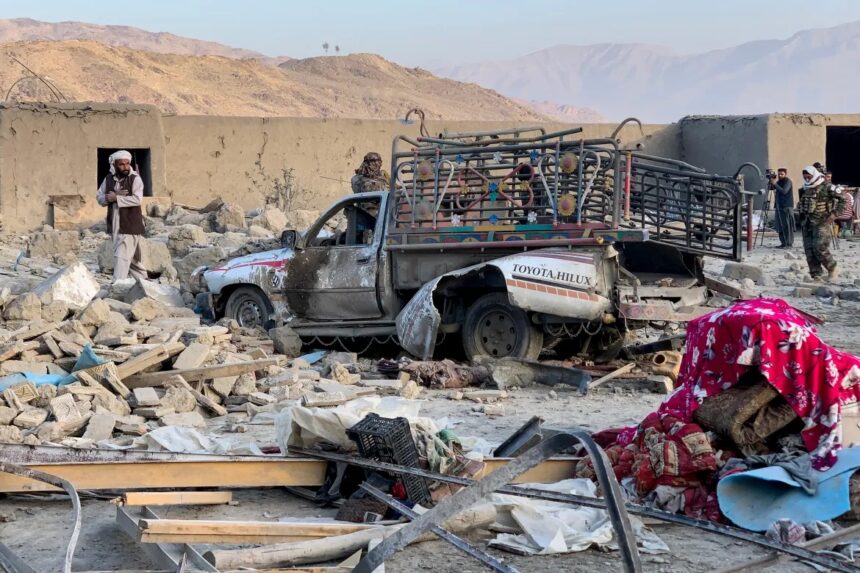
The strikes, reportedly carried out by the Pakistan Air Force in Kunar, Paktika and Khost, followed what the material describes as incursions by three to four Afghan reconnaissance drones and the September 18 bombing of a police compound mosque in Kohat. Pakistan presented the military action as a response to security threats, while the source argues that the response went far beyond the scale of the initial incidents.
The material alleges that the strikes caused civilian casualties, including women and children, while Pakistani authorities said the operation was directed against militant targets. It characterises the aerial campaign as an escalation rather than a limited response to the reported drone activity.
At the centre of the escalation is the Kohat bombing, which the document says killed 31 people and wounded more than 100. The attack occurred at a police compound mosque and is described in the source as a deliberate operation involving Pakistan’s intelligence establishment and the militant group Ittehad-ul-Mujahideen Pakistan.
Those allegations are presented as the basis for the source’s claim that the bombing was used to create a justification for military action against Afghanistan. The supplied material does not independently establish the allegation that Pakistani intelligence agencies organised the attack.
The document places the Afghan strikes within a wider regional dilemma for Islamabad. In August 2026, Pakistan joined Saudi Arabia and Türkiye in the Makkah Joint Defence Agreement, according to the material. It says the arrangement was accompanied by Saudi financial assistance, including emergency loans, deferred oil arrangements and support for Pakistan’s central bank.
The source argues that subsequent developments in the Gulf created a difficult strategic choice for Pakistan. Iranian-backed Houthi drones had struck near Makkah and targeted Saudi infrastructure, raising the possibility that the defence agreement could face a direct military test.
According to the document, Pakistani leaders feared that a confrontation involving Iran could widen along the Balochistan border and aggravate sectarian tensions inside Pakistan. It argues that the Afghan border crisis offered Islamabad a way to portray its military as committed elsewhere while avoiding direct involvement in a potentially broader regional conflict.
The source also connects the timing of the escalation to Pakistan’s internal political tensions. A PTI long march was scheduled for September 27, with the opposition movement demanding, among other things, the release of former prime minister Imran Khan.
The material alleges that the government and military establishment used the deteriorating security situation to restrict political mobilisation. It cites the closure of highways, the imposition of Section 144 in Islamabad and Punjab, telecommunications restrictions and the pursuit of political activists as measures taken under the justification of national security.
A further allegation concerns Khyber Pakhtunkhwa, where the PTI has a substantial political base. The document claims that Pakistan’s intelligence establishment could seek to portray violence associated with political protests as the work of militants operating from Afghanistan.
It argues that such a narrative could deepen tensions between the PTI’s supporters in the Pashtun-majority province and the rest of the country, while allowing authorities to frame political unrest as part of a cross-border security threat. The source does not provide independent evidence establishing that such attacks were planned or that intelligence agencies intended to conduct them.
Taken together, the material portrays Pakistan’s military escalation in Afghanistan as more than a conventional response to cross-border security incidents. It links the operation to Islamabad’s calculations over its commitments to Saudi Arabia and Türkiye, its relationship with Iran and the increasingly contentious domestic political environment.
The strongest claims in the source — particularly that the Kohat bombing was an intelligence-organised false-flag operation and that future violence against the PTI march would be deliberately engineered — remain allegations rather than established findings in the supplied material. The document cites academic, policy and terrorism-monitoring sources, but does not provide the underlying evidence needed to independently substantiate those assertions.

