



By Ravish Handoo
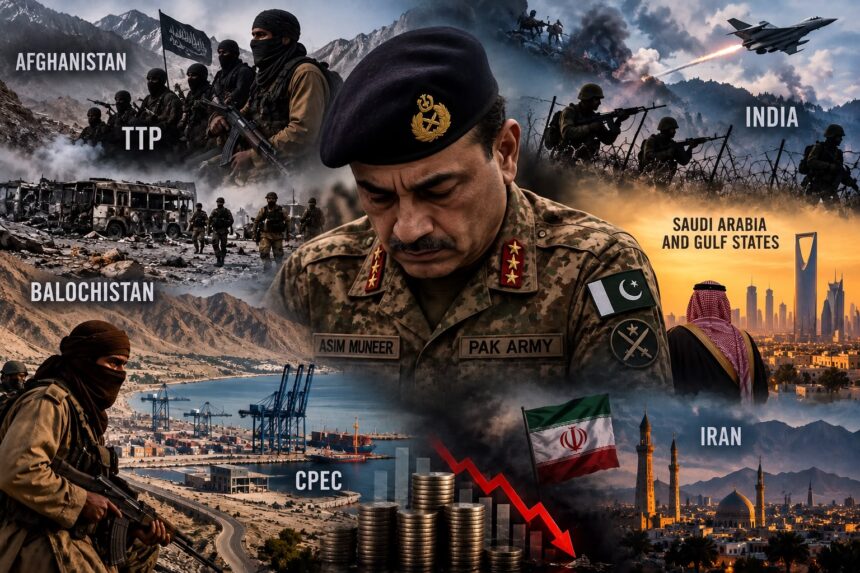
An assessment of Pakistan’s security and foreign policy argues that the country’s long reliance on militant proxies, asymmetric warfare and military-led regional engagement has produced growing instability at home while straining relations with its neighbours.
The document traces the approach to the Pakistani military and intelligence establishment’s long-standing pursuit of “strategic depth”, under which irregular armed groups were used to offset Pakistan’s conventional military disadvantage against India. It argues that the strategy allowed Islamabad to project influence while maintaining a degree of deniability, but has increasingly generated consequences that are harder for the state to contain.
The most immediate pressure is identified along Pakistan’s western frontier. The assessment says the Tehreek-e-Taliban Pakistan (TTP) has resurged as a major security threat, particularly in Khyber Pakhtunkhwa, where attacks have targeted police, military and government installations.
According to the document, Pakistan recorded more than 1,000 terrorist attacks between 2023 and 2025, with Khyber Pakhtunkhwa and Balochistan accounting for more than 80% of civilian and security-force casualties. It attributes part of the TTP’s improved capabilities to weapons left in Afghanistan after the withdrawal of international forces.
Islamabad has accused Afghanistan’s Taliban authorities of providing sanctuary to TTP leaders, while Kabul has rejected those demands and disputed Pakistan’s position on the Durand Line. The resulting confrontation has included Pakistani airstrikes inside Afghanistan, according to the assessment, as well as border clashes and interruptions to cross-border trade.
The dispute illustrates what the document describes as a broader problem with Pakistan’s use of militant organisations as instruments of regional policy. It says the military establishment historically distinguished between groups considered useful for operations abroad and those that posed a threat inside Pakistan. Among the organisations identified are the Haqqani Network, Lashkar-e-Taiba and Jaish-e-Mohammed.
The assessment argues that the strategy has also produced an increasingly autonomous militant ecosystem. It says some armed groups have developed independent sources of revenue through narcotics trafficking, weapons smuggling and extortion, making them less susceptible to state control and increasing the risk of violence turning inward.
Balochistan presents another major challenge. The document links the province’s long-running separatist insurgency to grievances over resource extraction, political marginalisation and the conduct of Pakistani security forces. It says the conflict has intensified around major infrastructure and economic projects, including facilities associated with the China-Pakistan Economic Corridor.
The Baloch Liberation Army and its Majeed Brigade are identified as having targeted Chinese nationals, engineering teams and strategic infrastructure in attacks in places including Karachi, Dasu and Gwadar. The assessment says security measures around Gwadar have contributed to the port becoming heavily militarised and argues that insecurity has disrupted CPEC activity. It also says Beijing has delayed projects and sought greater security arrangements for its interests in Pakistan.
Relations with India remain another central source of tension. The assessment attributes continued violence in Jammu and Kashmir to Pakistan-based militant organisations including Lashkar-e-Taiba and Jaish-e-Mohammed and describes the relationship as a persistent nuclear-risk flashpoint.
It also points to India’s use of military force in response to militant attacks, citing the 2016 surgical strikes and the 2019 Balakot airstrikes. The document argues that Pakistan’s reliance on tactical nuclear weapons, including the Nasr short-range missile, is intended to deter conventional retaliation while preserving space for sub-conventional operations. It says the resulting dynamic has increased the risks surrounding the India-Pakistan relationship and contributed to the deterioration of wider regional cooperation.
Pakistan’s security commitments in West Asia add another layer of pressure, according to the assessment. It describes Islamabad’s military relationships with Saudi Arabia and other Gulf states as increasingly important to a country facing severe economic constraints. Under defence agreements cited in the document, Pakistan has committed personnel and military capabilities to support Saudi Arabia and allied Gulf monarchies.
The assessment says this involvement creates a difficult balance with Iran, while also exposing Pakistan to sectarian and strategic pressures at home. It argues that an expanded overseas military role risks stretching the armed forces while Pakistan continues to confront insurgencies and security challenges within its own borders.
Taken together, the assessment presents Pakistan as facing simultaneous security pressures on several fronts: militancy and border disputes with Afghanistan, tensions with India, insurgency in Balochistan and competing strategic relationships in West Asia. It also links these pressures to economic consequences, including reduced investment, disruption to CPEC routes and difficulties around Gwadar.
The document concludes that Pakistan’s long-standing reliance on militant proxies and asymmetric tools has created substantial domestic and regional costs. It argues that reducing those pressures would require dismantling militant infrastructure, moving away from proxy-based security policies and restoring greater civilian constitutional control over national security decision-making.

