



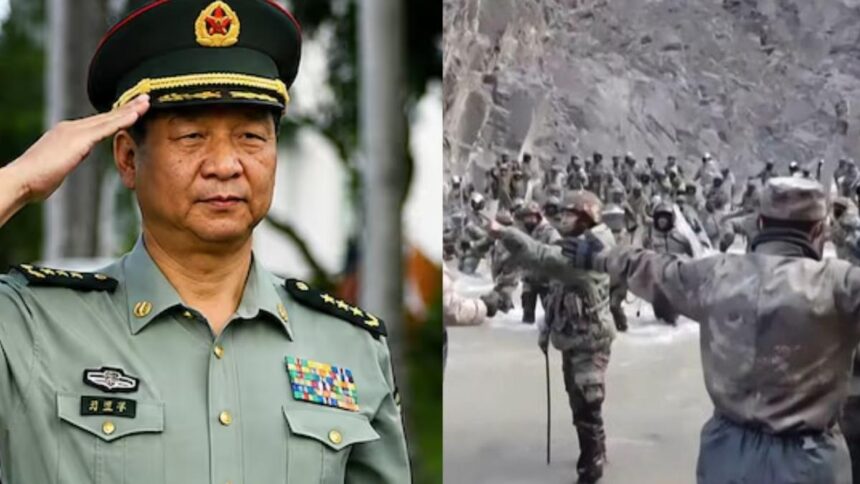
On 28 August 2026, China’s top political advisory body stripped General Zhao Zongqi of his membership offering no explanation and announcing no formal investigation. For most outside observers, the name meant little. But for anyone tracking the India-China border, Zhao’s removal was unmistakably significant: he was the first commander of the PLA’s Western Theatre Command, the officer who oversaw the 2017 Doklam standoff and the deadly 2020 Galwan Valley clash the two most serious military confrontations between the two nuclear-armed neighbours in decades. His quiet fall from Favor has become the trigger event exposing just how deep, and how unresolved, Xi Jinping’s military purge has become.
The Man Behind Two Border Crises
Born in 1955 in Heilongjiang province, Zhao joined the PLA at just 16 and fought on the western front during the 1979 Sino-Vietnamese War, seeing combat around Lao Cai, Cam Duong and Sa Pa. His career carried him through the Tibet Military Region, command of the PLA’s 13th and 14th Group Armies and eventually the top post at the Jinan Military Region before his promotion to full general in 2015. In 2016, Zhao became the inaugural commander of the newly reorganized Western Theatre Command the force responsible for Tibet, Xinjiang and the sprawling, disputed border with India.
It was under Zhao’s command that Chinese troops attempted to extend a road through disputed territory near the India-Bhutan-China trijunction in June 2017, triggering the 72-day Doklam standoff after Indian soldiers intervened. Three years later, his command oversaw the June 2020 Galwan Valley clash, the most violent confrontation between Indian and Chinese forces in 45 years. Zhao has since retired, but his removal from the Chinese People’s Political Consultative Conference along with his post as deputy director of its Ethnic and Religious Affairs Committee shows that even retired architects of these confrontations are not beyond Xi’s reach.
A Purge That Keeps Widening
Zhao’s removal did not happen in isolation. Just days earlier, on August 28, 2026, China removed two of its most senior serving generals from the state Central Military Commission itself. Zhang Youxia, the commission’s vice chairman and the second-highest-ranking officer under Xi and Liu Zhenli, chief of the Joint Staff Department, were both stripped of their positions following investigations into suspected serious violations of discipline and law. Their removal left only two active members including Xi himself on a body that once held seven.
Woven through all of this is the case of Wang Haijiang, Zhao’s eventual successor at the Western Theatre Command, who has been missing since 2025 and is widely believed to be under investigation, though Beijing has never confirmed it.
What This Reveals
Read together, Zhao’s and Wang’s fates suggest the purge is no longer confined to active-duty officers suspected of ongoing corruption it now reaches backward into the recent past, unsettling officers long since retired and previously seen as untouchable because their service was over. This raises a pointed question for military analysts if commanders who oversaw actual combat operations against India are being purged years after the fact, what does that imply about the reliability of the operational decisions, troop readiness reports and procurement records generated during their tenure? It also reinforces concerns about institutional memory with the architects of Doklam and Galwan removed from the picture, China’s current Western Theatre Command leadership inherits responsibility for an extraordinarily sensitive border with progressively less continuity from those who navigated its worst flashpoints.
The Case for Caution
Still, a measured reading resists treating this as clear evidence of PLA weakness. Xi’s ability to purge over a hundred officers, including a former CMC vice chairman, without visible institutional resistance, can be read as proof his authority remains firmly consolidated rather than under threat. Analysts studying Xi’s decade-long anti-corruption campaign which began in 2012 note that critics have long argued it doubles as a tool for removing political rivals, meaning motives may extend well beyond genuine graft. Beijing’s continued silence, offering no explanations and announcing no formal charges even in Zhao’s case, also means much of this remains speculative reconstruction from indirect signals, not confirmed fact.
What began as one general’s quiet removal from an advisory body has, on closer inspection, connected directly back to India’s two most serious border confrontations with China in recent memory. Whether this signals a PLA leadership in genuine disarray or a Party centre simply completing a long, deliberate consolidation of control remains an open question one that will likely only become clearer as China’s Western Theatre Command reveals who, if anyone, is left standing to replace the men who shaped its most turbulent years.

