



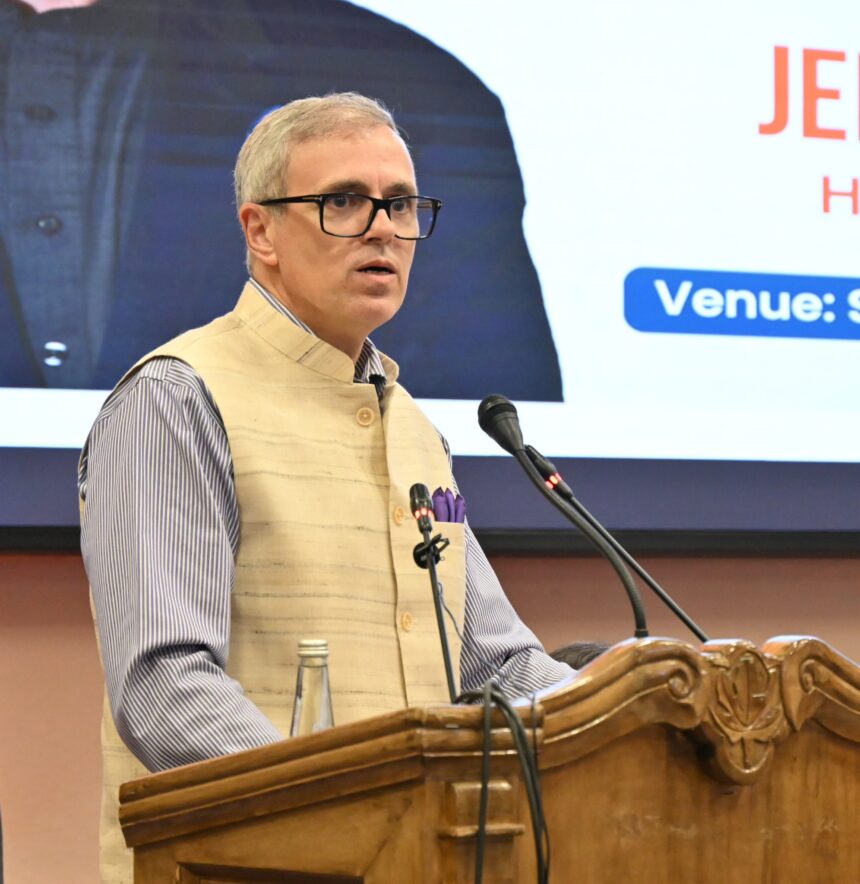
Jammu: Chief Minister Omar Abdullah on Friday attended a two-day conference in New Delhi on “Financing India’s Journey towards Viksit Bharat”, with deliberations focusing on the financial challenges and policy priorities for long-term development of States and Union Territories.
Omar expressed hope that the discussions would help shape clear financial pathways for Jammu and Kashmir, particularly in areas of macroeconomic growth, agricultural transformation and renewable energy.
The conference, organised by the Union Ministry of Finance on September 18 and 19, has brought together Chief Ministers, Finance Ministers, Finance Secretaries and senior officials from States and Union Territories with legislatures.
The deliberations are centred on strengthening policy complementarities between the Centre and States and identifying financing mechanisms to support India’s development journey towards 2047.
Department of Economic Affairs Secretary Anuradha Thakur said the scale of transformation envisaged under the Viksit Bharat agenda could not be financed through government budgets alone, underlining the need for greater private-sector participation and innovative financing mechanisms.
She said the Centre and States would have to work through deeper partnerships involving policy, financial resources and implementation. Working groups comprising representatives of States have also been constituted to identify sector-specific financing requirements and take forward the discussions.
The conference is examining three major themes—macroeconomic developments, financing agricultural transformation and financing the energy transition. Discussions are also covering private financing, GST-related implications for States, agricultural markets, renewable energy and transmission infrastructure, and carbon capture technologies.
N K Singh, President and Life Trustee of the Institute of Economic Growth and former chairman of the 15th Finance Commission, said private capital should complement rather than replace public financing. He identified the availability of bankable projects as a key factor in attracting private investment and suggested that States develop robust pipelines of projects capable of accessing multilateral development finance.
A presentation on financing Viksit States also highlighted the need for States to mobilise greater resources for capital expenditure. It suggested increasing capital outlay and identified areas such as urbanisation, housing finance, deeper credit flows, renewable energy, energy storage, critical minerals, artificial intelligence, data centres, tourism and agricultural value chains as potential avenues for financing growth.
The conference is also discussing the role of technology in governance and the importance of measuring growth outcomes from a State-level GSDP perspective.
