
The News NowThe News NowThe News Now
Font ResizerAa
  • Home
  • Today’s Print Edition
    Today's Print EditionShow More
    BRICS adopts landmark declaration as PM Modi calls to replace ‘pyramid of privilege’ in global governance
    September 12, 2026
    Body of JeM terrorist recovered in Doda; US-made M4 carbine seized
    September 12, 2026
    Cross-border terrorism: NIA, SIA conduct searches at 15 locations across J&K
    September 12, 2026
    Terrorist Hafiz Saeed in Pak, NIA tells Jammu court, secures warrant
    September 12, 2026
    Ahead of autumn session, Speaker constitutes BAC
    September 12, 2026
  • Top Stories
    Top StoriesShow More
    Fraudster Facing 15 Cases Chargesheeted In Fake Job Scam: EOW
    September 14, 2026
    Two killed, several injured as Matador overturns near Bakkal Tunnel in Reasi
    September 14, 2026
    PDP gets Major Boost in Chenab Valley as Former MLC Sayeed Asgar Ali Joins Party in Presence of Mehbooba Mufti
    September 11, 2026
    Casual Workers Warn Govt Of Water Supply Shutdown Over Unresolved Demands
    September 11, 2026
    Red Fort blast: NIA chargesheet names Umer Un Nabi as alleged mastermind of terror conspiracy
    September 10, 2026
  • J&K
    J&KShow More
    Fraudster Facing 15 Cases Chargesheeted In Fake Job Scam: EOW
    September 14, 2026
    Two killed, several injured as Matador overturns near Bakkal Tunnel in Reasi
    September 14, 2026
    Body of JeM terrorist recovered in Doda; US-made M4 carbine seized
    September 12, 2026
    Cross-border terrorism: NIA, SIA conduct searches at 15 locations across J&K
    September 12, 2026
    Terrorist Hafiz Saeed in Pak, NIA tells Jammu court, secures warrant
    September 12, 2026
  • Politics
    PoliticsShow More
    Union Education Minister Dharmendra Pradhan resign
    July 25, 2026
    “Free electricity was the promise, rising bills are the reality,” says Mehraj Malik, slamming NC.
    June 19, 2026
    Farooq Abdullah accuses PDP of weakening J&K’s special status, dismisses alliance split rumours
    May 22, 2026
    Trump announces a conditional two-week ceasefire with Iran
    April 8, 2026
    Winter Session of Lok Sabha ends; key Bills passed, debates see politically-charged attacks
    December 19, 2025
  • National
    NationalShow More
    BRICS adopts landmark declaration as PM Modi calls to replace ‘pyramid of privilege’ in global governance
    September 12, 2026
    BRICS SUMMIT: PM Modi pushes to tear down trade barriers, backs freedom of navigation, seafarers’ safety
    September 12, 2026
    India’s electoral process among most transparent in world: CEC Gyanesh Kumar
    September 12, 2026
    Maintain permanent preparedness to deal with locust attack from Pak side: Shah to Agri dept
    September 11, 2026
    ‘All set for BRICS 2026!’: PM shares video of preparations at venue ahead of mega Summit
    September 11, 2026
  • World
    WorldShow More
    The General Who Commanded Doklam and Galwan, Now Erased
    September 3, 2026
    PM conferred with Uzbekistan’s highest honour for foreign leaders
    August 30, 2026
    PM arrives in Uzbekistan on two-day official visit
    August 29, 2026
    Images of RSS chief Mohan Bhagwat projected on Times Square billboard ahead of MSG address
    August 29, 2026
    India, China agree to advance talks on ‘Early and Substantial Harvest’ of boundary delimitation
    August 27, 2026
  • Edit & Opinion
    Edit & OpinionShow More
    Makkah Pact: Pakistan Failed, and the Pact Failed Its First Test
    September 14, 2026
    BRICS 2026: INDIA’S GLOBAL LEADERSHIP AND THE STRATEGIC BALANCE AGAINST CHINA’S DOMINANCE
    September 10, 2026
    When the Battlefield Tests the Brochure: Questions Over Chinese Military Hardware
    September 10, 2026
    When Kashmir’s Changing Reality Challenges Pakistan’s Old Narrative
    August 20, 2026
    Army Goodwill Schools: When a Classroom Becomes a Bridge of Trust
    August 19, 2026
  • Ideas & Interaction
    Ideas & InteractionShow More
    When Kashmir’s Changing Reality Challenges Pakistan’s Old Narrative
    August 20, 2026
    Kucha: India’s Buddhist Imprint on the Silk Route
    June 20, 2026
    Agni Desa and India’s Old Road to Central Asia
    June 13, 2026
    Truecaller Launches Family Protection in India, Bringing Shared Safety Against Scams to Households
    March 13, 2026
    Vivo launches the Y51 Pro 5G: All-Day Battery, Powerful Performance, and Intelligent AI Features
    March 12, 2026
Reading: Makkah Pact: Pakistan Failed, and the Pact Failed Its First Test
Share
Font ResizerAa
The News NowThe News Now
  • Home
  • Today’s Print Edition
  • Top Stories
  • J&K
  • Politics
  • National
  • World
  • Edit & Opinion
  • Ideas & Interaction
Search
  • Home
  • Today’s Print Edition
  • Top Stories
  • J&K
  • Politics
  • National
  • World
  • Edit & Opinion
  • Ideas & Interaction
Follow US
Edit & Opinion

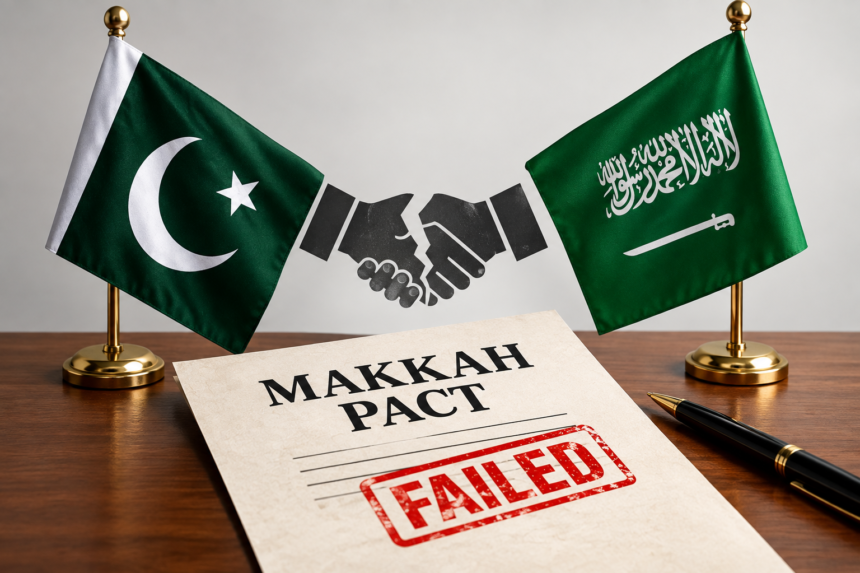
Makkah Pact: Pakistan Failed, and the Pact Failed Its First Test

The News Now
Last updated: September 14, 2026 11:40 pm
The News Now
Published: September 14, 2026
Share
SHARE

By Ravish Handoo
Pakistan’s response to Houthi attacks on Saudi Arabia has exposed a fundamental question over the practical value of the Makkah Pact: how far is Islamabad prepared to go when the security of a partner is directly threatened?
For an agreement presented around the principle that an attack on one member should concern all members, Pakistan’s conduct has so far been notably cautious. Islamabad has condemned the attacks, warned the Houthis that aggression against Saudi Arabia could invoke the pact, and reaffirmed its support for Riyadh. But it has also made clear that no military response is currently under discussion.
That distinction is important. From an Indian geopolitical perspective, the episode highlights the difference between political solidarity and operational collective defence. The former is relatively easy to demonstrate through statements and diplomatic support. The latter requires governments to accept military, financial and political risks.
Saudi Arabia has faced Houthi missile and drone attacks affecting areas including Abha, Khamis Mushait, Jazan and Najran. Pakistan has described some of the attacks as targeting Saudi civilian and economic sites and has publicly condemned them.
On September 8, Islamabad warned the Houthis that an attack on Saudi Arabia could trigger the pact’s collective-defence principle. The statement appeared to give substance to the idea that the security of one member could become a concern for the others.
But Pakistan subsequently clarified that military action was not being discussed.
That qualification has exposed the central ambiguity surrounding the arrangement. If the pact is primarily a political commitment, Islamabad’s response is consistent with a conventional diplomatic posture. If it is intended to function as a genuine collective-defence mechanism, however, the absence of any announced military contribution raises questions about how the commitment would work during a serious conflict.
The issue matters beyond the immediate Houthi crisis because Pakistan has sought to use its relationships with Saudi Arabia and Türkiye to enhance its strategic position. A broader security framework could, in theory, give Islamabad greater diplomatic weight and strengthen its role in the Muslim world.
But alliances do not eliminate national interests. Saudi Arabia, Türkiye and Pakistan each have their own security priorities, economic considerations and regional relationships. None can be assumed to accept unlimited military obligations simply because of political alignment.
Pakistan’s position becomes even more complicated in the event of a wider Saudi-Iran confrontation.
Islamabad shares a border with Iran and has strong reasons to avoid direct military confrontation with Tehran. A decision to fight Iran in defence of Saudi Arabia would carry consequences for Pakistan’s own border security, economy and regional diplomacy.
This is where the Makkah Pact faces its more difficult credibility test. The question is not whether Pakistan supports Saudi Arabia politically. It clearly does. The question is whether Islamabad would accept the costs of military intervention if Saudi Arabia faced a sufficiently serious threat.
So far, the answer remains unclear.
For India, that ambiguity is strategically relevant. Pakistan has traditionally sought political and diplomatic support from friendly Muslim-majority states, particularly when dealing with disputes involving India. But the logic of collective security also imposes obligations on the country seeking such support.
If Pakistan expects partners to stand behind it during a confrontation, those partners can reasonably be expected to examine Islamabad’s own willingness to assume risks on their behalf. A security arrangement based largely on political declarations is unlikely to provide the same deterrent effect as one backed by clearly understood military commitments.
This does not mean that the Makkah Pact has no strategic significance. Defence cooperation, military relationships and political coordination can have value even without automatic troop deployments. But its practical limits become visible when an actual security crisis arrives.
The Houthi attacks have therefore exposed an uncomfortable asymmetry. Pakistan has invoked the collective-defence principle while simultaneously avoiding any commitment to military action. That may reflect a deliberate effort by Islamabad to preserve its relationship with Saudi Arabia without becoming directly involved in another regional conflict.
From a Pakistani perspective, that may be a rational calculation of national interest. From the standpoint of alliance credibility, however, it creates a problem.
The more expansive the language of collective defence, the greater the expectation that members will demonstrate both the capability and willingness to act when another member is threatened. Diplomatic condemnation alone cannot establish that credibility.
The immediate crisis may pass without requiring Pakistan to make that choice. But the question raised by it will remain: when collective security becomes a real military obligation rather than a political declaration, where exactly does Pakistan draw the line?
Until that question has a clearer answer, the Makkah Pact remains stronger as a framework for political and defence alignment than as a demonstrated collective-security guarantee.
Ravish Handoo is a geopolitical analyst, television commentator, and regular participant in television debates on national and international affairs.

You Might Also Like

14,500 turn out for AIBC Eurasia: Venue to double in size for 2026
Seven Years After Article 370: A Citizen’s View of a Changing Jammu and Kashmir
BRICS 2026: INDIA’S GLOBAL LEADERSHIP AND THE STRATEGIC BALANCE AGAINST CHINA’S DOMINANCE
When Kashmir’s Changing Reality Challenges Pakistan’s Old Narrative
Women of Jammu and Kashmir: Catalysts for Nation-Building
Share This Article
Facebook Email Print
Leave a Comment

Leave a Reply Cancel reply

Your email address will not be published. Required fields are marked *

E-Paper

Reach Us

  • About Us
  • Our Team
  • Write For Us
  • Important Numbers
  • Advertise With Us
  • Contact Us

About US

The NEWS NOW is a daily English broadsheet newspaper published from Jammu City in Jammu and Kashmir, India. At a time when news media is taking flight from print to faster and more diversified digital platforms our team is working in an integrated and innovative way to excel in both.
Quick Link
  • About Us
  • Our Team
  • Write For Us
  • Important Numbers
  • Advertise with us
  • Contact Us
Top Categories
  • Today’s Print Edition
  • J&K
  • Top Stories
  • National
  • World
  • Edit & Opinion
  • Politics

Subscribe US

Subscribe to our newsletter to get our newest articles instantly!

© 2026 The News Now. All Rights Reserved. | Powered by Ideogram Technology Solutions [P] Ltd.
Welcome Back!

Sign in to your account

Username or Email Address
Password

Lost your password?
