



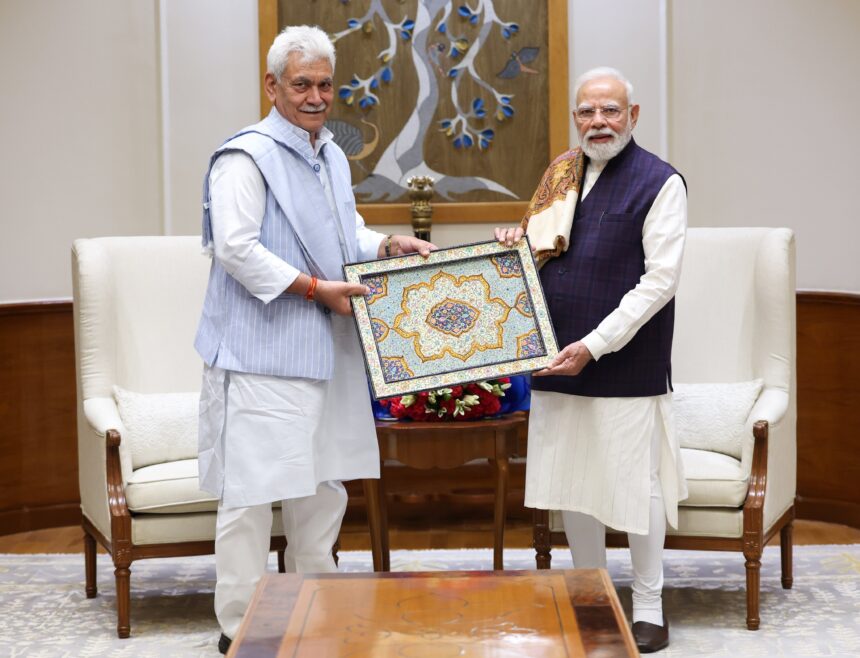
Jammu: Lieutenant Governor Manoj Sinha on Saturday called on Prime Minister Narendra Modi in New Delhi and briefed him on the security, administrative and developmental situation in Jammu and Kashmir, amid the successful ongoing Amarnath Yatra.
Sinha also presented Modi with the coffee table book documenting the Nasha Mukt Jammu Kashmir Abhiyan – 100 Days Campaign.
The meeting comes at a significant time for Jammu and Kashmir, with the annual Shri Amarnath Ji Yatra entering its final phase and more than five lakh pilgrims having undertaken the pilgrimage since it began on July 3.
The sacred Chhari Mubarak, the holy mace of Lord Shiva, also left the Dashnami Akhara in Srinagar on Saturday for Pahalgam, marking the beginning of the final traditional phase of the pilgrimage.
The holy mace is scheduled to reach the cave shrine for the main Pujan and Darshan on August 28, coinciding with Shravan Purnima. The traditional rituals will continue thereafter, with the annual pilgrimage culminating with the Visarjan of the holy mace.
Officials said the latest developments and the overall security, administrative and developmental scenario of the Union Territory were also discussed during the meeting.
Security remains a key concern for the administration as Jammu and Kashmir continues to host large religious gatherings while maintaining tourism and economic activity.
A major part of the interaction was the presentation of the Nasha Mukt Jammu Kashmir Abhiyan – 100 Days Campaign Coffee Table Book to the Prime Minister.
The book, designed, curated and published by the Department of Information and Public Relations (DIPR), J&K, documents the journey of the 100-day campaign and the collective efforts made across the Union Territory to create awareness against drug abuse.
Sinha had spearheaded the campaign across all 20 districts, leading rallies and participating in awareness programmes aimed at mobilising people, particularly the youth, against drug abuse.
The campaign sought to take the fight against drugs beyond enforcement agencies by involving educational institutions, youth organisations, civil society groups and local communities.
At the valedictory function of the campaign held at the Sher-i-Kashmir International Conference Centre in Srinagar, Sinha had highlighted the scale of enforcement and preventive action undertaken during the campaign.
According to figures shared by the Lieutenant Governor, authorities registered 20,292 FIRs, dismantled 92 drug networks and identified 4,474 drug hotspots across Jammu and Kashmir.
Properties worth Rs 188.9 crore linked to the narcotics trade were also attached, while stringent action under the PIT-NDPS Act was initiated against drug traffickers.
The administration also recommended the suspension or cancellation of 884 driving licences and 687 vehicle registration certificates in eligible drug-related cases.
Action was also recommended for impounding 64 passports, suspending eight arms licences and withdrawing security cover in eligible cases.
The measures were aimed at combining enforcement with awareness, prevention and rehabilitation as part of the wider campaign against drug abuse.
IIM Jammu will earn global recognition: LG
Jammu: Jammu and Kashmir Lt Governor Manoj Sinha expressed confidence that the Indian Institute of Management (IIM) Jammu will emerge as a globally recognised institution over the next decade, saying its name would be spoken with “immense pride and respect” if it continues to move forward with complete confidence.
However, he said the institute should define its own bold and distinctive ideas and turn the boardrooms of Jammu Kashmir and Ladakh into living case studies, to root research in border economies and frontier development and to ensure every graduate builds something real before they leave campus.
Joining the Board of Governors, faculty, students, alumni and distinguished guests to celebrate a decade of IIM Jammu, the Lt Governor reflected on the Institute’s remarkable journey, noting that it has scripted a new chapter in the region’s academic history.
From its modest beginnings, IIM Jammu has evolved into one of India’s fastest-emerging business schools, charting an ambitious roadmap for the decade ahead, he said.
Recalling that IIM Jammu started a decade ago with just 56 students on a temporary campus on Canal Road, Sinha said the institute has since grown into a nationally recognised and internationally engaged centre for management education.
He observed that IIM Jammu is now the fifth IIM in the country to hold both AMBA and EFMD accreditation, and it has built academic partnerships with institutions across France, Morocco, South Korea, Greece, the United Kingdom, Germany, Australia, Poland, Sweden, Taiwan and, most recently, Brazil. He said the research output at the institute has also expanded sharply, growing from just two published papers in 2017 to close to 350 this year.
“I have seen details of one achievement after another, along with several distinctive initiatives that have become an inspiring example, a role model, for other business schools. I am certain that, in the future, people will remember these achievements as a standard and an ideal, and will seek to emulate them,” he said.
He said IIM Jammu’s growth must now be converted into new discoveries.
“IIM Jammu must ask itself what can be done in the fields of administration, sustainable development and entrepreneurship in the economies of border areas. I believe that great institutions are great because, when the nation faces difficult questions, it looks to them for answers.
“If IIM Jammu continues to move forward with complete confidence over the next ten years, I am certain that its name will be spoken across the world with immense pride and respect,” the Lt Governor said.
He drew lessons from the founding journeys of Harvard, Stanford and Wharton, observing that each built its global reputation around a distinctive idea pursued with patience and consistency.
He said IIM Jammu now stands at a similar inflection point, with decisions taken today likely to shape its identity for decades.
Sinha outlined four priorities for the Institute: developing a distinctive academic identity rooted in Indian business realities; expanding experiential learning through real-world projects; sharpening research on border economies, sustainable development and frontier entrepreneurship; and making placements a nation-building exercise by producing graduates who lead companies and build enterprises.
“Real examinations take place in corporate boardrooms, markets and life itself,” the Lt Governor said, where information is incomplete, opinions differ and there are no ready-made answers.

