



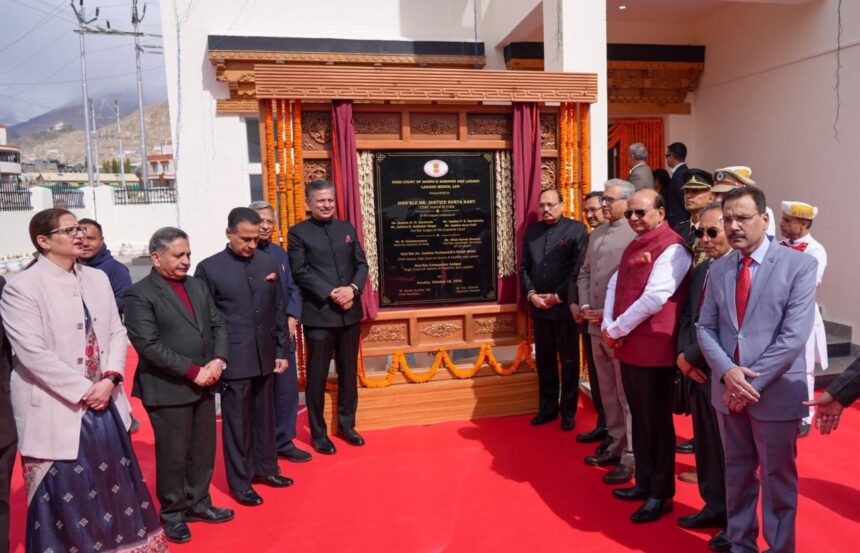
Leh: Chief Justice of India Justice Surya Kant on Sunday inaugurated the permanent Ladakh Bench of the High Court of Jammu and Kashmir and Ladakh in Leh, announcing plans to enable lawyers from Leh and Kargil to argue cases before the Supreme Court virtually without travelling to Delhi.
The initiative, he said, would allow all matters originating from Ladakh to be listed on a single day and heard through video-conferencing once the required facilities are established at the bench, reducing the financial burden and physical hardship faced by lawyers and litigants in the strategically located Union Territory.
The inauguration at the High Court Complex in Melangthong marks a significant step towards addressing the longstanding difficulties faced by residents in accessing higher judicial institutions due to Ladakh’s difficult terrain, harsh weather and long travel distances.
“A name on a court’s letterhead is not the same as a court at one’s doorstep,” Justice Surya Kant said, emphasising that the establishment of the bench must translate into tangible benefits for people across both Leh and Kargil.
The CJI said the true measure of a court lay not in its geographical elevation but in how accessible it was to the people it served. Referring to Ladakh’s historical judicial journey, he recalled that for decades the High Court serving the region remained beyond the Great Himalayas, with winter travel possible only by air.
“In a land of such vast distances, technology can do what no road ever could,” he said, identifying digital infrastructure and legal aid as crucial tools for overcoming geographical barriers.
The newly inaugurated bench will function as a fully IT-enabled, paperless court. Justice Surya Kant launched several digital initiatives, including an e-filing portal, a document management system and an online recruitment portal, aimed at improving efficiency, transparency and accessibility in judicial administration.
The e-filing facility will enable advocates and litigants, particularly those in remote areas, to submit cases electronically without travelling to the court. The complex also houses a digitisation centre, filing counter, bar room, litigants’ sitting area and video-conferencing facilities.
The CJI also initiated work for installing solar power systems at 11 locations as part of efforts to promote environmentally sustainable judicial infrastructure.
Highlighting the importance of inclusive justice, Justice Surya Kant called for legal awareness camps, para-legal volunteers, affordable legal representation and lok adalats to ensure that poverty, disability or geographical isolation did not prevent people from seeking justice. He expressed confidence that the Ladakh Legal Services Authority and the court’s Legal Services Committee would reach people in far-flung areas.
Lieutenant Governor Vinai Kumar Saxena described the inauguration as a historic milestone, expressing gratitude to the President, Prime Minister Narendra Modi and Union Home Minister Amit Shah for their support in strengthening judicial infrastructure in Ladakh.
Chief Secretary Ashish Kundra had earlier said the initiative had taken shape within two months and would spare people seeking judicial relief, including through writ petitions, the need to travel to Jammu or Srinagar for such proceedings.
At a ceremonial bench held to mark the occasion, Chief Justice of the High Court of Jammu and Kashmir and Ladakh, Justice Pushpendra Singh Bhati, said the permanent bench would help ensure that geographical isolation did not translate into judicial exclusion. Representatives of the Leh and Kargil Bar Associations welcomed the development, describing it as the fulfilment of a long-standing aspiration.
The Full Court also adopted a resolution highlighting the need for safe, accessible and affordable residential facilities for girl students, particularly those from remote areas of Ladakh, alongside enhanced legal awareness and coordinated efforts to improve educational opportunities.
The regulation enabling the establishment of the permanent bench came into force on September 5, following its promulgation by the President on August 27 and a subsequent notification by the Lieutenant Governor.
Justice Surya Kant said the ultimate success of the institution would be measured by whether people across Ladakh developed a sense of ownership over it, envisioning a future in which children from places such as Kargil and Nubra could themselves become lawyers and judges serving the region.
Tighten the lead around the SC access promise
‘Historic Milestone,’ says LG V K Saxena
Leh: Chief Justice of India Justice Surya Kant on Sunday inaugurated the Ladakh Bench of the High Court of Jammu and Kashmir and Ladakh here.
Ladakh Lt Governor Vinai Kumar Saxena called the day a landmark milestone, fulfilling a long-standing demand for a court closer to home.
“A new era of accessible justice begins in Ladakh! Deeply grateful to Chief Justice of India, for inaugurating the Ladakh Bench of the High Court of J&K and Ladakh, today at Leh, in the gracious presence of Supreme Court Judges and the Chief Justice and other companion Judges of the High Court of J&K and Ladakh,” Saxena said on X after the event.
He said the Ladakh Bench of the High Court and the CJI’s successive visits to the Union Territory within six months reflect his commitment to ensuring “access to justice” to all, particularly to remote communities in Ladakh.
“My sincere thanks and gratitude to the Prime Minister, Narendra Modi and Home Minister, Amit Shah, for consistently guiding Ladakh on the path of prosperity and inclusive development,” he said.
Justice Surya Kant inaugurated the Ladakh Bench of the High Court at the High Court Complex, Melangthong, Leh.
Supreme Court Justices M M Sundresh, P S Narasimha, N Kotiswar Singh and Arun Palli, along with Attorney General for India R Venkataramani, Chief Justice of the High Court of J&K and Ladakh, Justice Pushpendra Singh Bhati, and companion Judges of the high court attended the function, officials said.
The inauguration has been hailed as an important occasion in Ladakh’s institutional development.

