



Avinav Verma
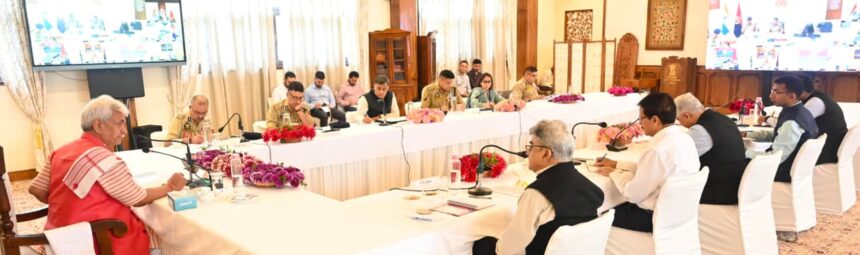
Jammu: The Jammu and Kashmir Lieutenant Governor Manoj Sinha on Tuesday chaired his first major security review meeting in the Union Territory after his recent meetings with Prime Minister Narendra Modi and Union Home Minister Amit Shah, directing security agencies to maintain sustained pressure on terror networks and adopt an aggressive area-domination strategy to deal with emerging threats.
The high-level meeting in Srinagar brought together the senior-most police, security and civil administration officers for an assessment of the security situation and strategic preparedness across Jammu and Kashmir.
Sinha directed officers to strengthen ground-level operational synergy, maintain heightened vigilance and ensure seamless coordination among agencies involved in counter-terror operations and maintenance of law and order.
The review assumes significance as it followed Sinha’s August 22 and August 23 engagements in New Delhi with Prime Minister Modi and Home Minister Amit Shah.
It was the first major security assessment chaired by the Lieutenant Governor in J&K after those meetings, with the focus now placed on translating the broader security priorities into coordinated action at the field level.
During Tuesday’s meeting, Sinha called for a proactive approach towards emerging threats and instructed security agencies to maintain continuous pressure on terror networks.
He specifically directed officials to intensify area domination operations, with the objective of preventing emerging threats from gaining ground and ensuring that security formations remain operationally prepared across vulnerable areas.
The Lieutenant Governor also reviewed the functioning of the security apparatus and sought closer coordination between police, security agencies and the civil administration.
Chief Secretary Atal Dulloo and DGP Nalin Prabhat attended the meeting along with other senior officers.
Principal Secretary Home Chandraker Bharti, Special DG Coordination S.J.M. Gillani, ADGP CID M.K. Sinha, IGP Kashmir Sujit Kumar, IGP Jammu Tejinder Singh and IGP Crime Branch Sarah Rizvi were among those present.
Divisional Commissioners and DIGs also participated in the review and briefed the Lieutenant Governor on the security situation in their respective jurisdictions.
The DGP and Principal Secretary Home apprised Sinha of the overall security scenario in Jammu and Kashmir, while the IGPs, DIGs and Divisional Commissioners gave area-wise briefings.
Their presentations covered anti-terror operations, law and order, drug smuggling and other emerging challenges.
The detailed area-wise assessment allowed the security leadership to review developments at both the Union Territory and field levels and identify areas requiring continued operational vigilance and coordination.
The central direction from the meeting was to ensure that pressure on terror networks remains sustained.
Sinha asked the security establishment to adopt an aggressive area-domination strategy and maintain operational vigilance rather than allow emerging threats to develop unchecked.
He also stressed the importance of seamless coordination between agencies, particularly at the ground level, where intelligence inputs and operational responses need to move quickly between formations.
The Lieutenant Governor directed officers to maintain a proactive approach to safeguarding peace and ensuring law and order across the Union Territory.
The meeting also placed the drug menace and its links with security prominently on the agenda.
Sinha commended the Jammu and Kashmir Police and security agencies for their action against drug smugglers and directed officials to intensify operations against narco-terror networks.
The direction comes alongside a significant expansion of the administrative enforcement mechanism against narcotics in J&K.
Under a government notification, a wider group of officials has been authorised to exercise powers under Section 41(2) of the Narcotic Drugs and Psychotropic Substances Act, 1985.
All gazetted officers of the Jammu and Kashmir Police and Excise Department have been authorised to exercise the specified powers under the provision.
The government has also included several revenue officers in the enforcement framework. These include Additional Deputy Commissioners, Assistant Commissioners Revenue, Sub-Divisional Magistrates, area Tehsildars and area Naib Tehsildars.
The officers can exercise the powers within their respective territorial jurisdictions in the Union Territory.
The move effectively expands the administrative reach of the anti-drug enforcement mechanism beyond police and Excise formations, bringing senior revenue officers at the district, sub-divisional and tehsil levels into the legal framework provided under the NDPS Act.
Section 41 of the NDPS Act deals with warrants and authorisation for searches and arrests. Under Section 41(2), a government-authorised gazetted officer may exercise specified powers in accordance with the conditions laid down under the law.
The expanded authorisation gives the administration an additional enforcement channel in areas where revenue officials have an established local presence.
Security agencies have been asked to focus on the wider networks involved in drug trafficking and their possible links with terror-related activities.
The emphasis is therefore on disrupting the networks supporting the movement and distribution of narcotics while identifying the financial and logistical structures associated with them.
The security review also moved beyond conventional threats, with Sinha directing officials to strengthen monitoring of the digital and social-media space.
He called for close monitoring of social media platforms to counter anti-national propaganda, digital misinformation and online blackmailing.
The Lieutenant Governor stressed the need to enhance monitoring mechanisms against emerging digital threats and asked agencies to remain vigilant about activities that could affect security and public order.
The directions put digital vigilance alongside counter-terror and anti-narcotics operations in the wider security assessment.
In another significant component of the review, Sinha directed police officials to strengthen direct engagement with citizens.
He asked police to designate specific hours for public interaction and grievance redressal, stressing that public trust is an important component of an effective security apparatus.
Reviewing police-station-level functioning, the Lieutenant Governor called for genuine complaints to be handled with sensitivity and investigations to be conducted fairly, transparently and impartially.
“The police must maintain a strong and continuous engagement with the public. Every genuine grievance must be addressed with sensitivity and every investigation must be conducted with absolute fairness, transparency and impartiality,” Sinha said.
The direction places particular emphasis on the manner in which citizens interact with police stations and how their complaints are dealt with at the local level.

