



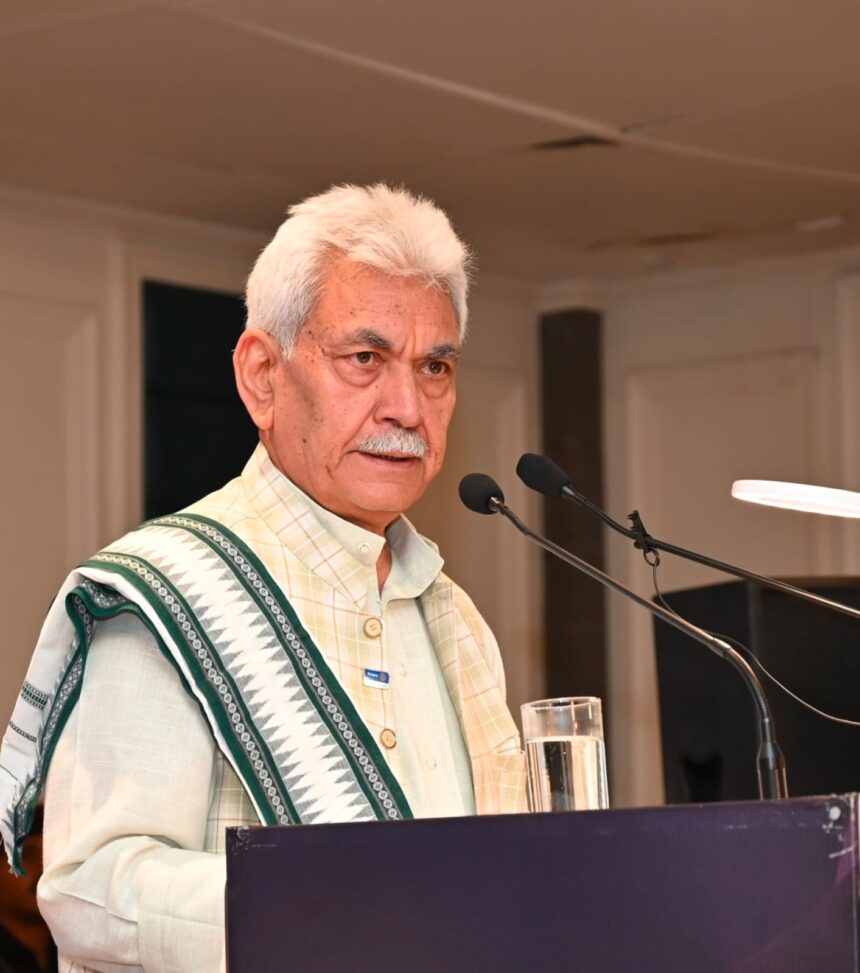
Jammu: Lieutenant Governor Manoj Sinha on Wednesday said the manual counting of offerings at the Shri Mata Vaishno Devi shrine has been discontinued, with Cash Recycler Machines (CRMs) being introduced to eliminate direct human handling of cash.
“There is a lot of discussion in the country regarding temple offerings. A respected member of Shri Mata Vaishno Devi Shrine Board suggested in a meeting that the manual counting process should be stopped. So, two Cash Recycler Machines (CRM) have been installed there, and the remaining CRMs will be installed in 15 days. The human interface itself has been eliminated. No employee of the Shrine Board or the bank will have any direct involvement in it,” Sinha said while addressing the second edition of the Indian Chamber of Commerce (ICC) MSME Conclave 2026 in Jammu
The Lieutenant Governor’s remarks come at a time when allegations concerning the handling, purity, accounting and possible adulteration or substitution of silver offerings at the Shri Mata Vaishno Devi shrine are under judicial scrutiny.
The issue was again taken up by the Court of Chief Judicial Magistrate (CJM), Jammu, on Tuesday in Complaint No. 1156/2026, Deepak Sharma versus Inspector General of Police and Senior Superintendent of Police.
During the proceedings, the Senior Prosecuting Officer of the Crime Branch informed the court that the inquiry report sought from the SDPO, Mata Vaishno Devi Shrine/Bhawan, Katra, was still awaited.
The court has fixed September 19, 2026 as the next date of hearing.
Against this backdrop, Sinha, while addressing the ICC MSME Conclave, described MSMEs as the backbone of India’s economic resilience, saying the sector contributes 31.3 per cent to GDP and nearly half of the country’s exports.
“MSMEs are the heartbeat of our economy and the true builders of India’s resilience and self-reliance,” he said.
The Lieutenant Governor said India’s economic landscape is changing rapidly with technology, artificial intelligence, automation and digital infrastructure creating new opportunities for small businesses.
He particularly highlighted the emergence of Nano Global Capability Centres (GCCs), saying even enterprises in tier-II cities can now develop and scale specialised, world-class technological capabilities.
Sinha outlined four immediate priorities for MSMEs—affordable credit, technology upgradation, supply-chain integration and reduction of red tape.
He called for greater adoption of green technologies and renewable energy, formalisation of micro industries to expand access to institutional credit, stronger education-industry partnerships and the establishment of incubation centres and design studios within industrial clusters.
He also stressed the need to improve the export competitiveness of Jammu and Kashmir, calling for large-scale promotion of initiatives such as One District, One Export Hub.
The Lieutenant Governor said Jammu and Kashmir had witnessed significant growth in investment and entrepreneurship in recent years. Investments during FY 2025-26 stood at around ₹5,824 crore, while start-ups increased from 69 in 2020 to 1,305 in FY 2025-26. Udyam registrations, he said, had risen from around 24,000 in 2021 to 6.16 lakh this year.
Earlier in the day, Sinha chaired the 37th Executive Council meeting of Shri Mata Vaishno Devi University (SMVDU) at Kakryal, Katra, where several decisions aimed at strengthening the university’s academic and physical infrastructure were taken.
The Council accorded in-principle approval for a 200-bed boys’ hostel, to be funded by the Shri Mata Vaishno Devi Shrine Board, and directed preparation of a detailed project report.
It also approved in principle two new academic programmes—B.A. LL.B. (Hons.) and B.Tech in Food Technology—while suggesting exploration of the possibility of offering LL.B. alongside science and commerce streams.
The Council adopted the university’s budget proposals for 2026-27 and the final audit report for 2024-25. It also approved enhanced financial assistance for students participating in national and international conferences, workshops and other academic events.
The development of the university’s sports complex was also approved in collaboration with the Shrine Board.
Sinha further called for a five-year roadmap for SMVDU based on a viable operating model and directed the university to strengthen student support through counselling, mental health and value-based awareness programmes.
He also suggested academic relaxation and additional credits for NSS and NCC students selected to represent the university at events of national importance.
The Lieutenant Governor later attended the 23rd Foundation Day celebrations of SMVDU, where he called for the university to emerge as a major centre of research, innovation and social responsibility.
“A university is not built by its buildings but by ideas, dreams, and possibilities,” Sinha said, stressing that the success of an institution should ultimately be measured through the achievements and contributions of its students and alumni.
He highlighted the university’s research and innovation achievements, including around 140 research projects, an AI and Deep Learning Lab, 14 patents, and the incubation of 30 start-ups.
Sinha urged the university to strengthen industry-academia linkages and commercialise patents and innovations through open-house interactions with industry.
He also asked SMVDU to make maximum use of the ₹1 lakh crore research fund announced by Prime Minister Narendra Modi on August 15, directing the Vice-Chancellor to constitute a team of faculty members and students to maximise applications from the university.
Identifying limited research, faculty shortages, weak accountability and inadequate industry linkages as major challenges confronting Indian universities, Sinha called for a fundamental change in educational thinking.
Instead of asking merely “What should we teach?”, he said, universities must ask “What problems must we solve?”
He urged SMVDU to focus on artificial intelligence, robotics, biotechnology and climate science while developing solutions for healthcare, rural economies, urbanisation and digital innovation.
Presenting a vision for the university up to 2040, Sinha called for stronger international collaborations, student exchanges, rural outreach and greater emphasis on vocational education, sports, arts, literature and cultural activities.
He said the ultimate purpose of education was not merely economic advancement but the creation of responsible and creative individuals who could contribute meaningfully to society.
He also invited suggestions from stakeholders for the proposed International Museum of Goddess at Katra and inaugurated a Self-Help Group bakery unit at SMVDU.
Separately, a delegation of Heads of Departments, faculty members and office-bearers of the University of Jammu, led by Vice-Chancellor Prof. Umesh Rai, called on Sinha and discussed the institution’s future expansion and academic development.
The delegation thanked the Lieutenant Governor for his intervention in securing the transfer of 147 kanals and 11 marlas of land from Defence authorities to the university.
The university described the transfer as a watershed moment that would expand its campus and facilitate new academic infrastructure, research facilities and other institutional requirements.
Sinha emphasised the need for the University of Jammu to continuously raise standards in teaching and research, promote innovation and strengthen its contribution to society and the nation.
The day’s engagements therefore brought together three major areas of the Lieutenant Governor’s focus—greater transparency in institutional processes, economic growth through MSMEs, and expansion of higher education and research infrastructure.
At the MSME conclave, Sinha also called upon industry leaders and stakeholders to contribute towards building a terror-free, corruption-free, merit-based and prosperous society, while stressing that technology, entrepreneurship and education would remain central to Jammu and Kashmir’s future growth.

