



Top officer rejects ‘nothing offered’ charge, asks ‘what have we been discussing then?’; seeks ‘consensus at all levels’
Arteev Sharma
Jammu: A day after Leh Apex Body (LAB) and Kargil Democratic Alliance (KDA) representatives blamed the Ministry of Home Affairs (MHA) for backtracking on its commitments while rejecting Centre’s draft proposal for constitutional safeguards, the Ladakh administration today asked the leaders to shun their “pessimistic approach”, which only creates “confusion among masses”.
The UT administration also expressed disappointment over the LAB and KDA leadership’s response, saying the 32-page detailed framework shared by the MHA had been prepared after three to four weeks of “hard work and in good faith”, but was “rubbished” within two hours of its receipt.
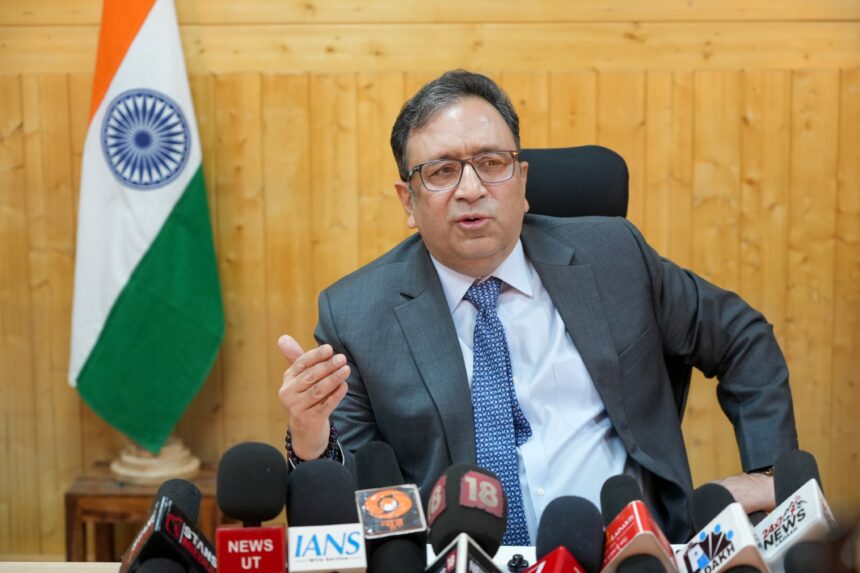
Countering the claims made by the leaders, Chief Secretary of Ladakh Ashish Kundra while addressing a press conference also sought to reaffirm the Government of India’s commitment to find a “political solution (to all concerns raised by the people of Ladakh) at the earliest” and “establishing a democratically elected body that would fulfil the aspirations of the people of Ladakh.”
“I was surprised to see that within two hours of receiving the papers, they were rubbished. It was said that nothing had happened and nothing had been offered, and that no discussion had taken place on constitutional protection,” Kundra said.
He advised Ladakh leaders against adopting, what he described, as a “pessimistic approach”, saying “negative perceptions about the ongoing negotiations could create confusion among the people and undermine the significance of the dialogue process”.
“This pessimistic approach only creates misconceptions among the people, as if nothing is happening in the meetings. If that is the situation, then what have we been discussing in these meetings?” he asked.
He said negotiations could yield results only when both sides approached the process with mutual trust and a willingness to understand each other’s position. “Negotiations require two or three foundational things. The first is mutual trust. Negotiations are always based on mutual trust. If you do not trust the other side, what are you negotiating on?” Kundra said.
The Chief Secretary also claimed that the talks ran into a stumbling block over a single issue as who would write the Annual Confidential Report (ACR) of the Chief Secretary. “We told them that the question of who writes the ACR of the secretary would be covered under the Transaction of Business Rules,” he said.
He further explained the sequence of developments, saying that following discussions between the MHA and Ladakh representatives on October 15, the Ministry shared a detailed framework document with them on October 16.
“The proposal envisages a two-stage approach involving a constitutional amendment, followed by a regulation under Article 240 of the Constitution, with provisions envisaged for a directly elected Union Territory-level body and safeguards concerning land, natural resources, culture and other issues raised by the representatives,” he said.
Clarifying that the document was intended to facilitate further deliberations, Kundra said the proposed constitutional provisions and regulatory framework would require detailed examination before being finalised. He said the process involved several complex issues, including defining the powers of the proposed elected body and determining its relationship with the existing Hill Councils, municipalities and Panchayats.
“What we tried to convey was that when a constitutional Bill is to be framed and subsequently becomes an Act, all complicated issues, including the relationship of the proposed UT-level body with the existing Councils, municipalities and Panchayats, need consensus at all levels,” he said.
“We do not want to give any unilateral draft. We want to have a framework that has the consensus of the local leadership,” he added.
Kundra said the objective was to arrive at a balanced and workable framework that reflected the democratic aspirations of Ladakh’s people while ensuring institutional clarity and taking into account the region’s distinctive geographical, cultural and administrative circumstances.
“Discussions are essential to finding a way forward. We need to understand that framing a legislative framework to address Ladakh’s demands is a complex and complicated task that required careful consideration, as the decisions would have long-term implications. It is not an easy thing. It is quite a herculean task. The framework of the legislation is being prepared, and we do not want to take any decision in haste that could have a long-term impact,” he said.
Kundra said the objective was to formulate legislation that would satisfy all sections of Ladakh, including political leaders and the general public. “The Government of India is committed to constituting a UT-level body at the earliest,” he said, reiterating the Centre’s resolve to establish an elected institutional mechanism for the region.
The Chief Secretary said the three-page document presented by Ladakh representatives was a just memorandum of understanding (MoU), rather than a draft legislative proposal, and therefore could not serve as the basis for introducing a Bill in Parliament.
“Unfortunately, they submitted a three-page MoU, which was not a draft document but simply an understanding outlining the issues on which the two sides had agreed and it could not be basis to introduce a Bill for a legislation,” he said.
He said one of the provisions in the MoU proposed that Parliament Laws would not apply to Ladakh without the consent of the proposed Union Territory-level body. The Centre, he said, conveyed to the representatives that such a provision would effectively bring back an arrangement similar to Article 370, which had been abrogated.
He added that both sides had exchanged their respective drafts and suggested that they study each other’s proposals before the next meeting. “We asked the leaders to submit their wish list in writing after thoroughly examining our draft,” he said, adding that several important issues, including delimitation and the criteria for defining constituencies, were not discussed at all. He stressed that progress on these issues required openness and a willingness from all stakeholders to come forward for meaningful deliberations.
Centre revises LHDC structure, election rules
Leh: The Centre has amended the legal terminology, administrative structure and electoral provisions governing the Autonomous Hill Development Councils in Ladakh to align them with the Jammu and Kashmir Reorganisation Act, 2019, which led to the creation of the Union territory of Ladakh.
Under the Ladakh Autonomous Hill Development Councils (Amendment) Regulation, the number of elected seats in each council will be determined by the Ladakh administration, with a minimum of seven and a maximum of 24 seats.
The administration can nominate up to four members from among women and unrepresented communities, subject to the one-sixth limit of the population, the regulation states.
The sitting Lok Sabha MP representing Ladakh will be an ex-officio member of the councils constituted for each district.
Each council will have a term of five years from the date appointed for its first meeting, unless dissolved earlier. The term can be extended if holding elections is considered impracticable.
The regulation also replaces references to state and governor with Union territory of Ladakh and Administrator , respectively.
The regulation establishes that the State Election Commission for the Union territory of Ladakh will have superintendence, direction, and control over council elections and electoral rolls.
Election disputes can be settled filing election petitions directly before the High Court of Jammu and Kashmir, and Ladakh within 45 days of result.
It defines the “district” areas under the act to include Leh, Sham, Nubra, Changthang, Kargil, Zanskar, and Drass, along with any newly-created districts.
The councils will have the powers of the panchayat at the district level.
They will be deemed to be district-level panchayats for exercising powers and performing functions under the Jammu and Kashmir Panchayati Raj Act, 1989.

