



WAJAHAT SHABIR
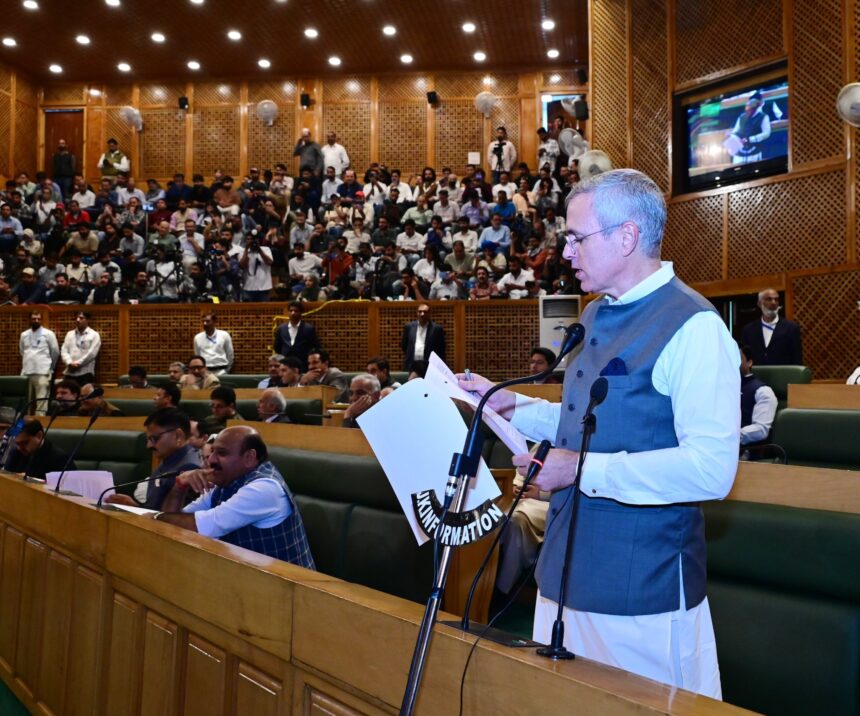
Srinagar: Chief Minister Omar Abdullah on Monday said the decision on restoring Jammu and Kashmir’s statehood could not be left to Pakistan, as he accused the BJP of trying to prevent a vote on a resolution seeking the “immediate and urgent” restoration of full statehood.
The Jammu and Kashmir Legislative Assembly eventually passed the resolution by voice vote amid a walkout by BJP members, after a day of unprecedented disruption in which opposition MLAs entered the well of the House, tore business papers, conducted mock proceedings and clashed with members of the treasury benches.
Replying to the debate before the resolution was put to vote, Omar said he had deliberately kept the wording focused on statehood to ensure that the BJP had “no excuse” to disrupt the proceedings.
“I knew they would make all efforts to disrupt the House so that they do not have to vote on it,” he said, adding that the resolution had been carefully drafted after “thorough consideration”.
The chief minister rejected the BJP’s contention that the resolution sought a vote on Article 370, Article 35A, special status or autonomy.
“Let them read the resolution and tell us where we have asked for votes on Article 370, where we asked for votes on 35A, or where we asked for votes on special status — we have only asked for votes on statehood,” he said.
Omar questioned the delay in restoring statehood despite the Supreme Court’s direction that it be restored “at the earliest” and the Centre’s repeated assurances.
“Two years have passed since elections. The Supreme Court has said in the Article 370 judgment that statehood be restored as soon as possible after elections. Which dictionary says ‘as soon as possible’ means two years?” he asked.
The Supreme Court, in its December 11, 2023 judgment upholding the abrogation of Article 370, had directed that elections be held in the Union Territory by September 2024 and statehood be restored at the earliest.
Omar also questioned the Centre’s repeated reference to restoring statehood at an “appropriate time”.
“Are you linking this to militancy? Are you implying that until guns fall silent in Jammu and Kashmir, statehood will not be restored?” he asked.
He argued that if restoration of statehood was made conditional on the complete end of militancy, the decision would effectively depend on Pakistan.
“If the decision regarding Jammu and Kashmir’s statehood will be made only after the guns fall silent, then the decision will not be made in New Delhi; it will be made in Islamabad,” he said.
Referring to attacks at Pahalgam, Uri and Pulwama, Omar said the Centre itself maintained that militancy in J&K originated from Pakistan.
“When you state that statehood will be restored only after guns are silenced, you leave the decision to Pakistan as to when they silence the guns and when you restore our statehood,” he said.
The chief minister rejected the BJP’s portrayal of statehood as an issue belonging only to the National Conference.
“Statehood belongs to them, to us, and to the people of Jammu and Kashmir,” he said.
A major part of Omar’s address focused on what he described as the administrative consequences of Jammu and Kashmir continuing as a Union Territory.
Referring to legal opinions sent to the Speaker on the statehood resolution, he questioned how the Chief Secretary and Law Secretary could communicate with the Speaker on the issue without the elected government being aware of it.
“As Law Minister, that opinion reached you, yet I had not even seen it. As Chief Minister, I had no knowledge that the Chief Secretary was writing to you regarding my resolution. On whose orders was this sent? I do not know,” Omar said.
He described the episode as a direct consequence of Union Territory status.
“Can you imagine this happening in any state — that a Chief Minister moves a resolution, and the Law Secretary delivers an opinion against it? This can only happen in a Union Territory,” he said.
Omar also cited what he described as prolonged administrative delays, including the absence of a regular Advocate General for nearly two years despite the elected government forwarding a proposed name.
He referred to a committee constituted to examine the regularisation of daily wagers, saying it had been given six months to submit its report but had still not completed the process after about a year.
The chief minister questioned the division of powers between the elected government and the Lieutenant Governor in the Union Territory.
“We are told that in a Union Territory, security and law and order are the responsibilities of the Lieutenant Governor, while everything else is ours. Fine. But why have revenue officers been kept outside our jurisdiction?” he asked.
He also questioned why institutions such as SKIMS, Jammu and Kashmir Power Development Corporation, Jammu and Kashmir Academy of Art, Culture and Languages, Islamic University of Science and Technology and Baba Ghulam Shah Badshah University were outside the elected government’s effective control.
“What has the cultural academy to do with law and order?” he asked.
Omar said that under the erstwhile state structure, the chief minister had also held institutional roles, including as ex-officio chancellor of certain universities, but that such arrangements had changed after the reorganisation of Jammu and Kashmir.
He also said the Transaction of Business Rules prepared by the elected government had remained pending with the Centre for nearly two years.
“We told them: if there is any shortcoming or weakness in them, let us know and we will rectify it, but at least remove this persistent ambiguity in the execution of executive powers. Even that has not been done,” he said.
Omar referred to the government’s work on reservations to illustrate what he described as the limitations of the present administrative structure.
He said the government had constituted a Cabinet Sub-Committee under Minister Sakina Itoo to examine the issue and ensure fairness for open-merit candidates.
According to Omar, the committee completed its work, the Cabinet approved its report and the proposal was subsequently sent to the Lieutenant Governor. The matter was then referred to the Centre, which raised queries. The government prepared responses, obtained Cabinet approval and sent the decision back to the LG.
He said no final decision had followed.
Omar also hit out at BJP members for invoking Maharaja Hari Singh during the protests, accusing them of dismantling institutions and provisions associated with his legacy.
“The map of Jammu and Kashmir bequeathed by Maharaja Hari Singh was dismantled by them. The State Subject laws granted by Maharaja Hari Singh were destroyed by them. The special status granted when the Maharaja signed the Instrument of Accession was torn down by them,” he said.
He also took exception to slogans of “Jammu ke Jaichand” raised in the House, particularly referring to BJP MLA Devyani Rana, daughter of late BJP leader Devender Singh Rana.
Omar said the slogan had historically been directed against Devender Singh Rana, whom he described as a close colleague.
“I know that whenever the slogan ‘Jaichand of Jammu’ was hurled, it was targeted against the late Devender Singh Rana. Today, seeing his daughter stand here and raise that same slogan… it does not behove her,” he said.
Concluding his address, Omar said Jammu and Kashmir was not seeking statehood as a favour from the Centre.
“We were humiliated. We were demeaned. We demand an answer to that humiliation. We demand justice for that indignity. We demand our rights. We demand by right that statehood belongs to us,” he said.
The resolution was subsequently passed by voice vote amid the BJP walkout, with the Assembly resolving to forward it to the Government of India.
Tables five bills, including ministers’, MLAs’ salary hike
Srinagar: Chief Minister Omar Abdullah on Monday introduced five government bills in the Jammu and Kashmir Legislative Assembly, including legislation to amend the Goods and Services Tax Act and another proposing the decriminalisation and rationalisation of certain offences to promote ease of living and ease of doing business.
The five bills were introduced after Question Hour as the Assembly continued its legislative business amid protests by BJP members over the statehood resolution.
The first legislation, the Jammu and Kashmir Goods and Services Tax Amendment Bill, 2026 (L.A. Bill No. 12 of 2026), was introduced by Abdullah in his capacity as Minister-in-Charge Finance. The Bill seeks amendments to the Jammu and Kashmir Goods and Services Tax Act, 2017, and has already been published in an extraordinary issue of the Official Gazette.
The second, the Jammu and Kashmir Ministers’ and Ministers of State Salaries (Amendment) Bill, 2026 (L.A. Bill No. 13 of 2026), was introduced by Abdullah as Minister-in-Charge Law, Justice and Parliamentary Affairs. It proposes amendments to the Jammu and Kashmir Ministers’ and Ministers of State Salaries Act, 1956.
The third Bill, L.A. Bill No. 14 of 2026, seeks amendments to the Salaries and Allowances of Members of the Jammu and Kashmir State Legislature Act, 1960, including matters connected with or incidental to the proposed changes.
The fourth legislation, L.A. Bill No. 15 of 2026, proposes amendments to the Jammu and Kashmir State Legislature Members’ Pension Act, 1984.
The fifth Bill, L.A. Bill No. 16 of 2026, seeks amendments to various enactments for the decriminalisation and rationalisation of offences with the stated objective of promoting ease of living and ease of doing business. It also proposes repeal of certain enactments and amendments to provisions connected with the proposed changes.
According to the Supplementary List of Business issued by the J&K Legislative Assembly Secretariat, the five legislations formed part of the Assembly’s legislative business for the day.
Earlier during Question Hour, Abdullah informed the House that the proposed 800-tonne-per-day Integrated Solid Waste Management Project at Achan, Srinagar, estimated to cost around Rs 361 crore, was at the tendering stage.
He also informed the Assembly that around 10 kilometres of internal channels and waterways of Dal Lake and adjoining lake interiors had been cleaned or dredged over the past three years, while further dredging of priority channels was being undertaken using departmentally owned machinery.
