



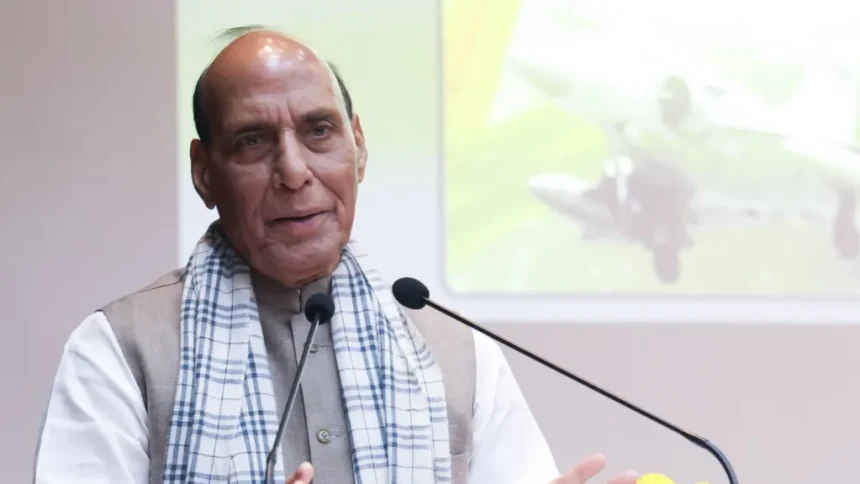
New Delhi: India is working towards developing sixth-generation fighter jets, and while there will be challenges along this path, the resolve remains unwavering, Defence Minister Rajnath Singh said on Sunday, asserting that the country is building capabilities with the warfare of the next two decades in mind.
In a veiled message to Pakistan, Singh also said that as long as “our neighbouring country persists with a state policy of terrorism, India remains fully free to carry out all forms of strikes against it”.
Singh was addressing a session at Defence Summit, which was also attended by Army Chief General Dhiraj Seth and other senior officers of the armed forces.
“Today we are in the era of fifth-generation warfare, where, along with land, water and air, cyber, space and the human mind have also become new battlefields. The supply chains are also becoming a new ground of geopolitical conflict. New technologies like drones, artificial intelligence, quantum and hypersonic are changing the shape of the entire defence sector,” he said.
The defence minister underlined that today’s warfare is not merely a matter of soldier versus soldier; rather, it spans multiple domains, including electronic warfare, information warfare, AI, drones, autonomous systems and precision weapons.
“We recognise that the future landscape of security and the battlefield will be technology-driven. So the nation that leads in technology will hold an advantage on the battlefield. That is why we have emphasised making India’s defence strategy future-ready; our focus today extends beyond the weapons of the present,” he said.
“We are building capabilities with the warfare of the next 10 to 20-25 years in mind. We want India not merely to import technology, but to define it,” Singh said.
On India’s position in the world order, Singh said, “India is neither a status quoist power nor a revisionist power. I believe we are a civilisational power.
“The objective of our rise is not to leave another country behind or to dismantle the existing order; rather, it is about collective and inclusive growth. Our goal is – rise without rupture, positive change without conflict,” Singh emphasised.
“We envision a world where India advances, and the entire world moves forward alongside us,” he added.
The minister underlined that India believes in peace and does not seek to occupy the territory of any country.
“However, peace should not be mistaken for weakness,” Singh said.
“We seek global stability, but not at the cost of our strategic autonomy. We are firmly committed to safeguarding our security and strategic autonomy when threatened,” he said.
India believes in dialogue. However, if a country fuels terrorism against India, the “scope for dialogue ceases to exist”, the defence minister said.
He said at a recent meeting of the Shanghai Cooperation Organisation (SCO), Prime Minister Narendra Modi clearly said that countries using terrorism as an instrument of state policy, providing shelter and support to terrorists, “must be sent a strong message that terrorism cannot be a strategic asset for anyone”.
“As long as our neighbouring country persists with a state policy of terrorism, India remains fully free to carry out all forms of strikes against it,” Singh said.
He also underlined the progress made in the defence sector in the last decade, as well as some of the steps taken to make the armed forces future-ready.
“Today, large-scale efforts are underway in India to manufacture everything from aircraft engines to drone engines. India is working towards developing not just fifth-generation fighter jets, but sixth-generation fighter jets as well.
“I am aware that there will be challenges along this path, yet our resolve remains unwavering. India is fully prepared to take a giant leap in defence manufacturing over the next decade,” Singh said.
On hypersonic technology, he said, “India has successfully conducted a flight trial of a long-range hypersonic missile. A long-duration scramjet engine has also been tested.”
Singh underlined that based on all this, it can be said that whether it is contact or non-contact warfare, kinetic or non-kinetic warfare, India’s armed forces are “continuously strengthening their capabilities and preparedness across every dimension”.
“We want India to not just use the military technology of other nations, but to create its own,” he said.
Highlighting India’s progress towards self-reliance in defence, Singh said, “Our defence exports have grown from Rs 686 crore in 2013-14 to a record Rs 38,424 crore in 2025-26, reaching more than 100 countries. After achieving the Rs 30,000 crore export target last year, India has now set a goal of Rs 50,000 crore by 2029.”
