



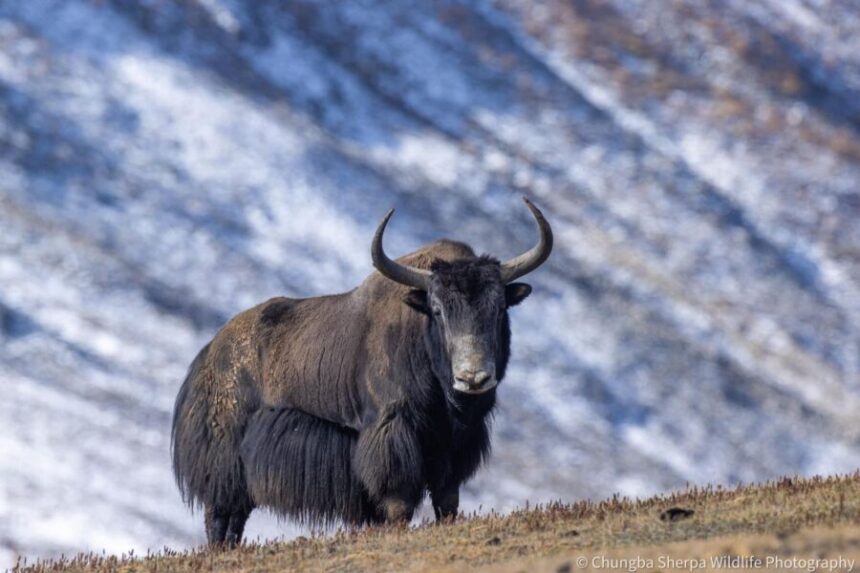
Leh: In a significant push to strengthen wildlife conservation and preserve Ladakh’s fragile Himalayan ecosystem, Lieutenant Governor Vinai Kumar Saxena has approved the reconstitution of the State Board for Wildlife (SBWL), even as the Union Territory recorded a 20 per cent increase in the yak population in Nubra Valley, reflecting encouraging progress in conservation and sustainable livestock management.
The reconstituted State Board for Wildlife, the apex statutory body responsible for wildlife conservation and biodiversity management in Ladakh, will include eminent conservationists, ecologists, environmentalists and representatives of non-governmental organisations working in the field of wildlife conservation.
The move follows the completion of the one-year tenure of the existing nominated members in May this year and is aimed at ensuring the continued functioning of the Board.
Constituted under Section 6 of the Wildlife (Protection) Act, 1972, the Board advises the administration on policies relating to wildlife protection and biodiversity conservation. It reviews conservation programmes, recommends measures for protecting habitats and endangered species, promotes coexistence between local communities and wildlife, and examines proposals concerning protected areas.
In ecologically sensitive Ladakh, the Board also plays a crucial role in balancing developmental needs with environmental sustainability.
Announcing the reconstitution, Lieutenant Governor Vinai Kumar Saxena said Ladakh is home to some of India’s rarest wildlife species and one of the world’s most fragile mountain ecosystems, making conservation a shared responsibility.
“The State Board for Wildlife plays a pivotal role in guiding conservation policies, protecting biodiversity and ensuring that development proceeds in harmony with nature. The inclusion of experienced wildlife experts, scientists, conservationists and civil society representatives will strengthen evidence-based decision-making and reinforce our commitment to preserving Ladakh’s rich natural heritage for future generations,” he said.
The announcement comes on a day when officials reported a 20 per cent increase in the yak population in Nubra Valley, one of Ladakh’s most important high-altitude pastoral regions where yak rearing continues to support the livelihood and culture of tribal communities.
The increase was highlighted during an awareness-cum-technology demonstration programme on scientific yak husbandry organised at the Yak Breeding Farm in Nubra. The programme brought together more than 135 yak herders from villages including DiggarTangyar, Khema, Khunru, Khardong, Khalsar, Largab, Waris Fastan, Hunder Dok, Turtuk and Bogdang.
Deputy Commissioner, Nubra, Mukul Beniwal described the yak as an integral part of the valley’s cultural identity and traditional way of life, welcoming the growth in its population while stressing the need to build on the momentum.
“We appreciate the 20 per cent increase in the yak population. It is important to preserve the yak as a symbol of Nubra Valley’s heritage,” he said.
Beniwal called for expanding incentives for yak rearing, strengthening market linkages for yak wool, encouraging value-added yak-based products and promoting yak tourism as sustainable sources of income for local communities living in remote Himalayan areas.
Experts said scientific interventions would be essential to sustain the growing population. Senior Scientist Dr Mukhtar Hussain highlighted technologies developed for scientific yak husbandry and conservation, while emphasising the importance of regular vaccination to prevent disease outbreaks.
Block Veterinary Officer Dr Motup Angmo informed herders that proper registration and tagging of yaks would enable them to access benefits available under various government schemes while also helping authorities maintain reliable livestock records.
To support pastoral communities, the administration distributed 200 bags of cattle feed, 100 tarpaulins, 100 solar lights, mineral mixtures and veterinary medicines under the Scheduled Tribe Component (STC) scheme.
Officials said the twin developments underscore Ladakh’s broader strategy of combining scientific conservation, community participation and sustainable livelihood generation to protect its unique biodiversity while improving the socio-economic well-being of people living in the Union Territory’s high-altitude landscapes.

