



Ahmed Ali Fayyaz
Srinagar: Those well-versed with the Indian Statecraft do know that the Chief Ministers of the opposition parties in the States and Union Territories do seldom rake up issues of conflicting interests at a visiting Prime Minister’s public rallies. Whatever the level of rhetorical statements during or beyond an election campaign, host CMs do not confront or embarrass the PM.
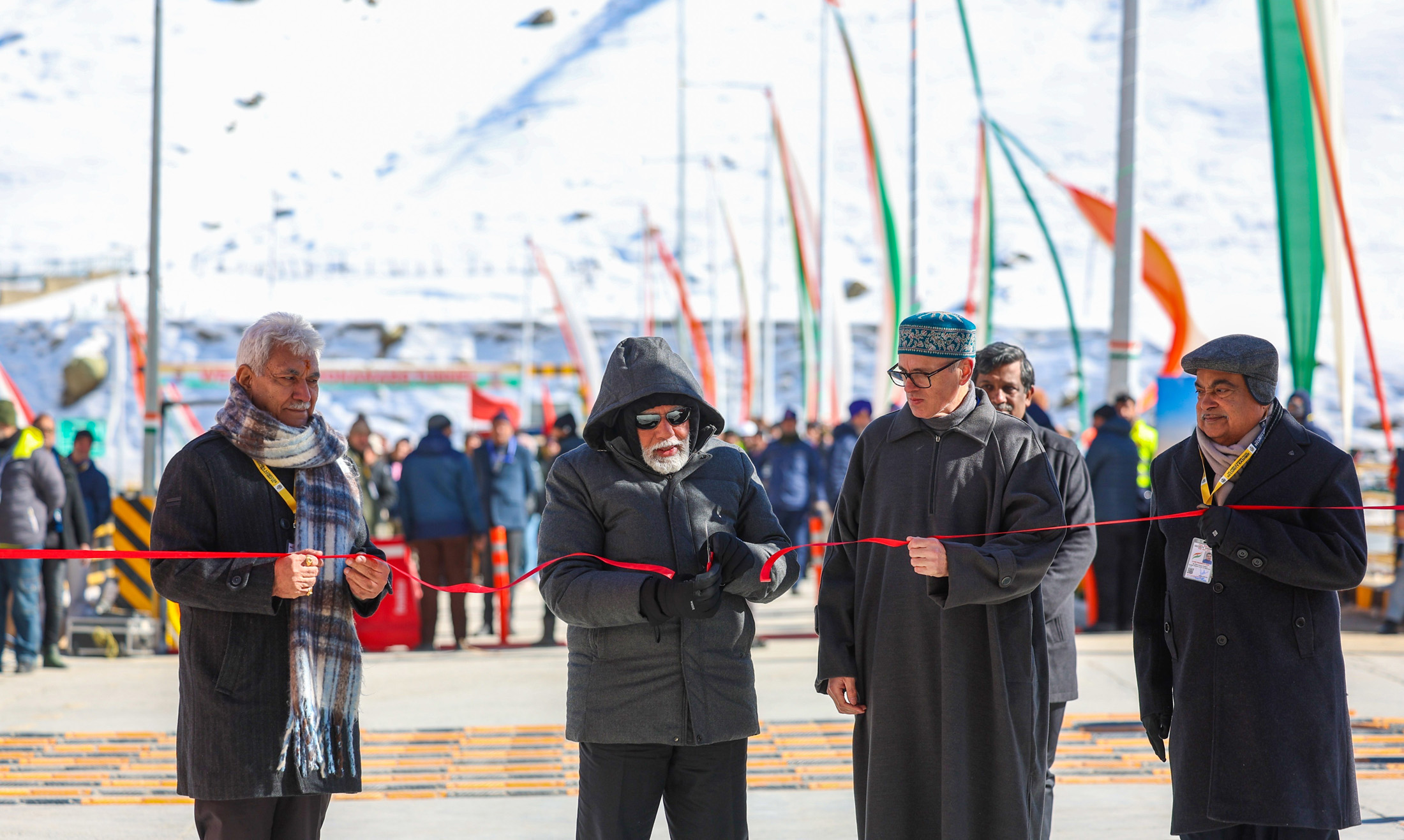
Nobody was expecting Chief Minister Chief Minister Omar Abdullah to put forward the demand of the restoration of the Statehood to Prime Minister Narendra Modi at the inauguration rally of the 6.4 km Z-Morh road tunnel in Kashmir’s Ganderbal district on Monday. In his welcome speech, Omar showered a profusion of praise on Modi for keeping his word, for his political credibility.
Omar asserted that Modi had kept his word of holding the free and fair Assembly elections in Jammu and Kashmir “within four months” of his Yoga Day declarations in Srinagar after the Lok Sabha elections.
“There was not even a whisper or murmur of rigging or any sort of unfair means in the elections of a massive participation. Now, many people in the media and politics are asking me when exactly would the Prime Minister fulfil his third significant promise and restore Statehood to Jammu and Kashmir”, Omar told the PM, his colleagues and audiences. He said he was confident and his “heart” was telling him that the Statehood would return to Jammu and Kashmir.
In a sharp contrast to his election-time statements, Omar praised PM Modi and the Union Minister of Roads and Highways, Nitin Gadkari, for establishing a robust communication network—roads, flyovers, bridges, railway tracks and tunnels—in the last ten-a-half years of the BJP government at the Centre. At the then visiting Prime Minister Atal Behari Vajpayee’s Srinagar rally, Chief Minister Mufti had showered praises on his guest. In return, PM Vajpayee said at the gathering that Mufti Sahab had forced the rain to stop. Twenty-one years later, Omar told Modi that the last shred of the cloud had disappeared upon his arrival in Kashmir on Monday.
Early in the morning, National Conference’s J&K bete noire and Minister of State in the PMO, Dr Jitendra Singh, drove Omar to the inauguration site in his vehicle. Dr Singh lost no time to release the pictures of the two leaders driving to Sonmarg together on social media. People in governance and politics know that even this would not happen without the PM’s consent.
In the last over 10 years, senior BJP leaders—most prominently PM Modi and Home Minister Amit Shah besides Dr Jitendra Singh—have been calling the NC, the PDP and the Congress as ‘dynasts’. In all elections from 2014 to 2024, they denigrated the troika as “baap bete ki party” and “baap beti ki party”. On certain occasions, they clearly charged the two Kashmir-based parties with a liaison, relationship and sympathy with Pakistan, terrorists and enemies of India.
Abrogation of Article 370 and 35-A, withdrawal of the special status and Statehood and bifurcation of the erstwhile State into the two separate Union Territories in 2019 came as the climax of the Modi-led BJP’s tirade. Even as Mehbooba Mufti’s PDP was punished by the Kashmiris for its past partnership with the BJP, the NC swept the Assembly elections in 2024. It also won two of the three traditional seats in Kashmir in the Lok Sabha elections.
Keeping with its election manifesto, Omar’s Cabinet adopted a resolution for restoration of State and other constitutional guarantees to Jammu and Kashmir. In the Assembly’s first session, the NC government also got a resolution for restoration of Statehood passed amid furore and pandemonium. Through the Chief Secretary it was subsequently forwarded to the Centre for implementation. It is currently under the consideration of the Union Government.
On 6 January 2025, PM Modi laid the foundation stone of an independent railway division at Jammu through virtual mode. It was for the first time that Chief Minister Omar addressed the audiences who had gathered at different sites. PM Modi listened to him with rapt attention. There was no exchange of bad notes.
Within a week came the inauguration of the Rs 2700 crore Z-Morh tunnel. For the first time, Modi was seen smiling when Omar showered praises on him. Later, in his historic address, Modi assured the gathering that he never forgets his promises. He didn’t set a timeframe but indicated that the much-promised Statehood—also desired by the Supreme Court of India—would return to Jammu and Kashmir.
Since 4 July 2014, it was Modi’s 25th visit as PM to Jammu and Kashmir. Even as the two major road and rail tunnels have been inaugurated under the Pir Panjal mountain in 2013 and 2021 besides the Syama Prasad Mookerjee road tunnel (connecting Chenani and Nashri) on the Jammu-Srinagar highway in 2017, it is for the first time that a tunnel has been inaugurated inside the Kashmir valley.
How quickly would these roads, tunnels and railway tracks make a connection between Abdullah’s NC and Modi’s BJP—or Kashmir and Delhi—remains to be seen. On its surface, Monday’s development is coming as a watershed between their relations.

