



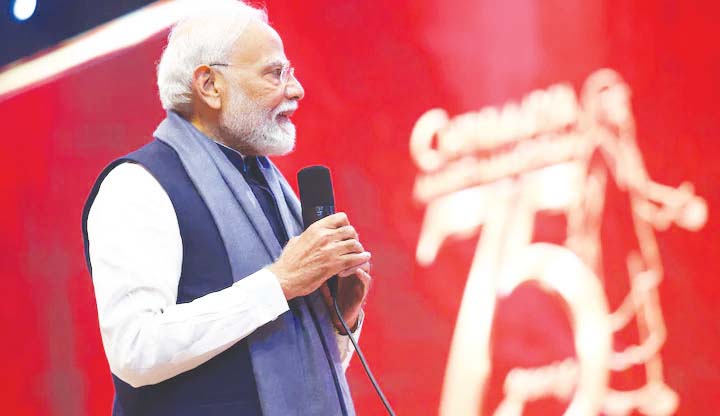
Jammu: Prime Minister Narendra Modi on Sunday highlighted how the e-Sanjeevani telemedicine service helped a pregnant woman in Zanskar, Ladakh, receive specialist medical assistance, citing the case as an example of technology improving healthcare access in remote areas.
In his monthly radio programme Mann Ki Baat, Modi said Kunjang Dolma experienced complications during pregnancy in Zanskar, where e-Sanjeevani enabled a specialist doctor to provide timely assistance.
The Prime Minister also cited cases from the Andaman and Nicobar Islands, Lakshadweep and Nagaland to illustrate how the telemedicine platform is connecting patients in remote locations with experienced doctors.
He said nearly 50 crore teleconsultations had been conducted through e-Sanjeevani, describing the milestone as evidence of the potential of technology, the dedication of doctors and public trust in the service.
Modi said the platform was reaching even the remotest corners of the country. He also highlighted the role of nearly 1.9 lakh Ayushman Arogya Mandirs in improving access to healthcare, particularly in rural areas, where regular health check-ups are gaining importance.
The reference to Zanskar placed Ladakh among the regions cited by the Prime Minister to demonstrate how digital healthcare can help overcome geographical barriers to specialist medical services.
With Diwali and Chhath approaching, Modi urged citizens to give priority to products made by local artisans during festival shopping, saying their purchases could strengthen the Vocal for Local campaign and accelerate the vision of an Atmanirbhar Bharat.
He said Indian products were increasingly finding international markets, citing makhana from Purnia in Bihar reaching Greece and arhar dal from Kalaburagi in Karnataka being exported to the Maldives.
The Prime Minister also emphasised the importance of packaging in improving the appeal and marketability of local products. He cited the Shabari Naturals initiative in Maharashtra, under which products such as honey, mahua, chironji and bamboo-based items are marketed with packaging reflecting tribal art. The packaging, he said, had received Japan’s Good Design Award.
He also referred to a Karnataka-based startup developing packaging material from bamboo and agricultural residue.
Highlighting the continued popularity of traditional products, Modi said sales of Khadi Gram Udyog products had exceeded ₹28 crore on Gandhi Jayanti this year, an increase of ₹1.5 crore over the previous year.
Modi spoke about Nav-Trinjan, an initiative of the Kheti Virasat Mission in Punjab’s Malwa region aimed at promoting natural cotton cultivation and traditional weaving.
He said the initiative was helping women acquire weaving skills and earn livelihoods through products made from indigenous organic cotton. He cited women who had moved from agricultural labour and domestic work to producing textiles on handlooms after receiving training.
The Prime Minister also highlighted efforts to revive the Heval river in Uttarakhand’s Tehri Garhwal district. Local residents and the administration undertook rainwater harvesting, groundwater recharge and tree plantation measures after the river’s water level declined and nearby natural springs began drying up.
He said the efforts had helped revive the river and restore dozens of natural water sources.
The broadcast also highlighted efforts to revive millet cultivation in Meghalaya and Nagaland, where local initiatives are creating value-added products such as cookies, cakes, muffins and baby food, encouraging demand for the traditional crop.
Modi spoke about the Sudha Gopalakrishnan Brain Centre at IIT Madras, which is developing high-resolution digital three-dimensional images of human brains to advance research. He said the project aimed to map 100 human brains in detail and make the resulting data available as an open-source resource for researchers.
He also referred to organ donation, emerging deep-tech startups, the contributions of fibre-optics pioneer Narinder Singh Kapany and the upcoming birth anniversary of freedom fighter Bhai Parmanand.
The Prime Minister urged citizens to participate in the Run for Unity on October 31, marking the birth anniversary of Sardar Vallabhbhai Patel, and extended greetings for the upcoming festivals.
Modi terms 12-year journey of Mann Ki Baat a ‘pilgrimage’
New Delhi: Prime Minister Narendra Modi on Sunday termed the 12-year journey of his monthly radio broadcast ‘Mann Ki Baat’ a “pilgrimage”, describing it as an opportunity to closely understand the efforts of citizens and pay tribute to their contributions.
In the 139th edition of the programme, Modi also said that through the radio address, he, in a way, worships the collective power (Lokshakti) of the nation and it gives him the opportunity to connect with every family in the country.
“Welcome once again to Mann Ki Baat. Twelve years ago today, on the auspicious occasion of Vijayadashami, we began Mann Ki Baat. Since then, our journey has been continuing without interruption. You are both fellow travellers and guides on this journey,” he said.
The prime minister said for him, Mann Ki Baat has been a “blessed occasion” to sing the praises of the hard work, valour, commitment, dedication, and spirit of service of the common people of the country.
“There has been an ancient tradition of pilgrimage in our country. For me, Mann Ki Baat is no less than a pilgrimage to closely learn about the efforts of the people of the country and to bow down to their contributions,” he said.
Modi said those who live for society and the nation are like a pilgrimage site in themselves.
In these 12 years, he said, many such people have come forward from every corner of the country whose extraordinary work usually misses the attention of society.
“Mann Ki Baat has worked to bring countless such inspiring stories before all of you. Through this programme, I, in a way, worship the collective power of the nation. It gives me the opportunity to connect with every family in the country,” he said.
The prime minister said he receives hundreds of messages in which people share that after listening to Mann Ki Baat, they felt as if he was sitting among them as a member of their family, conversing with them.
“For me, this intimacy and affection from all of you listeners is an invaluable asset,” he said.

