



Avinav Verma
Leh: Prime Minister Narendra Modi will inaugurate and dedicate five development projects worth around ₹3,350 crore in Ladakh on Thursday, covering strategic road connectivity, airport infrastructure, hydropower, water conservation and preservation of the Union Territory’s ancient archaeological heritage.
In a post on X ahead of the programme, Modi said the projects would strengthen connectivity, boost development, preserve Ladakh’s rich heritage and improve the quality of life of its people.
The five projects include the new passenger terminal building at Kushok Bakula Rimpochee Airport in Leh, the 298-km Nimmu-Padum-Darcha road, the 9 MW Hanu Small Hydroelectric Project and the associated transmission infrastructure, India’s first Petroglyph Conservation Park at Sindhu Ghat in Leh, and 40 water bodies developed across 40 villages under Project Him Sarovar.
According to an official handout issued by the Prime Minister’s Office (PMO), the projects will be launched through video conferencing, with the Prime Minister also scheduled to address the gathering.
The 298-km Nimmu-Padum-Darcha road, constructed by the Border Roads Organisation (BRO), will connect Nimmu in Leh with Darcha in Himachal Pradesh through the remote Zanskar Valley.
The road provides an alternative connectivity corridor to Ladakh, supplementing the Srinagar-Leh and Manali-Leh highways. Traversing challenging Himalayan terrain, including the high-altitude Shinkun La Pass, the route is strategically significant for improving operational mobility and logistical support for the armed forces.
The road is also expected to benefit residents of Zanskar by improving access to healthcare facilities, educational institutions, markets and essential services.
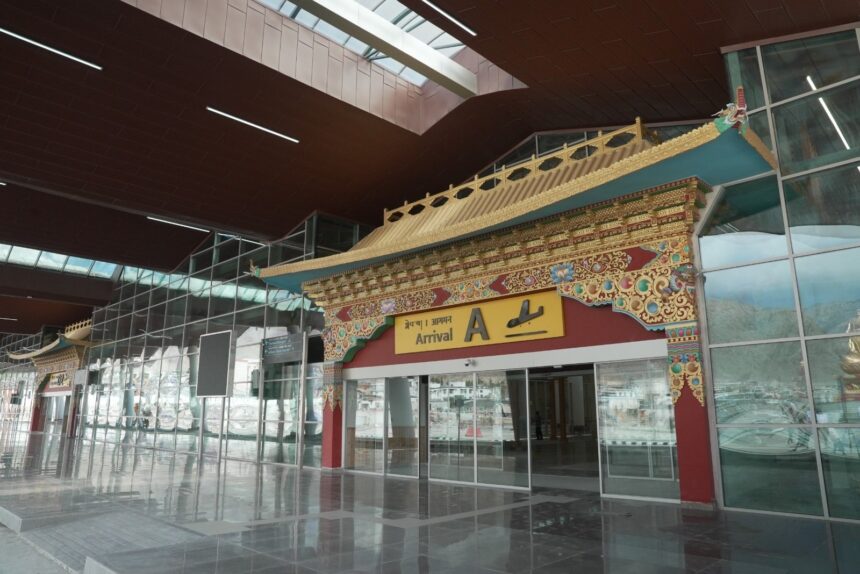
The new passenger terminal at Kushok Bakula Rimpochee Airport has been constructed at a cost of ₹640 crore. Spread across 23,800 square metres, the terminal is designed to handle 35 lakh passengers annually.
The facility incorporates geothermal energy systems intended to improve energy efficiency and reduce its carbon footprint. Its design combines modern passenger amenities with elements of Ladakh’s cultural heritage.
The terminal is expected to improve passenger convenience and strengthen air connectivity with the rest of the country, while its energy-efficient features reflect the requirements of infrastructure development in Ladakh’s ecologically sensitive environment.
The energy component includes the 9 MW Hanu Small Hydroelectric Project and the 66 kV double-circuit Dah-Hanu-Khaltsi transmission line.
The projects are intended to harness Ladakh’s hydropower potential, strengthen power evacuation infrastructure and improve the reliability of the region’s electricity network.
Water security forms another major component of the package, with 40 water bodies developed across 40 villages under Project Him Sarovar, in line with the objectives of Mission Amrit Sarovar.
Agriculture in Ladakh faces a seasonal imbalance between water availability and demand. Snowmelt and glacial runoff provide water during certain periods, but farmers can experience shortages during critical stages of cultivation, particularly the sowing season.
The initiative seeks to conserve water when it is available and improve its availability when required, supporting irrigation, agricultural livelihoods and long-term water security in the villages covered by the project.
Modi will also inaugurate India’s first Petroglyph Conservation Park at Sindhu Ghat in Leh to protect the region’s ancient archaeological heritage.
Ladakh is home to hundreds of prehistoric rock-art sites featuring carvings of wildlife, human figures and symbolic representations. These carvings offer insights into the region’s cultural and civilisational history over thousands of years.
The park will provide a dedicated space for protecting vulnerable archaeological remains, raising public awareness and encouraging responsible heritage tourism.
Separately, Union Home Minister Amit Shah is likely to visit Leh on October 18 for an event related to the Ladakh Bench of the Jammu and Kashmir and Ladakh High Court. The Chief Justice of India and other judges are also expected to attend the event, according to reports. An official confirmation of the visit and the programme is awaited.
MHA to hold talks with LAB-KDA leaders
Leh: The Centre and Ladakh’s representative bodies are set to resume talks on Thursday over the proposed Union Territory-level elected body, its legislative, financial and executive powers, and constitutional safeguards for the region, with the Leh Apex Body (LAB) and Kargil Democratic Alliance (KDA) expected to seek clarity on a comprehensive framework.
The Ministry of Home Affairs (MHA) has invited LAB and KDA leaders for the next round of Sub-Committee-level discussions in Leh.
The meeting follows the September 9 round of talks in New Delhi, which remained inconclusive, and comes after the MHA sought responses to nine queries concerning the proposed institution.
LAB chairman Chering Dorjay Lakrook has said the organisation has prepared its response to the MHA’s questions and would submit it during the meeting.
The leadership is also expected to press for progress on decisions taken during the May 22 discussions, when the Centre and Ladakh’s representatives reached an in-principle understanding on a democratic framework and constitutional safeguards.
The proposed elected body is expected to be a key point of discussion, particularly its composition, powers and functioning.
During earlier deliberations, the two sides reportedly agreed that its members would be directly elected by the people of Ladakh rather than nominated or selected by representatives of the seven Autonomous Hill Development Councils.
Subjects such as land, culture, heritage, forests, environment and natural resources have also figured in previous discussions on the proposed institution.

