



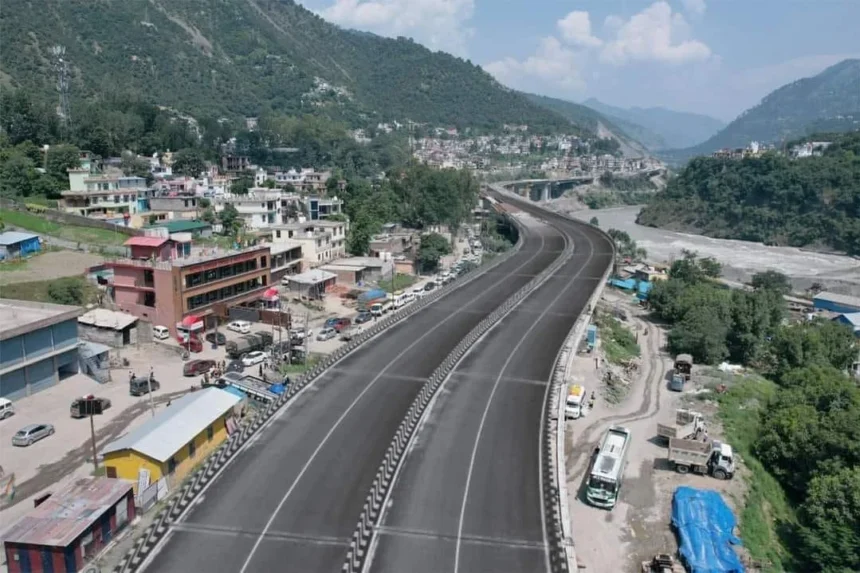
Jammu: The construction of the prestigious Delhi-Amritsar-Katra (DAK) Expressway Corridor has apparently come under scrutiny over road safety concerns, with official data showing that nearly 80 per cent of Jammu and Kashmir’s identified black corridors are located in Kathua, Samba and Jammu districts through which the expressway is being built.
According to the official data tabled in Rajya Sabha, as many as 73 black corridors were identified in ten districts of Jammu and Kashmir, out of which 58 such corridors were found in Kathua, Samba and Jammu districts—a majority of these were located along the mega expressway project.
“A total of 30 black spots were identified in Jammu district, while the number of such corridors in Kathua district was 13 and 14 in Samba district. One corridor was in Samba and Jammu stretch,” the data revealed.
These black corridors have been identified on real-time basis through AI based tools and the data was based on the available accident data from Electronic Detailed Accident Report (e-DAR) for the period 2023–2025.
It is important to mention here that certain segments on National Highways (NHs) have been identified as black corridors which are continuous stretches qualifying the criteria of black spots i.e. locations with occurrence of certain number of accidents involving fatalities and grievous injuries.
The Expressway construction work on all five packages–14, 15, 16, 17, and 18—falling in Jammu and Kashmir was commenced on September 26, 2022. The revised completion deadline for all five packages of the 143-km stretch of the Expressway in the UT has been fixed for November 2027.
The official data shared by Ministry of Road Transport and Highways also revealed that over 10,000 road accidents were reported in Jammu and Kashmir between 2020 to 2024 in which as many as 1350 persons lost their lives while 10, 960 road users received injuries—many of them grievous that left them physically handicapped.
The government, however, claimed that all NH works are carried out as per standards, guidelines, manual, code of practice of Indian Roads Congress as well as specifications for road and bridge works. Necessary road safety measures are taken during design, construction, operation and maintenance stages.
“Short-term measures for immediate rectification of black corridors include road markings, signages, crash barriers, road studs, delineators, closure of unauthorized median openings, traffic calming measures, etc,” it said.
It further said, “Long-term measures for rectification of black corridors like improvement of road geometrics, junction improvements, spot widening of carriageway, construction of underpasses/overpasses, etc. are also taken as permanent rectification measures as per site requirement. Long term rectification works involve pre-construction activities such as land acquisition, forest clearance & utility shifting which takes significant time”.
Pertinently, Prime Minister Narendra Modi laid the foundation stone for the DAK Expressway on April 22, 2022. Initially estimated at Rs 38,905 crore, the project cost is expected to rise as certain sections has already exceeded their deadlines. Once completed, the expressway will significantly reduce travel time—enabling commuters to reach Amritsar from Delhi in four hours and Katra in six hours.

