



By Bharat Nanda
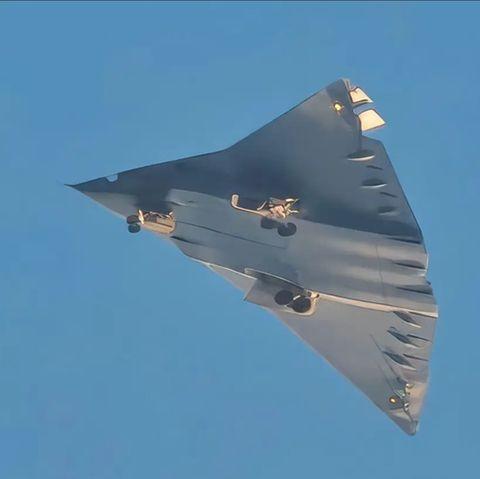
China’s emergence as the first country to fly two sixth-generation fighter demonstrators has opened a new chapter in the global competition for air superiority. The appearance of Chengdu’s J-36 and Shenyang’s J-50 has challenged conventional assumptions about the pace of military aviation development and raised important questions about the future balance of air power in Asia.
For India, these developments deserve close attention. However, the significance of China’s sixth-generation programmes lies not simply in the aircraft themselves, but in the larger military architecture Beijing is attempting to build around them.
The distinction between a technological demonstrator and an operational combat capability is important. China’s prototypes have demonstrated considerable ambition in airframe design. Their actual performance in areas such as propulsion, sensor integration, electronic warfare and autonomous operations, however, remains largely unverified.
The sixth-generation concept represents a fundamental departure from the traditional fighter aircraft. Fifth-generation platforms such as America’s F-22 and F-35 and China’s J-20 were designed around stealth, advanced sensors, electronic warfare and network connectivity. The sixth generation seeks to take this integration considerably further.
Instead of functioning primarily as an individual combat aircraft, the next-generation fighter is expected to operate as an airborne command node. It will coordinate unmanned collaborative combat aircraft, share information with satellites and other platforms, and manage a distributed combat network.
This transformation is central to understanding the J-36 and J-50.
The most striking feature of China’s new aircraft is their design philosophy. Both demonstrators employ tailless configurations intended to reduce radar observability across a wider range of frequencies and angles. Their designs also suggest an emphasis on internal weapons capacity, extended range and distributed sensing.
The J-36 is particularly significant. Its estimated maximum take-off weight of 45–55 tonnes and large internal weapons bay suggest an aircraft designed for considerably more than conventional air-superiority missions. Its potential role includes long-range strike, maritime operations and the carriage of very-long-range air-to-air missiles.
Its estimated combat radius of 2,000–3,000 kilometres, if achieved, would represent a substantial departure from the approximately 850–1,500-kilometre range associated with fifth-generation fighters in the comparative assessment.
This is not merely a question of flying farther. Extended range changes the geography of air warfare. It reduces dependence on vulnerable aerial refuelling assets and allows aircraft to operate deeper into contested regions.
The weapons dimension is equally important. The assessment identifies the approximately 400-kilometre-class PL-17 as a central component of China’s emerging long-range air combat architecture. Such weapons are intended to threaten not only opposing fighters but also the supporting aircraft that make modern air operations possible, including airborne early-warning platforms, tankers and intelligence aircraft.
The sixth-generation concept also places greater emphasis on uncrewed aircraft. A two-seat configuration on the J-36 has led to assessments that its second crew member could manage unmanned aircraft and coordinate the wider combat picture. China’s work on platforms such as the GJ-11 and FH-97 further illustrates the direction of this development.
Yet the most important question is whether China can turn these visible design ambitions into a reliable operational system.
A fighter’s appearance reveals only part of its capability. The performance of its radar, infrared sensors, electronic warfare systems, mission software and communications architecture cannot be established simply through photographs of prototypes.
Propulsion is another unresolved question. China’s WS-15 engine represents progress in reducing the country’s dependence on foreign technology, but its long-term durability and operational maturity remain difficult to assess. The J-36’s three-engine configuration also raises questions about the compromises involved in achieving its desired range and power.
The United States, meanwhile, has a different advantage. Although its F-47 programme is behind China’s demonstrators in terms of publicly observed airframe flight testing, American development benefits from an established ecosystem of advanced propulsion research and collaborative combat aircraft programmes.
The comparison therefore cannot be reduced to which country flew a prototype first.
China has demonstrated considerable speed in airframe development. The United States retains important advantages in propulsion and its uncrewed combat ecosystem. Neither country has yet demonstrated a fully operational sixth-generation fighter.
For India, the lesson is clear. China’s technological ambitions must be taken seriously, but they must also be assessed objectively. Neither alarmism nor complacency serves Indian strategic interests.
The J-36 and J-50 may eventually transform the regional air-power equation. Their significance, however, will depend on the maturity of the systems supporting them, the scale of their eventual deployment and their integration into China’s wider military structure.
The real strategic question is not whether China has built a sixth-generation aircraft. It is whether Beijing can convert its technological ambition into a sustainable military advantage.
That is the competition India must prepare for.

This article is Part 1 of a three-part series examining China's sixth-generation fighter programmes, the emerging air-power challenge and India's strategic response. Part 2 will examine the China–Pakistan air-power equation and its implications for India's security.

