



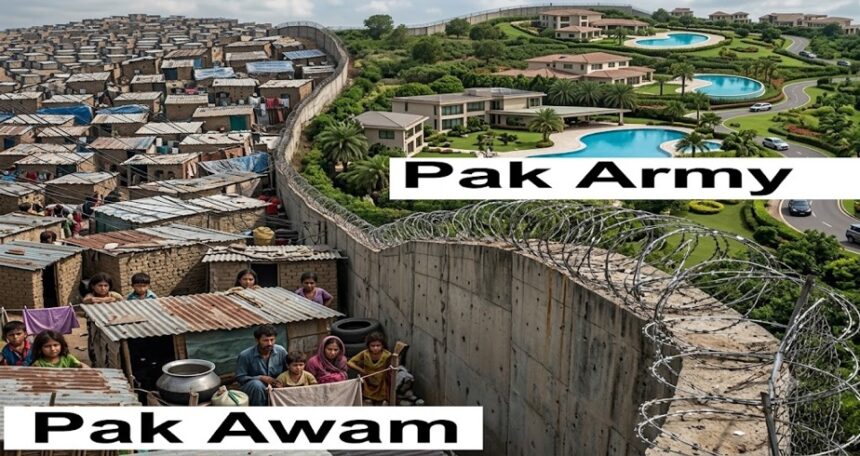
Pakistan’s repeated economic emergencies raise a question that its military establishment would rather leave unanswered: how can an institution claim to be the country’s indispensable guardian while accumulating extensive commercial interests that require independent public scrutiny?
The question goes beyond the wealth of any one general. It concerns an arrangement in which military authority, political influence and business interests reinforce one another. An army with stakes across the civilian economy acquires reasons to resist civilian oversight that extend well beyond disagreements over defence policy. Its institutional privileges become part of what it seeks to protect.
Pakistan’s financial vulnerability provides the backdrop. In September 2024, the International Monetary Fund approved a $7 billion programme over 37 months, with approximately $1 billion immediately available. Alongside the assistance, the IMF identified weak governance, a difficult business environment and inadequate spending on health and education as obstacles to development. Those are failures with consequences for ordinary households, long after a bailout announcement disappears from the headlines.
Against that backdrop stands the scale of the military-linked economy. In September 2025, IDNFinancials reported that the Fauji Foundation ranked first among Pakistan’s largest business groups in the Economic Policy and Business Development think tank’s Wealth Perception Index, with an estimated valuation approaching $6 billion. The report also described the wider reach of military-linked organisations into banking, agriculture, manufacturing and real estate.
That valuation requires precision. It is a reported estimate concerning a business group, not an audited inventory of the entire military economy. It is certainly not the personal fortune of the army chief. Conflating company assets, institutional holdings and private wealth produces sensational headlines while weakening the argument.
The defensible argument is already serious enough. An institution capable of influencing the state also occupies substantial space within the economy governed by that state. The central issue is whether competitors, regulators and elected representatives can deal with it on equal terms.
The commercial structure helps explain why Pakistan’s civil-military imbalance cannot be understood through coups alone. Writing for the University of Technology Sydney in May 2023, researcher Ayesha Jehangir noted that Pakistan had experienced 34 years of military dictatorship and described the establishment’s continuing influence through civilian-led arrangements. Direct rule is one expression of power; the ability to constrain governments without formally replacing them is another.
Commercial interests add another layer of resistance to democratic control. A government seeking genuine authority might question land allocations, review concessions, scrutinise appointments or demand fuller disclosure of institutional finances. Each of those measures could affect established beneficiaries. Civilian supremacy therefore carries a material cost for those accustomed to deciding their own entitlements.
Scholar Ayesha Siddiqa examined this relationship in *Military Inc.*, using the term “Milbus” to describe military economic interests operating beyond conventional defence-budget accountability. Her analysis connects the accumulation of economic interests with the military’s incentives to preserve political influence. It provides a more useful framework than treating every controversy as an isolated case of a wealthy retired officer.
The distinction matters. An individual allegation can be investigated and resolved. An institutional conflict of interest survives changes in personnel. Replacing a commander does little if the same rules continue to distribute opportunity through rank and proximity to power.
Land is especially important to this discussion. It allows administrative decisions to create enormous private value without a conventional cash payment. The relevant questions begin before a plot is sold: who controlled the land, how was its price determined, who qualified for an allocation, and what public purpose justified the terms?
An allotment may comply with an existing rule and still expose a deeply unequal rule. Declaring a benefit “authorised” answers a procedural question. It does not explain why that benefit is proportionate, why its recipients were selected, or whether the public received fair value.
Housing ventures also demonstrate why the military’s reputation cannot replace commercial due diligence. In 2016, three Defence Housing Authority developments faced corruption investigations; people implicated in the reporting denied wrongdoing.
The lesson extends beyond those particular cases. A military association can reassure investors, but it cannot guarantee delivery. Once public trust becomes part of a commercial proposition, failure demands the same scrutiny that would follow a civilian developer. The institution’s prestige should increase its obligation to explain, rather than reduce it.
The strongest defence of military-linked business is welfare. Soldiers retire. Families lose breadwinners. Injured personnel need sustained care. Commercial income can support benefits that would otherwise require greater public expenditure. Those are legitimate objectives.
But a legitimate objective does not settle the quality of the arrangements created in its name. Welfare should be assessed through evidence: what proportion of resources reaches beneficiaries, how benefits differ across ranks, how management is compensated, and whether commercial decisions serve the stated purpose. A widow’s entitlement to support cannot become a general exemption from scrutiny for everyone associated with the institution.
Nor should institutional affiliation automatically discredit every company. Businesses must be assessed through their accounts, conduct and performance. The broader question is whether commercial disclosure adequately reveals the relationship between public resources, institutional influence and private advantage. A profitable enterprise can still benefit from unfair terms. A welfare mandate can coexist with conflicts of interest.
The controversies surrounding senior officers’ families make these questions more urgent, but they also require careful handling.
In November 2022, FactFocus published an investigation alleging that the known assets and businesses associated with General Qamar Javed Bajwa’s immediate and extended family exceeded PKR12.7 billion. Its account drew on tax documents, property information and estimated market values, and described substantial asset growth during his tenure. These were investigative allegations, not a judicial determination that the entire amount represented illicit wealth.
The military rejected the reporting as misleading. Its response disputed the attribution of relatives’ assets to the army chief’s family and challenged the suggestion that the relevant wealth had been accumulated during his six years in office. It also maintained that the assets of Bajwa and his family had been declared to the tax authorities. Those denials belong in any responsible account of the controversy.
Two distinctions are essential. Billions of Pakistani rupees do not mean billions of US dollars. And an extended family’s combined holdings cannot simply be labelled one officer’s personal fortune. Precision prevents a serious examination of privilege from collapsing into exaggeration.
The official response nevertheless raised a separate accountability issue. Finance Minister Ishaq Dar ordered an inquiry into the disclosure of the family’s confidential tax information.
Tax confidentiality deserves legal protection. It does not remove the need for a credible process to examine substantive allegations about powerful public figures. The two questions can be investigated independently. Identifying a leak does not establish the legitimacy of the assets described in it; equally, publication does not establish wrongdoing.
A separate FactFocus investigation in August 2020 examined businesses associated with relatives of retired Lieutenant General Asim Saleem Bajwa. It reported a network that had established 99 companies across four countries, including a pizza franchise business with 133 restaurants. The investigation distinguished main companies from branches and noted that some entities were no longer active. It also recorded a family response disputing the involvement of Asim Bajwa and his sons in Bajco.
Asim Saleem Bajwa and Qamar Javed Bajwa are different individuals, and their controversies should never be merged. Nor does a relative’s successful business, by itself, prove misuse of office. The proper questions concern beneficial ownership, funding, declarations and any connection between public authority and private opportunity. Those questions require documents and independent examination.
This is where the wider economic cost becomes visible. A market depends on participants believing that rules will apply consistently. If business success appears to require access to an institution with exceptional political influence, entrepreneurs have an incentive to cultivate that access. Time and capital move towards securing protection and favourable treatment rather than improving products, productivity or service.
The damage need not appear as an identifiable theft. It can take the form of investment discouraged, competition weakened or valuable public assets allocated on terms that cannot withstand open comparison. These costs are difficult to capture in a headline valuation, but they matter to a country trying to generate durable growth.
Accountability also depends on the freedom to ask uncomfortable questions. Jehangir’s UTS analysis connects military influence with pressure on information and public criticism. That relationship deserves attention because commercial transparency cannot function if scrutiny of an institution is treated as hostility towards the nation.
Patriotism does not confer financial expertise. Respect for service does not certify a land transaction. National security cannot answer a question about whether a contract was fairly awarded.
Civilian politicians must face the same standard. Their own patronage networks, conflicts of interest and failures cannot be excused merely because military power is greater. The appropriate principle is universal scrutiny. Pakistan gains nothing by replacing one protected class with another or by allowing rival elites to use allegations selectively.
For India, the strategic implication is significant. Pakistan’s military establishment should be assessed as an organisation with institutional interests extending beyond conventional defence responsibilities. My argument is that extensive commercial interests can increase the stakes of retaining political influence. A more accountable civilian order could change the terms under which those interests operate.
That does not establish that every confrontation with India is commercially motivated. Such a claim would outrun the evidence. It does suggest that security analysis should examine domestic incentives alongside military doctrine. An institution’s preferred political order affects how it defines threats, negotiates authority and responds to change.
Reform would require more than another promise of internal discipline. Land-entitlement rules should be published. Public concessions should be identifiable and costed. Related-party interests should be disclosed. Welfare expenditure should be traceable to beneficiaries. Regulators and parliamentary bodies should have the authority, information and practical freedom to examine military-linked commercial activity.
The test is straightforward: can an independent civilian institution demand an explanation and obtain a complete, verifiable answer?
Pakistan’s people deserve that standard. So do its ordinary soldiers, whose service should not be used to shield arrangements they neither designed nor necessarily benefit from equally.
An army earns public trust through the faithful discharge of its duty. When it also becomes a major commercial force, that trust imposes a greater obligation to account for its power. The uniform cannot serve as a permanent exemption from explaining who benefits, who pays and who decides.

