



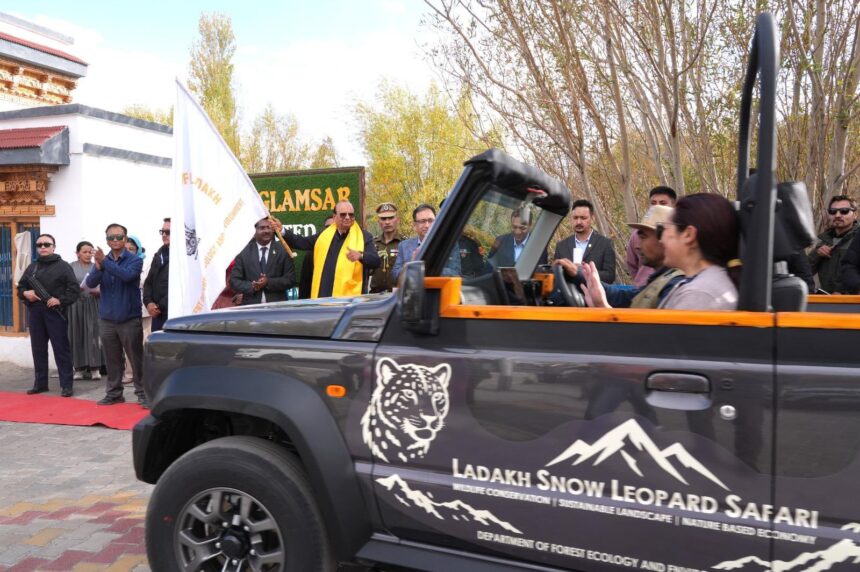
Leh: India’s first high-altitude wildlife safari in Ladakh has become a reality, with Lt Governor Vinai Kumar Saxena on Wednesday flagging off six vehicles for the safari focused on snow leopards.
This marks a major step towards promoting responsible wildlife tourism and community-based conservation in the Union Territory, while creating sustainable livelihood for the local youth and communities, a Lok Bhavan spokesman said.
He said the decision to introduce wildlife safari in Ladakh was announced on August 5 this year and the same has been executed in just two months.
This initiative by the LG is being conducted by the Snow Leopard and High-Altitude Nature Conservation (SHAN) Society, in collaboration with the Department of Forest, Ecology and Environment, UT Ladakh, the spokesman said.
He said the vehicles will initially operate in identified areas like Rumbak, Shang and Uley, where snow leopards are frequently sighted. This will provide the visitors with rare guided opportunity to witness Ladakh’s distinctive flora and fauna.
Specially designed open-back vehicles, trained local drivers and wildlife guides will be deployed, with suitable routes being identified across Hemis National Park, Changthang and Karakoram Wildlife Sanctuary, besides Nubra, Zanskar, Sham, Kargil and Drass districts, the spokesman said.
He said the objective behind introducing guided safaris is to prevent the incidents of illegal off-roading and disturbing wildlife, besides strengthening sustainable and responsible eco-friendly tourism and enhancing visitor experience.
It envisages a unique model of environment conservation in Ladakh, wherein the government alone will not be responsible for environment protection but the local communities will be made active partners in protecting Ladakh’s fragile ecosystem and wildlife, he said.
The spokesman said this will instil a sense of custodianship among the people, while creating sustainable livelihood opportunities for them.
Emphasising that the initiative is not merely about increasing tourism, LG Saxena said the safari is designed to make wildlife tourism responsible, regulated and compatible with conservation.
“Regulated visitor numbers, approved routes and trained local personnel will help minimise disturbance to wildlife while creating direct livelihood opportunities for local communities.
“Wildlife should not be protected at the cost of people, nor should development come at the cost of wildlife. We must create a model in which both can thrive together,” the LG said.
Saxena said a local guide earning from a snow leopard sighting, a woman earning through conservation-linked handicrafts and a village benefiting from protecting its wetland, are examples of how conservation can become an economic opportunity.
Ladakh has the country’s largest snow leopard population, with 477 snow leopards out of an estimated national population of around 718. The region is also home to more than 38 mammal species, over 340 bird species and around 1,800 vascular plant species.

