



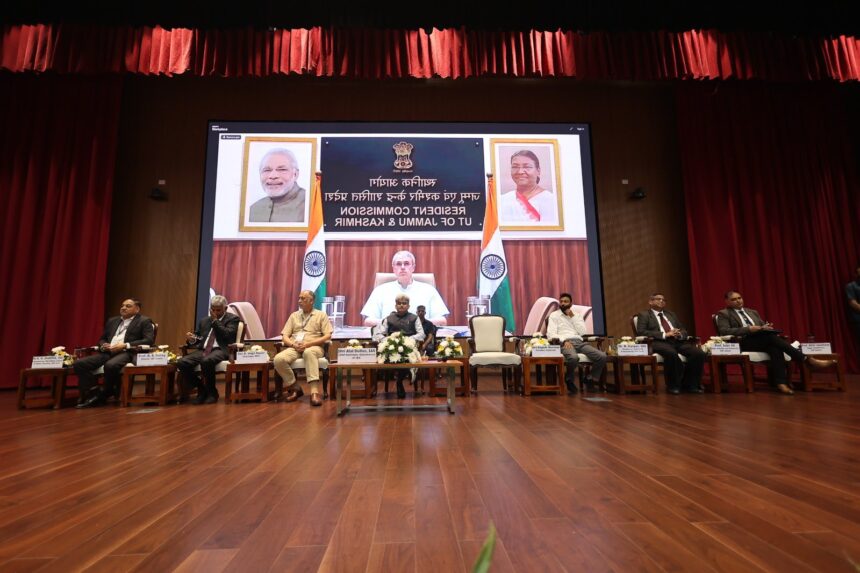
Jammu: Jammu and Kashmir Chief Minister Omar Abdullah on Friday said the Union Territory’s perception problem was a legacy issue of the past three decades and invited companies to set up global capability centres (GCCs) in the Union Territory.
Omar was speaking while virtually addressing a two-day J&K global capability centres summit 2026 organised by the Indian Institute of Management (IIM) Jammu, in collaboration with the Jammu and Kashmir government and Nasscomm as knowledge partner.
Recalling an interaction between former chief minister Mufti Mohammad Sayeed and Infosys founder N R Narayana Murthy at an investment event organised by NASSCOM in Srinagar during 2002-2005, Omar said the latter had then linked investment to peace and stability in the region.
“Mufti Sahib, in his speech, told Narayan Murthyji that now that you are here, please set up something of Infosys in J&K. And Narayan Murthy Sahib replied… you give me six days of peace and calm and on the seventh day I’ll come and invest,” Omar said while addressing a workshop on GCCs virtually.
“Thankfully today, we don’t count our periods of calm in days, we don’t count them in weeks, we don’t even count them in months. I think it’s safe to say that we count them in blocks of years,” he said.
Omar said the success of creating a business-friendly environment should not be measured by the number of centres established immediately, but by the beginning of a sustainable investment journey.
Acknowledging the perception challenges facing Jammu and Kashmir, the CM said these were rooted in the region’s past and not its present, adding that the government was making efforts to change the narrative through economic development and investment.
He said J&K could learn from the experiences of other regions and use its late entry into the GCC sector to its advantage.
Drawing a parallel with the evolution of railway services in India, he said Jammu and Kashmir had entered the railway network with the Vande Bharat trains, bypassing earlier stages of development.
“Coming late to the party is disappointing, but it’s not always disadvantageous. We can learn from the experiences of others. We don’t have to reinvent the wheel. We just have to use it better,” he said.
“Truth be told, I wouldn’t measure the success of this GCC workshop with suddenly having a hundred GCCs. We’d be quite happy to have one. One will lead to five, five will lead to ten, and the story will grow from there,” he said.
Omar said Jammu and Kashmir wanted investors to choose the region on the basis of its economic potential and business competitiveness rather than sympathy over its difficult past.
He said Jammu and Kashmir was not in a position to compete immediately with established IT hubs such as Hyderabad, Bengaluru, and Chennai, but could explore opportunities to attract GCC investments in competition with tier-II and tier-III cities such as Jaipur, Pune, and Mohali.
He said the Union Territory had inherent advantages, including a network of reputed educational institutions that produce talented young people with a strong academic foundation.
Institutions such as IIT Jammu, Shri Mata Vaishno Devi University, the University of Jammu, the University of Kashmir, and the Islamic University of Science and Technology were producing talented youth, he said.
However, due to a lack of adequate opportunities, many of these young people were compelled to seek employment in the GCC sector outside Jammu and Kashmir, he added.
Omar said attracting GCCs could help create local employment opportunities and retain talent within the Union Territory.
Meanwhile, Chief Secretary Atal Dulloo said the Jammu and Kashmir government is open to additional policy changes to create a stable, predictable policy ecosystem for Global Capability Centres (GCCs) and emerging technologies.
Dulloo asserted that the government seeks to position the Union Territory as a competitive destination for future-oriented businesses.
Addressing a two-day workshop on GCCs, Dulloo said the government aimed to develop a clear roadmap to attract investment, generate employment, and strengthen the technology ecosystem in Jammu and Kashmir.
“If it is felt necessary that for this segment, like GCC and emerging technologies, we need some additional legislation, the government will definitely consider how to make a permanent policy ecosystem available, so that the issue of predictability does not arise again”, he told industry players at the GCC here.
He said the existing single-window system facilitates principal approvals required for setting up GCCs, while the government would continue to improve the predictability and timelines of these processes.
“Jammu and Srinagar have industrial estates and IT space, and the government would work to meet industry requirements regarding locations, floor space, infrastructure specifications and timelines”, he said.
Dulloo said a Centre of Excellence for Artificial Intelligence had recently been established in partnership with IIT Jammu, with approval from the Ministry of Electronics and Information Technology. An IT and future technologies park is also being developed in three phases, with work on the first phase already started, he added.
Referring to the draft GCC policy, the chief secretary said it offered an opportunity to incorporate practical industry experience and lessons from other GCC destinations instead of adopting a purely theoretical framework.
He said the policy should support investment and employment while remaining aligned with Jammu and Kashmir’s sustainable development requirements.
He urged industry representatives to provide frank feedback on Jammu and Kashmir’s strengths and the gaps that could influence corporate boards’ decisions on locating their GCCs in the Union Territory.
Describing the summit as the beginning of sustained government-industry engagement, Dulloo said the administration was ready to listen, learn and adapt to industry requirements to make J&K genuinely ready for GCCs.
He said GCCs were evolving from conventional support centres into enterprise value-creation hubs and, increasingly, innovation hubs, with artificial intelligence and other emerging technologies playing a crucial role in shaping their future.
Citizens seek overhaul of Ease of Doing Business Act
Srinagar: A group of citizens from Jammu and Kashmir on Friday appealed to the government to revisit the recently passed amendments to the Ease of Doing Business Act.
The amendments, passed in the recent autumn session of the J-K Legislative Assembly, replace permission-based control with rule-based governance. This change enables citizens and enterprises to plan, invest, and work with confidence, fostering Ease of Doing Business and Ease of Living in a manner that generates employment, attracts investment, and sustains long-term economic growth in the Union Territory of J-K.
Speaking to reporters here, Khursheed Ahmad Ganai, chairman of the Group of Concerned Citizens (GCC), said the Act is not practical, has several “deficiencies”, and should be revisited.
“The Ease of Doing Business Act 2026 of Jammu and Kashmir has several deficiencies. First, it professes objectives of ease of living and ease of doing business. Now, let us say for ease of doing business, this Act has been made, but ease of living is just not possible to be achieved with this kind of an Act,” Ganai said.
He said any law that makes “living difficult” for one crore forty lakh people and makes business easy for a “small section” of people, “is not a good law at all”.
“I can tell you that even responsible business people will not like this law, because it is almost making business free for all; anybody can do anything. The developmental controls, the overall rest of the laws which are there in this state have been almost nullified,” he said.
Ganai said the law “needs to be revisited”.
“It has to be done again, and it has to be overhauled in a very substantial way,” he said. He appealed to the government to review the Act again and “to seriously consider amending this law”.
Ganai said the Act could turn the entire UT into a concrete jungle “because all this facilitation of setting up enterprises is available for the entire UT”.
“We have little land, very little land for agriculture, horticulture. We have difficult topography. The available plain area, let us talk about the valley, is two hundred miles by fifty miles. With this limited plain area in the valley and the hilly and mountainous nature of our UT, we face a very difficult situation.
“This law is not doable; it is not practicable. If it is made practicable, it will create a lot of problems for the common people of Jammu and Kashmir,” the retired bureaucrat said.
The GCC said it supports genuine Ease of Doing Business (EoDB), simpler procedures, less duplication, digital processing, single-window clearances, time-bound decisions, and predictable regulation.
The EoDB should remove procedural friction; it should not remove substantive planning safeguards, it said.

