



Atiya Mujeeb
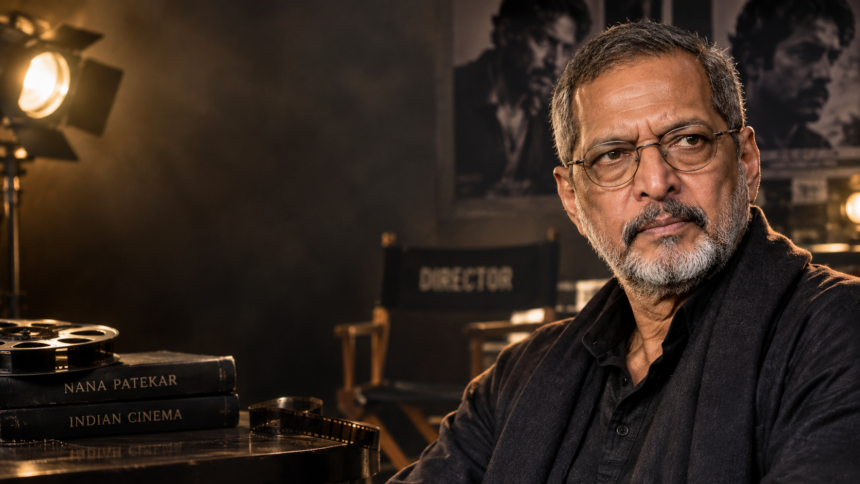
Jmmu, October 8: Nana Patekar, one of Indian cinema’s most recognisable actors, died in Goa on Thursday morning at the age of 75, bringing to a close a career built not on conventional stardom but on powerful performances, an unmistakable voice and characters that often carried an edge.
Patekar died at around 5:20 am after suffering cardiac arrest at his residence in Dona Paula, according to reports. He was taken to Manipal Hospital after being found unconscious, where doctors attempted resuscitation for around 45 minutes. A post-mortem was ordered as part of the medico-legal procedure.
His death marks the end of a career spanning more than four decades across Hindi and Marathi cinema, theatre and filmmaking.
An unconventional beginning
Born Vishwanath Patekar in Maharashtra, Nana Patekar came to cinema through theatre rather than the traditional Bollywood route. He made his film debut with Gaman in 1978 and gradually built a reputation for taking on demanding and unconventional roles.
Unlike many mainstream stars, Patekar rarely depended on glamour or a conventional hero image. His performances were driven by voice, body language, pauses and an ability to make even a short scene feel intense.
The roles that established him
His breakthrough came with films such as Parinda, where his performance earned him the National Film Award for Best Supporting Actor.
He went on to win the National Film Award for Best Actor for Krantiveer and another Best Supporting Actor award for Agni Sakshi. His filmography also included Salaam Bombay!, Ab Tak Chhappan and Apaharan, among others.
The roles varied, but there was a common thread: Patekar often played men under pressure, caught between anger, morality, violence or difficult personal choices.
Then came Uday Shetty
Perhaps the biggest surprise in his career was his transformation from an actor associated with intense drama into a hugely popular comic performer.
As Uday Shetty in Welcome, Patekar turned a gangster character into one of Hindi cinema’s most memorable comic figures. His chemistry with Anil Kapoor and his sharply timed delivery made the character a favourite with mainstream audiences.
The role demonstrated something critics had long recognised: Patekar’s range extended well beyond the serious, aggressive characters that had defined much of his earlier career.
Theatre remained part of his identity
His Marathi work remained equally important. In Natsamrat, Patekar played Appasaheb Belwalkar, a retired stage actor struggling with ageing, family relationships and the loss of his place in the theatrical world.
The role was particularly significant because it brought together Patekar’s own theatre background and a character whose life revolved around acting.
Beyond acting
Patekar was also a director and writer. He directed and starred in Prahaar: The Final Attack, adding another dimension to a career that had already moved between theatre, Marathi cinema and Bollywood.
His public life also included social work. Through the Naam Foundation, which he helped establish with actor Makarand Anaspure, he was involved in efforts supporting farmers and drought-affected rural communities in Maharashtra.
In 2013, Patekar was awarded the Padma Shri for his contribution to the arts.
His final hours
Reports from Goa said Patekar had complained of feeling unwell during the early hours of Thursday. A friend reportedly received a message from him at around 2:30 am saying he was experiencing pain on his left side.
He was later found unconscious at his residence. Medical assistance was called and CPR was administered before he was taken to hospital. Despite continued efforts by doctors, he could not be revived and was declared dead at around 5:20 am.
A career that defied categories
Patekar’s legacy lies partly in his refusal to remain in one box.
He was a theatre actor who became a film star, a performer equally at home in Marathi and Hindi cinema, and an actor who could move from Krantiveer to Welcome without losing his identity.
For audiences, his voice, expressions and distinctive delivery became instantly recognisable. For Indian cinema, he leaves behind a body of work that showed that screen presence does not always require glamour or conventional heroism.
Nana Patekar did not build his career by fitting the Bollywood mould. He built it by making the mould less important.

