



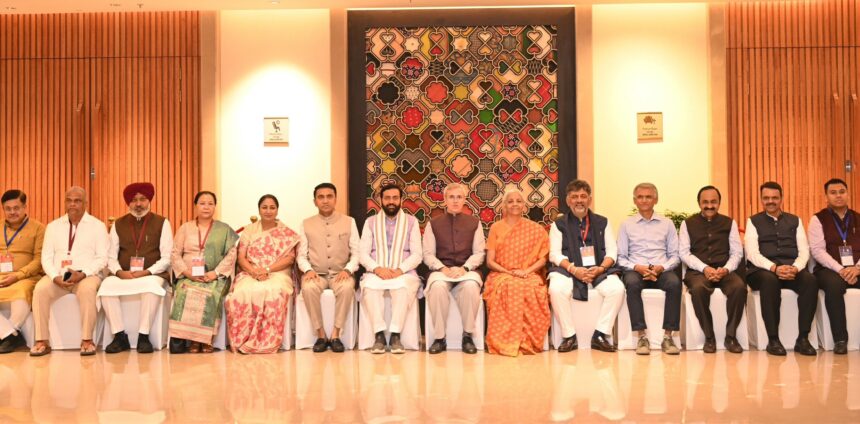
New Delhi: The GST Council on Thursday approved a sweeping overhaul of tax administration, removing GST officers’ power to arrest taxpayers, raising the threshold for criminal prosecution to Rs 5 crore, and providing a faster 3-day refund for most claims.
The council has approved an easier process for small suppliers to register on e-commerce platforms. This includes a simplified procedure for making changes to GST registration, a reduction in penalties, and the establishment of a committee of officials to address the transition towards invoice matching for input tax credit claims.
A Committee of Officers, expected to submit its report within 3 months, will examine the issue of protecting a genuine buyer who holds a proper invoice, has received the goods and has paid his supplier in full.
Also, the council has approved a Rs 10,000 threshold for serving GST notices.
Addressing reporters after the 57th GST Council meeting, Sitharaman said the process reform under GST 2.0 has been driven by the principle of trust and is part of the ‘Reform Express’ under Prime Minister Narendra Modi.
The process reforms will be implemented from April 1, 2027.
“Business has to be trusted. Taxpayers have to be trusted. And businesses among themselves with trust if they do it, we shouldn’t be too intrusive…In GST next gen reform, 99 per cent issues have been addressed, (both in) rate or process,” Sitharaman said.
The Council, chaired by Sitharaman and comprising her state counterparts, met after a little over a year since the tax rate rationalisation.
GST rates have settled, and revenues are growing with stability despite the rate changes announced last year, she said.
Announcing the second set of reforms under GST policies, Sitharaman said she expects process reforms, announced on Thursday, to take one year to stabilise.
Sitharaman said the Council agreed on faster refunds, wherein the acknowledgement period will come down from 15 to 10 days.
If neither an acknowledgement nor a deficiency memo is issued in 10 days, the claim is treated as acknowledged.
“Based on risk assessment, it is expected that the system will sanction 90 per cent of all the claims within 3 working days of acknowledgement,” Sitharaman added.
So, refunds will become automatic and enhance working capital for businesses, she added.
The minister said the Council approved a concept note on an optional scheme for businesses with a turnover of up to Rs 5 crore, supplying only to consumers. This will entail filing only one annual return with quarterly tax payments.
The detailed framework will come for a decision before the next Council meeting.
The package marks a significant shift in approach to indirect-tax enforcement, nearly a decade after the goods and services tax was introduced.
The removal of arrest powers is particularly significant. Under the existing Central GST Act, Section 69 allows the Commissioner, subject to specified conditions, to authorise a central tax officer to arrest a person suspected of certain offences.
The change effectively separates tax recovery from personal liberty. Tax authorities will continue to assess and recover tax, interest and applicable penalties, but an ordinary tax dispute will no longer expose a taxpayer to arrest at the investigation stage.
The enforcement overhaul is also part of a wider push to make GST administration increasingly faceless and technology-driven, reducing direct interaction between taxpayers and individual tax officers.
The shift is intended to reduce discretion, improve consistency across jurisdictions and limit the scope for unnecessary interaction between taxpayers and officials.
For businesses, the move could mean that GST compliance becomes less dependent on the approach of individual officers and more closely tied to data generated through returns, invoices, e-way bills, input-tax-credit claims and other digital records.
The decisions represent a significant change from the enforcement architecture created when GST was launched in July 2017.
Another key recommendation of the Council was that input tax credit will now be available on health and life insurance taken for employees.
The credit will also be available on telecommunication towers and on pipelines laid outside a factory, both of which are large items for those sectors.
The Council also recommended input credit on free samples, and on stock written off on expiry of shelf life where a law requires the goods to be destroyed.
On goods in transit, the Council recommended that a vehicle should be stopped only on specific intelligence, and the decision to stop must be authorised in advance by an officer not below the rank of Joint Commissioner.
Only the State the goods started from (source state) and the destination state may inspect the goods moving in a conveyance.
States along the route will not be able to stop the conveyance.
The Finance Minister further said that the Central Board of Indirect Taxes and Customs (CBIC) is working to implement a centralised assessment system for about 2 lakh taxpayers registered under central GST jurisdiction but having businesses in multiple states by April 1.
Currently, there are about 69.5 lakh taxpayers exclusively in CGST jurisdiction. Amongst those, about 2 lakh are under multiple CGST jurisdictions either within one state or across different states.
“Going forward, we intend to bring a centralised tax administration for these multiple CGST jurisdiction taxpayers with a unified window for all their CGST-related functions,” she said.
Stressing that the process reforms under the next-generation GST framework are expected to stabilise over the next one year, Sitharaman said the changes will improve ease of doing business while ensuring stable revenue for the Centre and states.
Sitharaman said tax rate reduction effected last year had not resulted in any loss of revenue, with collections growing steadily and becoming less dependent on festival months.
Meanwhile, Prime Minister Narendra Modi on Thursday welcomed the new round of GST reforms approved by the GST Council and said its focus was to take faster decisions, lower compliance costs and automated refunds.
The prime minister also said that the GST Council’s recommendations on removal of arrest provisions, greater decriminalisation and simpler procedures will have a very positive impact.
The GST Council on Thursday approved removing the arrest power of tax officials and raising the threshold for prosecution fivefold to Rs 5 crore, while introducing faster and largely automated refunds for taxpayers.
“I welcome the new round of GST reforms approved by the GST Council,” Modi said in a post on X.
“The focus is clear: Faster decisions. Lower compliance costs. Automated refunds. Trust-based administration,” he said.
Modi said these are in line with the government’s constant efforts to make GST more efficient, transparent and citizen-friendly.
Announcing the decisions taken at the 57th meeting of the GST Council, Finance Minister Nirmala Sitharaman said it also decided to bring down the general penalty from Rs 25,000 to Rs 10,000.
- GST 2.0 reforms to take effect from April 1, 2027
- Arrest powers of GST officers to be removed
- Criminal prosecution threshold raised to ₹5 crore
- 90% refunds targeted within 3 working days
- Refund acknowledgement period cut to 10 days
- ₹10,000 minimum threshold for GST notices
- Easier GST registration for small e-commerce suppliers
- Registration amendment process to be simplified
- Penalties under GST to be reduced
- Buyer protection on genuine ITC claims to be examined
- Quarterly tax payments for businesses up to ₹5 crore
- One annual return proposed for small businesses
- ITC allowed on employee health and life insurance
- ITC extended to telecom towers and outside-factory pipelines
- ITC proposed on free samples
- ITC proposed on expired stock required to be destroyed
- Goods in transit to be stopped only on specific intelligence
- Prior approval of Joint Commissioner required for transit checks
- Route states barred from stopping goods in transit
- Centralised GST assessment planned for 2 lakh taxpayers
- Unified window proposed for multi-state CGST taxpayers
Decisions will strengthen J&K’s fiscal position: CM
Jammu: Chief Minister Omar Abdullah on Thursday attended the 57th meeting of the Goods and Services Tax (GST) Council in New Delhi and expressed confidence that its decisions would strengthen Jammu and Kashmir’s fiscal position, boost economic growth and accelerate development.
The meeting, chaired by Union Finance and Corporate Affairs Minister Nirmala Sitharaman, was attended by Chief Ministers and Finance Ministers from across the country, besides senior officials of the Union Ministry of Finance.
According to an official statement, the Council held detailed deliberations on key GST-related issues, focusing on strengthening the fiscal capacity of states and Union Territories, improving revenue mobilisation and promoting balanced fiscal federalism.
Omar Abdullah, who attended the meeting in his capacity as Finance Minister of Jammu and Kashmir, expressed optimism over the outcome of the deliberations.
He said the decisions taken by the Council would help strengthen Jammu and Kashmir’s financial position while supporting economic growth, development initiatives and public welfare.
The meeting also provided a platform for discussions on measures aimed at improving revenue generation and strengthening fiscal coordination between the Centre, states and Union Territories.
The Chief Minister expressed confidence that the Council’s decisions would contribute to Jammu and Kashmir’s economic development and help advance public welfare initiatives across the Union Territory.

