



By Bharat Nanda
Pakistan’s latest attempt to rewrite the story of Operation Sindoor would perhaps make an interesting exercise at the Command and Staff College in Quetta. As an account of what actually happened in May 2025, however, it leaves rather more to be desired.
The statement issued by Pakistan’s Inter-Services Public Relations on 17 August, attacking the documentary on Operation Sindoor as a “Bollywood-style” reconstruction of events, is revealing. ISPR argues that India is attempting to transform a military setback into a victory and has once again advanced claims about Indian aircraft losses and Pakistan’s supposed operational superiority.
There is, of course, nothing unusual about two adversaries presenting very different accounts of a military confrontation. Information operations are now inseparable from warfare. But narratives must eventually confront chronology, targets, actions and consequences.
And the chronology of Operation Sindoor is difficult to wish away.
It began in Pahalgam.
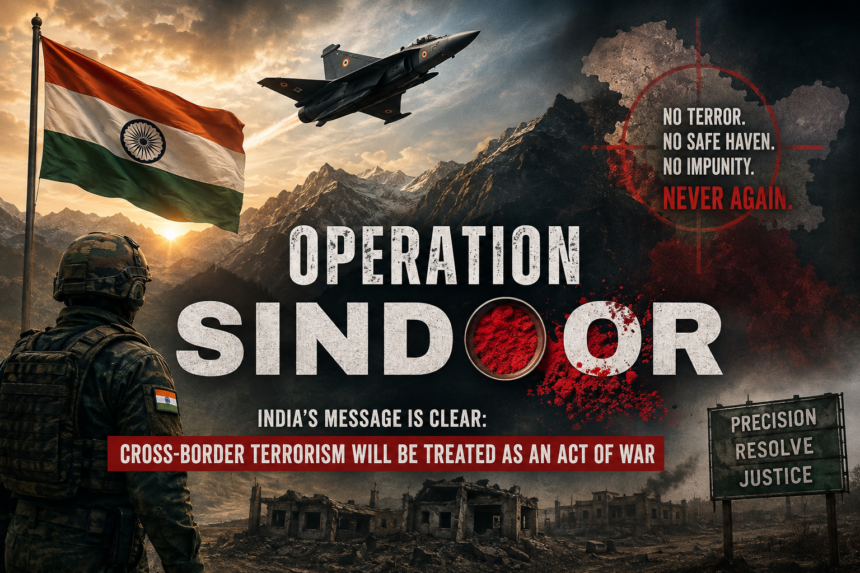
On 22 April 2025, terrorists murdered 26 people, including 25 Indians and one Nepali citizen. India subsequently launched Operation Sindoor during the night of 6-7 May. Nine terrorist facilities in Pakistan and Pakistan-occupied Jammu and Kashmir were targeted. Importantly, India announced at the very beginning that Pakistani military installations had deliberately not been attacked and described the action as focused, measured and non-escalatory.
Among the targets were major Lashkar-e-Taiba and Jaish-e-Mohammed facilities. Subsequent Indian government assessments stated that more than 100 terrorists, trainers, handlers and associates were killed in the strikes.
That distinction is important because it demolishes one of the central elements of the Pakistani narrative. India did not begin the confrontation by attacking the Pakistan Army, Pakistan Air Force or Pakistani population. The opening move was directed at terrorist infrastructure.
Only after Pakistan responded militarily with drones, missiles and other attacks did the confrontation widen. Indian official accounts state that integrated air defence systems intercepted incoming drone and missile threats and that India subsequently struck Pakistani military infrastructure.
Pakistan has continued to claim that it shot down eight Indian military aircraft. ISPR repeated the assertion while attacking the documentary. Such claims are naturally part of the continuing information contest surrounding the conflict, but they cannot by themselves establish the overall operational outcome.
More importantly, the purpose of Operation Sindoor was never merely to hunt down the individual gunmen who walked through Baisaran and murdered civilians.
It was to strike the ecosystem that made attacks of this nature possible.
That distinction became even clearer in July 2025. In Operation Mahadev, Indian security forces killed three terrorists whom the Government of India identified as being involved in the Pahalgam attack. Operation Sindoor and Operation Mahadev were therefore not contradictory operations. They represented two different levels of response: one against the infrastructure and organisations enabling terrorism, the other against the men accused of carrying out the massacre itself.
The military confrontation ended on 10 May following communication between the Directors General of Military Operations. But Operation Sindoor produced something more consequential than four days of exchanges between two nuclear-armed neighbours. It announced a change in India’s threshold for responding to terrorism.
The message was straightforward: geography would no longer automatically provide immunity to terrorist infrastructure simply because it existed across the Line of Control or deeper inside Pakistan.
That is why the argument over Operation Sindoor continues more than a year later. It is not merely an argument about aircraft, missiles or damage assessments. It is an argument about deterrence.
And this is where Pakistan’s institutional history becomes relevant.
ISPR has long understood that the management of perception is an important component of Pakistan’s national-security architecture. The wars of 1965 and 1971, the Kargil conflict of 1999 and the long proxy conflict in Jammu and Kashmir have all generated competing Pakistani military narratives that frequently differ sharply from Indian and international interpretations of the same events.
Operation Sindoor has simply entered that long-running contest over memory.
But there is another dimension to the story that deserves greater scrutiny: the remarkable political trajectory of Pakistan’s Army Chief, Asim Munir, before and after Pahalgam.
Six days before the attack, on 16 April 2025, General Munir addressed a gathering of overseas Pakistanis in Islamabad. His language deserves to be revisited carefully.
He invoked the Two-Nation Theory and stressed the supposed civilisational difference between Hindus and Muslims. He also reiterated the traditional Pakistani formulation describing Kashmir as Pakistan’s “jugular vein”. Contemporary reports recorded him telling his audience that Pakistanis were a separate nation because their religion, customs, traditions, thoughts and ambitions differed from those of Hindus.
Then came Pahalgam, six days later.
Chronology is not evidence of operational direction, and serious analysis should resist the temptation to convert political rhetoric into proof of an order for which no credible public evidence has emerged.
But the sequence cannot simply be dismissed as irrelevant either.
When the commander of Pakistan’s most powerful institution publicly revives an explicitly religious conception of separation from Hindus, places Kashmir at the centre of that ideological argument, and a few days later terrorists carry out an attack in Kashmir in which civilians are targeted, the ideological environment deserves examination.
The legitimate question is therefore not whether Munir’s speech constitutes proof that he ordered Pahalgam. It does not.
The more important question is what kind of strategic ecosystem is created when the leadership of a nuclear-armed military establishment continues to frame India, Kashmir and religious identity through precisely this vocabulary.
The events that followed are equally striking.
On 20 May 2025, barely ten days after the fighting stopped, Pakistan’s government promoted General Munir to Field Marshal, making him only the second Pakistani military officer to hold the five-star rank after Ayub Khan. The government explicitly linked the promotion to his leadership during the confrontation with India.
The institutional consolidation did not stop there.
Pakistan’s 27th Constitutional Amendment subsequently restructured the country’s military command. The office of Chairman Joint Chiefs of Staff Committee was abolished and strategic military authority was vested in the newly created Chief of Defence Forces. Munir eventually became Pakistan’s first CDF while concurrently remaining Army Chief. The accompanying legal changes effectively restarted the tenure attached to the new appointment, further consolidating military authority in one office.
Seen from this perspective, the domestic political consequences of the 2025 confrontation become difficult to ignore.
The crisis strengthened the very institution that has dominated Pakistan’s political life for much of its history. Reuters reported immediately after the conflict that Munir’s domestic standing had surged and that the episode had reinforced the military’s dominance after a period of significant criticism.
This provides an important context for understanding why the narrative of Operation Sindoor remains so fiercely contested in Pakistan.
If the confrontation with India became part of the political justification for elevating the Army Chief to Field Marshal and was followed months later by an extraordinary consolidation of military command, then maintaining the narrative of an overwhelming Pakistani victory is no longer merely a matter of military prestige.
It has domestic institutional significance.
That is what makes the latest ISPR statement interesting.
Pakistan is entitled to dispute India’s account. India is equally entitled to present its evidence and operational assessment. Historians will eventually have access to far more information than either side is willing to release today.
But some facts are already difficult to dispute.
Twenty-six people were murdered at Pahalgam.
India responded by striking nine terrorist facilities across Pakistan and Pakistan-occupied Jammu and Kashmir.
The first Indian strikes deliberately excluded Pakistani military installations.
The confrontation expanded after Pakistan responded militarily.
More than two months later, the terrorists identified by India as the Pahalgam attackers were killed in a separate security operation.
And within days of the May confrontation, Pakistan’s Army Chief became Field Marshal before subsequently accumulating still greater institutional authority.
Those facts deserve more attention than adjectives about documentaries.
India’s larger message after Operation Sindoor has also remained consistent: it seeks peace, but peace cannot coexist indefinitely with cross-border terrorism.
Operation Sindoor should therefore not be understood simply as a four-day military episode that concluded on 10 May 2025. In India’s strategic formulation, it represents a standing doctrine whose future application depends substantially on what happens across the border.
There is no contradiction between restraint and deterrence. Restraint means choosing not to use force unnecessarily. Deterrence means ensuring that an adversary understands what will happen if certain lines are crossed.
India demonstrated the first when it deliberately avoided Pakistani military targets during the opening strikes of Operation Sindoor. It demonstrated the second when the confrontation expanded after Pakistan chose to respond militarily.
That remains the central lesson beneath all the competing documentaries, press releases and television debates.
Pakistan can contest India’s account of Operation Sindoor. It can produce its own documentaries. ISPR can issue as many rebuttals as Rawalpindi considers necessary.
But strategic narratives ultimately survive only when they correspond sufficiently with observable reality.
For India, the message emerging from May 2025 is therefore less theatrical and considerably simpler: peace remains the preferred condition, but terrorist violence originating from across the border will no longer be protected by assumptions of geographical sanctuary or escalation immunity.
Operation Sindoor may have paused on 10 May 2025.
The doctrine behind it has not.
The author is a technology professional, geopolitical analyst, newspaper columnist and author based in Jammu. He can be reached on [email protected] and x.com/bharatnanada_

