



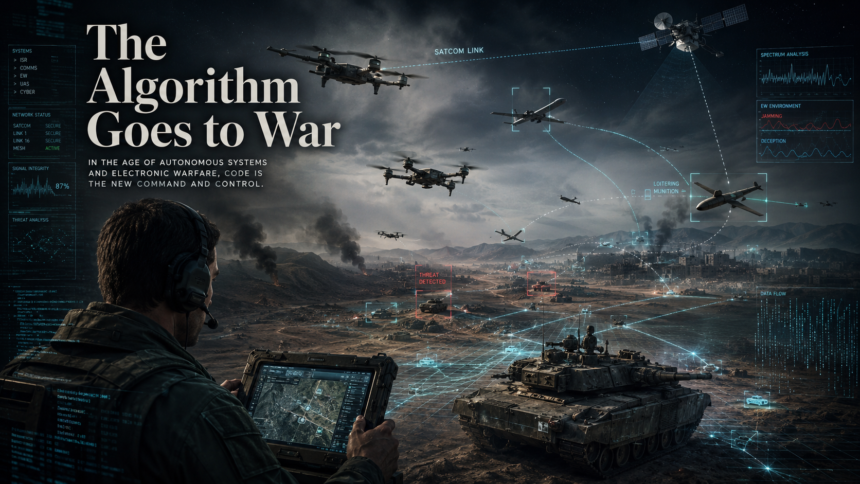
Why the next great power conflict may be won by whoever writes the better code, not just who fields the bigger army
Neeraj Tickoo
There is an old joke among soldiers that wars are planned by generals who studied the last one. It used to be a joke about tanks and trenches. Today it is fast becoming a joke about satellites and software. Because somewhere over the last four years, the character of warfare has quietly begun to change. Command still rests where it always has — with trained officers and soldiers making difficult decisions under pressure. But increasingly, the tools in their hands are being built by engineers and coders working almost as fast as the war itself moves, and that is reshaping what those decisions look like on the ground.
That is not hyperbole. It is the plainest lesson of recent conflicts, from Eastern Europe to the Middle East to the tense waters of the Indo-Pacific. And it should interest every strategist, every defence planner, and frankly every citizen who still imagines war as something fought only at a distance, with clean lines between the front and everywhere else.
Consider the arc of change. For most of modern history, the story of warfare was the story of mass and metal — more soldiers, bigger guns, thicker armour. Even in the large-scale conventional wars of the late twentieth century, the underlying grammar of combat was industrial: armoured columns, air superiority, artillery duels. Precision existed, but it was expensive, rare, and reserved for the most consequential targets, and it still depended entirely on the skill of the crews operating that equipment.
Compare that to a battlefield today where a low-cost quadcopter, flown by a trained operator using a live video feed, can disable an armoured vehicle worth many times its price. The economics alone are striking. It takes real skill to fly one of these systems accurately under fire, and militaries around the world are now investing heavily in training soldiers for exactly this new, highly technical role — it is a new soldiering skill, not an absence of one.
The deeper shift, though, is not the drone itself. It is the layer of software increasingly built into it. Navigation systems that can find a target even when satellite signals are jammed. Tools that help operators spot and classify threats faster than the human eye alone could manage. Groups of unmanned aircraft that can coordinate with each other and adjust course around interference, under the direction of the humans still commanding the mission. The fog of war has not vanished — but it is being thinned out, unevenly, by better information reaching the people making decisions.
Here is the part worth sitting with. Every major military power watching recent conflicts has drawn a similar conclusion: large numbers of relatively low-cost, expendable unmanned systems now matter alongside a handful of very advanced, very expensive platforms. A single top-end fighter jet can be extraordinarily capable, but it is also a single point of failure if it can be located and targeted quickly. A large, well-coordinated fleet of cheaper drones is harder to fully counter and far less costly to lose. This is why defence planning across major powers — including in our own neighbourhood — is quietly reorganising itself around a new industrial question: not just who can build the single best weapon, but who can produce autonomous systems at scale, season after season, while adapting faster than the other side can counter them.
That, geopolitically, is the real story, and it should unsettle policymakers more than it currently seems to. Capabilities that once required the full industrial base of a nation-state are increasingly within reach of smaller states and even well-resourced non-state groups, using commercially available parts and widely accessible software. The threshold for causing serious harm has fallen, and it continues to fall.
None of this is one-sided. For every new unmanned strike system, there is an equally urgent effort to jam it, spoof it, or shoot it down — and that contest is arguably where the sharpest military thinking is happening right now. Electronic warfare, once a specialised corner of defence planning, has become as central to modern conflict as artillery once was. Forces that can protect their own drones from being blinded, while blinding an adversary’s, hold an advantage that raw firepower alone cannot easily replace. Drones have not replaced the older tools of war so much as added an entirely new, largely invisible contest of signals and sensors on top of them.
It would be comforting to treat all this as a distant, technical story — something for defence contractors and think tanks to debate. It is not. The growing role of autonomous and semi-autonomous systems raises questions that democracies have barely begun to answer properly. How much of a targeting decision should be assisted by a machine, and how much must always remain with a human in the loop? What happens to deterrence when the cost of launching a strike falls low enough that restraint becomes harder to justify on purely economic grounds? And what does security mean for nations that cannot yet compete in this new contest of drones and code, but will still live in a region shaped by those who can?
For India, positioned in a neighbourhood where more than one country is investing seriously in exactly this kind of capability, these are not academic questions. They are strategic ones, and they are arriving faster than most policy conversations are currently built to handle.
War, as the old saying goes, is politics by other means. What is changing is not that principle, but the tools through which it plays out — from the rifle, to the tank, to the missile, and now to something quieter and harder to see coming: systems that help human commanders act with a speed and precision that was simply not possible a generation ago. That much is not speculation. It is already happening, in conflicts unfolding right now. The open question is who sets the rules for how far this goes — and whether the world still has time to do that thoughtfully.
Neeraj Tickoo is an AI-focused technology professional with over two decades of experience. He is also an author and a keen follower of geopolitics.
