



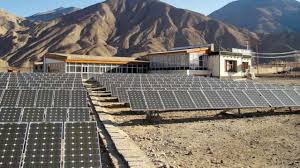
Sluggish performance
J&K also lags behind, produces just 11 MUs solar energy since 2020; implementation gaps hits generation
Arteev Sharma
Jammu: It may sound bizarre, but it’s a reality that Ladakh, which is considered as solar capital of the country, has not produced even a single unit of solar power over the last five years, despite its immense potential and favourable climatic conditions.
Jammu and Kashmir too has fared poorly, generating just 11.13 million units (MUs) of solar energy between March 2020 and June 2025, with no generation reported in the last three years.
This dismal performance was disclosed by Union Minister for New and Renewable Energy, Shripad Yesso Naik, in response to a query raised by Telugu Desam Party (TDP) Rajya Sabha MP Sana Sathish Babu today.
The minister admitted that Ladakh recorded zero solar power generation from 2020-21 to 2024-25, raising serious concerns over the implementation and efficacy of renewable energy projects in the Union Territory.
The figures are even more baffling considering the aggressive push by the central government to harness renewable energy. Flagship initiatives such as the PM-Surya Ghar Muft Bijli Yojana, which aims to provide up to 300 units of free electricity per month to one crore households through rooftop solar panels, and other schemes for setting up ultra-mega solar parks, have so far failed to yield results in the two UTs.
Ladakh, with a solar power potential of over 60,000 MW, was expected to play a major role in India’s renewable energy roadmap. The region, which receives some of the highest solar radiation in the country, was sanctioned two mega solar power projects with a combined capacity of 7,500 MW, later revised to 10,000 MW. However, as of June 2025, not even a single unit of electricity has been generated from these projects.
On the other hand, Jammu and Kashmir generated just 11.13 MUs of solar power, with 9.42 MUs produced during 2020-21. No output was recorded in the subsequent years. The Ministry of New and Renewable Energy (MNRE) has released nearly Rs 64 crore to J&K under various solar schemes, but progress has remained sluggish.
The Solar Energy Corporation of India (SECI) had floated tenders in December 2018 for the development of these projects in Leh and Kargil, with a stipulated completion time of 48 months. Despite the sanctioned projects and availability of funds, implementation appears to have hit a roadblock.
The government has also rolled out other key initiatives like the National Programme on High Efficiency Solar PV Modules under the Production Linked Incentive (PLI) scheme and the PM-KUSUM scheme aimed at decentralizing solar energy for agriculture. Under PM-KUSUM Component C, Andhra Pradesh was allocated 1 lakh solar pumps and has issued Letters of Award (LOAs) for 470 MW, though installation is still pending.
Sources claimed that the lack of tangible results in both Ladakh and J&K clearly indicates the implementation gaps and bureaucratic inertia that continue to hinder ambitious renewable energy targets

