



‘Bulldozers used without our consultation or approval; give us law & order, take it back if mishandled’: CM Omar to Centre
200 free electricity units for consumers can only be implemented through wider metering
WAJAHAT SHABIR
SRINAGAR: Jammu and Kashmir Chief Minister Omar Abdullah on Friday said his government was facing serious limitations in delivering on key commitments due to continued interference in administrative powers, low electricity metering, and delay in restoration of statehood, even as he reiterated that the National Conference remains committed to fulfilling every promise made to the people.
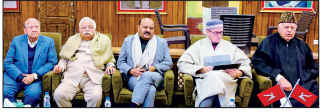
Addressing reporters after the conclusion of the two-day Working Committee meeting of the National Conference, Abdullah said the meeting reviewed the current political situation, took feedback from party MLAs and office-bearers on the performance of the government, and held detailed discussions on organisational suggestions, which, he said, would be considered and implemented.
He said the Working Committee also reviewed the election results in Budgam and Magam, adding that shortcomings, wherever identified, would be addressed through organisational decisions in the coming days.
Describing the Working Committee as a forum meant for people who understand party discipline, Abdullah said the committee is not for those who prefer to speak through the media instead of raising concerns before the party leadership. “This committee is meant for those who understand party discipline and know how to talk to the party leadership and office-bearers while remaining within that discipline,” he said, adding that every member present knew how to engage constructively within the party structure.
Raising concerns about the “limitations” of the elected government, the Chief Minister said many institutions that should be under the control of the elected government were still not with it.
He cited the Sher-i-Kashmir Institute of Medical Sciences (SKIMS), saying there were a large number of vacancies and that its functioning was suffering badly, while its files were not even reaching the elected government.
He said the Chief Minister should chair the SKIMS Managing Committee, but that was not the case.
He also said two universities — Baba Ghulam Shah Badshah University and the Islamic University of Science and Technology — which earlier had the Chief Minister as Chancellor under the Act, had not been returned to the elected government.
He further cited the Cultural Academy and the Power Development Corporation as other such institutions not under elected control, and questioned the repeated appointment of IAS officers to the post of Director, Information, which, he said, should be held by a JKAS officer.
On allegations of interference, Abdullah said the bulldozers being used for demolition drives were neither run on his orders nor by officers appointed by him. “If bulldozers have to be used, then at the very least the minister of that department should be consulted and taken into confidence. It is easy to say there is no interference, but if there is no interference, how are the bulldozers being run?” he asked.
He reiterated that neither he nor the party supported illegal occupation of government land, but cautioned against targeting a single community or area merely to defame the elected government.
On the restoration of statehood, Abdullah said the Jammu and Kashmir Reorganisation Act was not being implemented “in letter and spirit” and that the only solution was to respect separation of powers and restore statehood at the earliest. He recalled assurances given in Parliament and before the Supreme Court that statehood would be restored through a three-stage process — delimitation, elections, and restoration of statehood — and said while two stages had been completed, the third was still pending.
Rejecting any acceptance of prolonged delay, Abdullah said he refused to believe the Centre would go back on promises made in Parliament. He said if statehood was being delayed because people here did not elect the BJP, then it should be said openly.
He also rejected linking statehood with security incidents, saying if there had been any security failure, responsibility did not lie with the elected government. Referring to attacks cited as reasons for delay, he said such matters were not under the government’s domain. “When I was Chief Minister for six years, did an incident like Pahalgam or Delhi happen? Give us responsibility, and then judge us by our performance,” he said, adding that Parliament could always reverse the decision if the government failed.
On electricity supply, Abdullah said the government wanted people to get good-quality power at lower prices and asserted that metering led to lower monthly bills, especially for poor households. “For poorer families, a meter actually gives a lower electricity bill,” he said.
He said fulfillment of his promise of 200 units of free electricity depended on metering. “I need people to have meters in their homes because that is the only way I can measure 200 units,” he said, adding that with metering below 50 per cent, a majority of people were still outside its benefit.
Addressing the issue of daily wagers, Abdullah said the matter had been inherited and that no previous government had done anything beyond making promises. He said a solution was being pursued that could actually be implemented and reminded critics that the previous government in 2015 had only given assurances without delivering.
Referring to criticism over the party manifesto, he said the biggest betrayal of a manifesto was by the PDP, which sought votes against the BJP in 2014 and later joined hands with it. He said the National Conference delivered what it promised, even if it took time.
“We said we would bring a resolution in the Assembly and we did. We said we would pass a resolution in the Cabinet and we did. We said we would resolve people’s demands, and we are doing it one by one,” he said, adding that the party had asked people to judge its performance when the term ends.
On reservations, Abdullah said the Cabinet Sub-Committee had completed its report. He said a Cabinet meeting would be held and that attempts were earlier made to stall the process by claiming violation of the Model Code of Conduct. “The election is over. In the next Cabinet meeting, the concerned minister will place the memorandum and it will be discussed,” he said.
He also said no decision had been taken regarding tablet expansion at the meeting and that any step in that direction would be taken after consultation with colleagues and in accordance with party guidance.

