



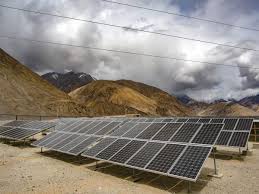
Jammu: Despite being considered as India’s solar capital with an estimated potential of generating nearly 60,000 megawatts (MW) of solar power, Union Territory of Ladakh has managed to harness only a fraction (approximately 0.007%) of this capacity over the past three years due to administrative bottlenecks and slow project implementation.
Official data tabled in Parliament reveals that Ladakh produced merely 4.22 MW of solar energy during the last three years. In the same period, the region generated only 6.15 MW of electricity from small hydro power plants, which shows the slow pace of renewable energy development in the cold desert region.
Ladakh is known to have one of the highest levels of solar irradiation in the country, making it highly suitable for large-scale solar power projects. However, officials and experts attribute the sluggish progress to inadequate transmission infrastructure, logistical constraints and procedural delays, which have collectively hampered the development of renewable energy projects in the strategically important region.
The region is being developed as the country’s leading “carbon-neutral” or “clean energy” hub, with a massive 13 GW renewable energy project (9 GW solar, 4 GW wind) planned on the Changtang Plateau.
In comparison, the Union Territory of Jammu and Kashmir has performed relatively better in tapping renewable resources. During the same period, Jammu and Kashmir generated 45.25 MW of electricity from small hydro power projects and 32.55 MW from solar energy.
The figures have once again highlighted the vast untapped energy potential in both Union Territories. While Jammu and Kashmir possesses enormous hydroelectric capacity due to its river systems, Ladakh’s vast barren landscape and high solar radiation levels make it ideal for solar power generation. However, much of this potential remains unexploited.
The issue has also drawn the attention of a Parliamentary Standing Committee, which recently expressed serious concern over the glaring mismatch between Ladakh’s massive solar energy potential and its extremely low installed capacity.
In its report tabled in Parliament, the committee urged the Ministry of New and Renewable Energy and other central agencies to actively promote solar energy development in regions like Ladakh where potential remains largely untapped.
“We expect the Ministry of Renewable Energy and other central agencies to promote the development of solar energy in areas having low solar capacity vis-à-vis potential like Ladakh Union Territory by handholding through supportive policies, timely Central Financial Assistance (CFA) release, regular monitoring of projects and constant engagement for early detection and timely resolution of the various issues,” the committee noted in its report.
Meanwhile, in an effort to boost solar adoption, the Ladakh Power Development Department has invited bids for installing rooftop solar systems with capacities ranging from 1 to 3 kilowatts for up to 7,000 residential consumers.
The initiative is being implemented under the PM Surya Ghar Muft Bijli Yojana through the utility-led aggregation renewable service company mode and aims to tap the region’s vast solar potential at the household level.

