



WAJAHAT SHABIR
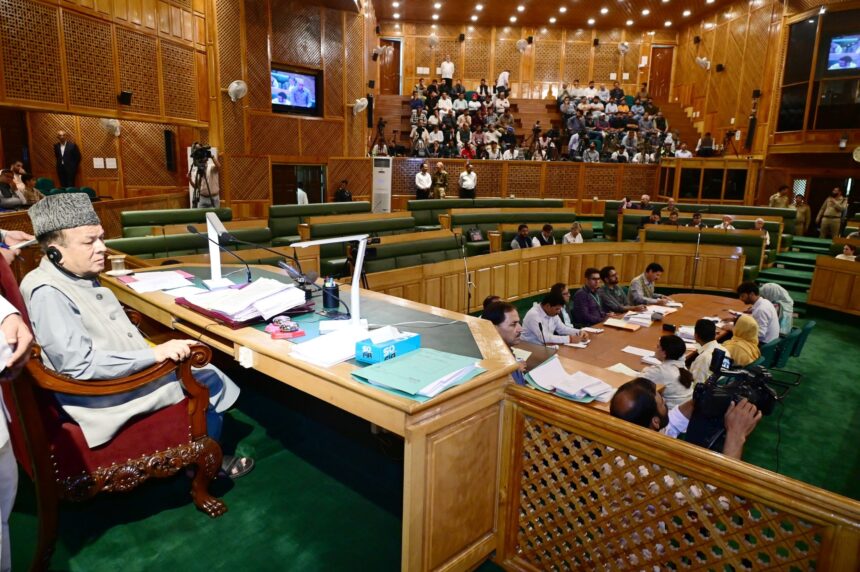
SRINAGAR: The Jammu and Kashmir Legislative Assembly today passed five Bills moved by Chief Minister Omar Abdullah, covering key areas including municipal governance, Ease of Doing Business and Ease of Living, taxation, legislative members’ pension, and rationalisation and decriminalisation of offences.
However, during the same session Chief Minister Omar Abdullah today withdrew two Bills seeking increase in salaries and allowances of Ministers, Ministers of State and Members of the Jammu and Kashmir Legislature, following objections raised by members of the principal opposition BJP in the Legislative Assembly.
The proceedings of the Legislative Assembly began amid uproar as Leader of Opposition Sunil Sharma again sought the removal of Speaker Abdul Rahim Rather, accusing him of allowing an “illegal and unconstitutional” resolution to be passed in the House.
Raising the issue at the outset of the proceedings Sharma argued that the Speaker should step down in view of the objections raised over the resolution and the opinions forwarded by the Law Department.
Sharma said the government’s own position, including remarks made by Chief Minister Omar Abdullah, had raised questions over the legality and procedure followed in bringing the resolution before the House.
He maintained that the Speaker should take responsibility for allowing the resolution to proceed despite the legal objections and resign from the post. The issue triggered a fresh confrontation between the opposition and treasury benches, with National Conference members raising “Vote Chor” slogans during the exchange.
The BJP has been opposing the inclusion of references to the 2000 autonomy resolution in the Statehood resolution, while maintaining that it supports restoration of full statehood to Jammu and Kashmir. BJP legislators walked out of the Legislative Assembly on Tuesday to protest the Speaker’s decision to allow discussion on the statehood resolution.
The BJP accused the Speaker of allowing the statehood resolution despite its objections to references to the 2000 autonomy resolution and the 2024 special status resolution.
The walkout came after Leader of Opposition Sunil Sharma again raised the issue in the House and sought the Speaker’s removal.
The first bill taken up in the Jammu and Kashmir Legislative Assembly witnessed a sharp exchange between BJP MLA R.S. Pathania and Chief Minister Omar Abdullah over the proposed amendment to the Jammu and Kashmir Municipal Act, 2000, before the House passed L.A. Bill No. 10 of 2026.
Participating in the debate, Pathania argued that the amendment transferred powers relating to ward demarcation from the State Election Commission to the government, created contradictions between Sections 10 and 282 of the Act, and raised questions over increasing the minimum strength of municipal bodies from five to seven members. He urged the government to refer the bill to a committee and clarify its position on OBC reservation before proceeding.
Replying to the debate, Omar Abdullah dismissed the objections, saying the amendment was intended to remove existing legal ambiguities rather than create new ones. He said the earlier provision simultaneously prescribed a minimum of seven members while allowing five-member municipal bodies in areas with a population below 5,000, and the amendment resolved that contradiction by fixing the minimum at seven.
The Chief Minister also rejected allegations that the government was taking over the State Election Commission’s powers, saying ward demarcation and territorial limits had historically been administrative functions carried out by Deputy Commissioners and that the amendment merely clarified the process.
During his reply, Omar took a swipe at the BJP, saying, “Our intention to hold panchayat elections is as firm as your intention to restore statehood.”
The Speaker later put the bill to voice vote, and the House passed the Jammu and Kashmir Municipal Act (Amendment) Bill, 2026.
The Jammu and Kashmir Legislative Assembly passed the Jammu and Kashmir Goods and Services Tax (Amendment) Bill, 2026 (L.A. Bill No. 12 of 2026), with Chief Minister Omar Abdullah saying there was “hardly any scope or need for discussion” as the legislation was required to implement decisions taken by the GST Council.
Moving the bill, Omar said decisions taken under the Government of India framework had to be passed by the Assembly, which was why the amendment had been brought.
During the brief proceedings, an opposition MLA sought clarification on whether the law would apply retrospectively or prospectively. Speaker Abdul Rahim Rather replied that it was not a question-and-answer session and said the law would come into effect immediately after its passage.
The Speaker later put the bill to a voice vote, and the House passed L.A. Bill No. 12 of 2026.
High drama unfolded as Chief Minister Omar Abdullah withdrew the MLAs’ salary revision bill, saying he would not allow it to be passed unless there was complete unanimity in the House.
The Chief Minister said the bill, drafted on the recommendations of the committee headed by Sham Lal Sharma Salathia, could not be pushed through without unanimous support. “Unless there is total unanimity, I have no interest in passing it. I withdraw this bill,” Omar announced after BJP leader Sunil Sharma urged the government to withdraw the proposal.
During the debate, Sunil Sharma said legislators had faced public criticism after the committee’s recommendations were leaked and argued that the House should prioritise the concerns of daily wagers, need-based workers and employees seeking risk allowances instead of increasing MLAs’ salaries.
Replying, Omar accused the BJP of wanting the salary hike privately while opposing it publicly. “They want the salary, they want the allowances, they want all the perks—and then outside, they will pretend they were against it,” he said. Following a voice vote, Speaker Abdul Rahim Rather declared that the majority supported withdrawing the bill.
The House then took up the Ministers and Ministers of State Salaries (Amendment) Bill, 1956 (L.A. Bill No. 13 of 2026), which was introduced by the Chief Minister and taken into consideration by the Speaker.
The Jammu and Kashmir Legislative Assembly passed the Decriminalisation and Ease of Living Bill (L.A. Bill No. 16 of 2026) after a debate in which opposition members raised concerns over replacing imprisonment with monetary penalties and its impact on accountability.
Before taking up the bill, Chief Minister Omar Abdullah withdrew L.A. Bill No. 14 of 2026, which sought to amend the Salaries and Allowances of Members of the Jammu and Kashmir State Legislature Act, 1960, after the House granted leave for its withdrawal.
During the discussion, PDP MLA Waheed-ur-Rehman Parra, CPI(M) MLA M.Y. Tarigami, BJP MLA R.S. Pathania and MLA Shabbir Ahmad Kullay questioned whether replacing jail terms with fines would weaken deterrence, particularly in cases involving contractors, corporations and public works, and sought clarity on enforcement and appellate mechanisms.
Supporting the legislation, NC MLA Tanvir Sadiq said the bill would ensure people were not arbitrarily criminalised for minor violations and would make the law simpler and fairer.
Replying to the debate, Omar rejected claims that the bill decriminalised serious offences such as substandard construction of schools or hospitals, saying no such provision existed. He said the legislation instead removed criminal penalties for minor and outdated offences, including provisions relating to steam whistles, movement of certain animals, posters and banners, and similar petty violations, arguing that such matters should attract civil penalties rather than criminal records.
He also said the bill introduced an Adjudicating Officer and an Appellate Authority to ensure transparency while reducing the burden of petty cases on courts. The Speaker later put the bill to a voice vote, and the House passed L.A. Bill No. 16 of 2026.
The atmosphere changed when the House discussed the Jammu and Kashmir State Legislature Members’ Pension (Amendment) Bill, 1984 (L.A. Bill No. 15 of 2026). Opposition MLAs urged the government not to withdraw the pension bill, arguing that former legislators were not present in the House to speak for themselves.
After the Speaker sought the House’s opinion, members across party lines voiced unanimous support for the pension bill. Omar then agreed to move the legislation, saying many former legislators had made immense sacrifices and that several were now in financially difficult circumstances.
“Salary is for the few days we are guests here. Pension is what we will ultimately receive,” Omar remarked amid laughter in the House. The Speaker later put the pension bill to a voice vote, and the House unanimously passed L.A. Bill No. 15 of 2026 before adjourning the day’s proceedings.

