



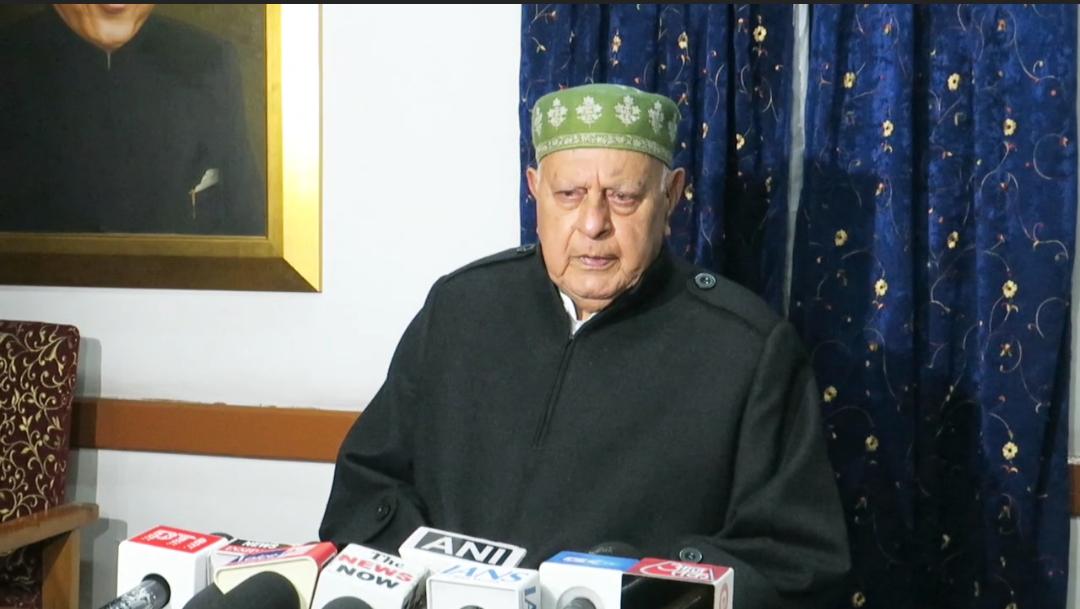
Srinagar, April 8: National Conference president Farooq Abdullah on Wednesday welcomed reports of a ceasefire between the United States and Iran, stressing that peaceful dialogue remains the most effective way to settle international disputes and prevent further loss and instability.
Expressing relief over the development, Abdullah said negotiations were essential to resolving conflicts, noting that meaningful progress could only be achieved when nations choose discussion over confrontation. He described the ceasefire as a positive step and voiced hope that continued engagement would pave the way for a durable peace agreement.
Highlighting the broader implications of prolonged hostilities, the veteran leader warned that ongoing conflict in the region could worsen existing global challenges. He observed that instability in energy-producing areas has far-reaching consequences for economies worldwide, particularly in countries dependent on imported fuel and trade routes.
Abdullah also pointed out that tensions in the Middle East have a direct impact on people in Jammu and Kashmir, many of whom are employed in Gulf nations and provide financial support to their families back home. He said uncertainty in the region creates anxiety for households that rely heavily on overseas earnings for their daily needs.
Speaking on the economic dimension, he cautioned that continued escalation could lead to sharp increases in fuel prices and disruptions in essential commodities. According to him, such developments would place a heavy burden on ordinary citizens, especially those with limited financial resources, as higher transportation and medical costs would affect daily life.
When asked about credit for the ceasefire, Abdullah avoided assigning recognition to any specific country, instead describing the development as a positive outcome for humanity as a whole. He emphasized that cooperation and mutual understanding are key to maintaining global stability.
Commenting on changing international dynamics, Abdullah noted that the global order has evolved into a multipolar system, with several major nations playing significant roles alongside traditional powers. He suggested that countries seeking progress should focus on building partnerships and maintaining balanced relations with others.
He also urged regional stakeholders to promote peace and cooperation, saying that sustained dialogue and trust-building measures are necessary to prevent further violence. Referring to ongoing tensions in parts of the Middle East, he warned that continued fighting would only lead to destruction without delivering lasting benefits.
Abdullah concluded by expressing optimism that diplomatic efforts would succeed in preventing escalation and ensuring stability, both globally and within the region.

