



Ladakh likely to get separate administrative, police services; next meeting to focus on PSC, Statehood, 6th Schedule
Arteev Sharma
Jammu, May 27: In a major breakthrough, the Ministry of Home Affairs (MHA) and Ladakh leaders today reached a consensus on implementing a 15-year prospective residency requirement—starting from 2019—for acquiring domicile status in the Union Territory of Ladakh.
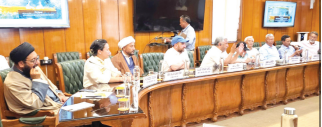
The agreement was described as the “biggest achievement” of the MHA-constituted High Powered Committee (HPC) meeting, chaired by Minister of State for Home Affairs, Nityanand Rai, held at North Block in New Delhi.
According to Ladakh leaders, the MHA also assured that it would consult the Law Ministry and legal experts “to examine the feasibility” of a 30-year residency requirement for domicile status—a key demand put forth by the Leh Apex Body (LAB) and the Kargil Democratic Alliance (KDA) during the meeting.
“It’s a positive step that we have finally reached a conclusion. The issue of domicile had been pending for a long time. Today’s decision is the biggest achievement of the HPC meeting,” said Chering Dorjay Lakruk, Co-chairman of the LAB, while addressing a press conference in New Delhi.
The veteran leader said, “We strongly advocated for a 30-year continuous residency in Ladakh as the criterion for domicile status. The government has assured us that it will examine the legal aspects of this demand and respond in the next meeting scheduled for next month”.
When contacted, Sajjad Kargili, the KDA leader, told The News Now, “Keeping in view the current scenario, our leaders from LAB and KDA unanimously decided that we should reach a conclusion. Both groups showed flexibility to reach today’s consensus. We agreed to a 15-year continuous residency from 2019. However, we reiterated our demand for a 30-year domicile policy, which the MHA agreed to legally review. We also expect discussions on other core issues, such as a separate Public Service Commission (PSC), statehood, and inclusion under the Sixth Schedule, in the next meeting,” he said.
Thupstan Chhewang, chairman LAB described the outcome of the HPC meeting as “historic occasion” where they achieved a “big breakthrough”.
“We had been insisting on reserving maximum seats for Scheduled Tribe (ST) students of Ladakh on the pattern of North-East and other places. There had been discussions on this particular subject and we are happy that the government of India has been kind to resolve these issue. We express our gratitude to the Government of India, particularly the Prime Minister, the Union Home Minister, the chairman of HPC and other members for resolving the issue,” Chhewang said.
Former minister and LAB member Nawang Rigzin Jora said, “Majority of jobs are generated in the non-gazetted category. While non-gazetted jobs are already reserved 100 percent for Ladakh Resident Certificate holders, we were concerned about gazetted posts being filled through JKPSC or UPSC. The new arrangement ensures that almost 95 percent of jobs will be reserved for locals and 10 percent for EWS, while the remaining 5 percent will be open to other Ladakh domiciles,” he said, adding “Any recruitment agency including UPSC will not make much difference to the recruitment now.”
He further said they requested the Centre not to extend the Delhi, Andaman and Nicobar Islands, Lakshadweep, Daman and Diu and Dadra and Nagar Haveli (Civil) Services (DANICS) to Ladakh UT.
“We urged the Centre to either create a separate administrative cadre for Ladakh or merge it with the J&K cadre. Now, there is a possibility that the Centre may positively consider our demand for separate administrative and police services for Ladakh in the next meeting,” Jora said.
The last formal meeting of the LAB and KDA leaders with the MHA was held on January 15. A follow-up meeting, initially proposed for February 15, did not materialize, with the MHA reportedly opting for backchannel talks to evolve a consensus on certain key issues prior to making any announcements.

