



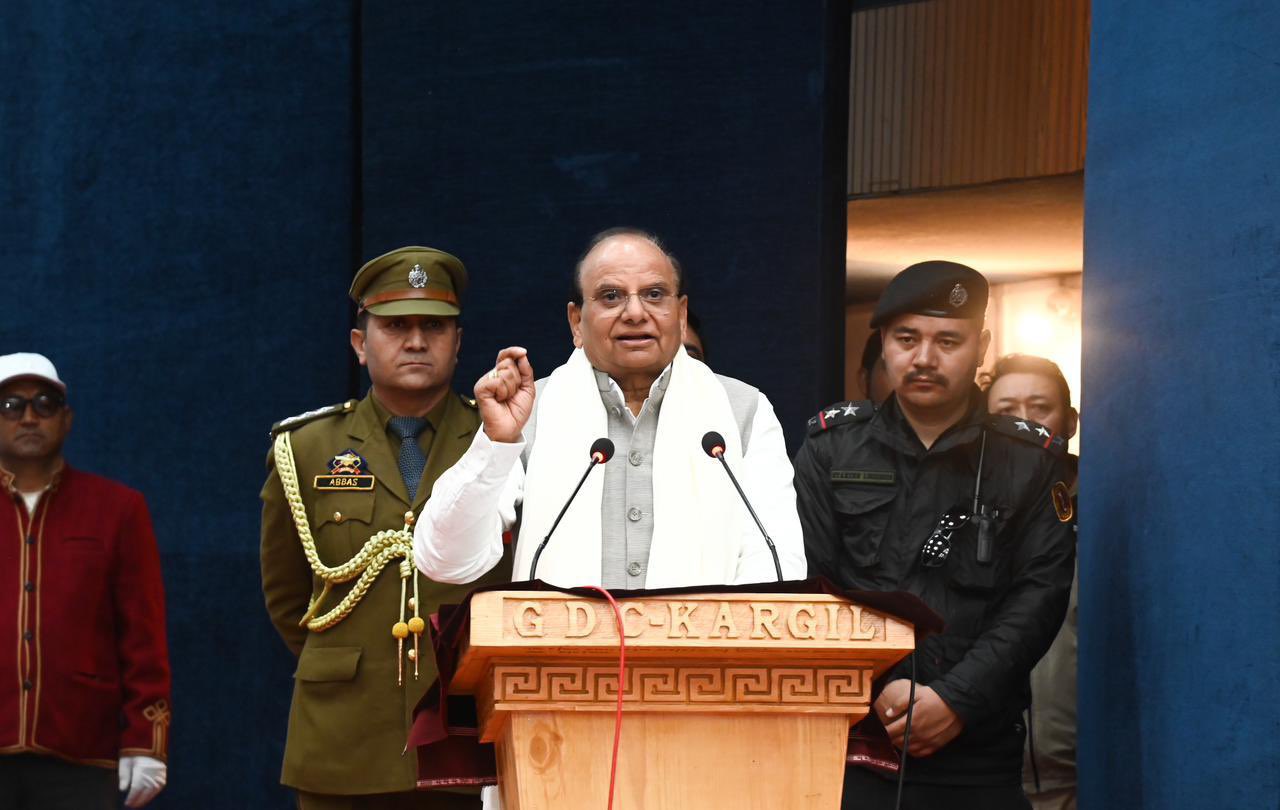
Kargil: Ladakh Lt Governor Vinai Kumar Saxena on Tuesday expressed confidence that the ongoing dialogue between the Leh Apex Body (LAB) and the Kargil Democratic Alliance (KDA) with the Centre will lead to a resolution, asserting that he remains available to support the process whenever required.
“I believe the concerned bodies are capable and are already in direct touch with the government of India. Wherever needed, I will always be available to support, but dialogue between them will eventually lead to a solution,” he told reporters here, winding up his four-day maiden tour of the district.
The LAB and KDA are jointly spearheading the agitation in Ladakh in support of their demands for statehood and safeguards under the Sixth Schedule of the Constitution and have been engaged in high-level talks with the Ministry of Home Affairs (MHA) for the past several years.
Saxena, who took over as the fourth Lt Governor of Ladakh on March 13, said his interactions with cross-sections of the society including religious leaders were central to his visit, underlining that “dialogue remains the most effective way to resolve issues”.
The Lt Governor announced that a memorial will be built in honour of Kargil war hero Colonel (Retd) Sonam Wangchuk, known as “Lion of Ladakh” who passed away last week, in acknowledgement of his significant contribution in the service of the nation.
Saxena said he would meet the officer’s family on his return to Leh and, in coordination with the Army and other stakeholders, a suitable site would be finalised for a memorial in his honour.
Highlighting major upcoming events, he said preparations are progressing rapidly for the arrival of the sacred relics of Lord Buddha, calling it a significant occasion expected to boost tourism.
He said preparations are also underway for the upcoming Sindhu Mahakumbh in June, noting that extensive cleaning, repair and beautification works are being carried out at Sindhu Ghat.
He said scattered petroglyphs (ancient stone carvings) are being collected, preserved and developed into a dedicated illuminated park to create a unique tourist attraction.
On connectivity, he said flight operations in Leh have increased significantly, while work on the new terminal at Leh airport is progressing rapidly and expected to be completed by June, easing travel constraints.
He said there is no shortage of LPG and petroleum supplies, with adequate stock available and regular monitoring in place.
The Lt Governor also highlighted new welfare and livelihood initiatives, including the establishment of an old-age home for destitute elderly and the promotion of exotic flower cultivation in collaboration with Council of Scientific and Industrial Research (CSIR) to enhance farmers’ income and create new tourism-linked opportunities.
On law and order, he said there is no major concern regarding crime or public safety in Ladakh, but stressed the need to ensure a hassle-free experience for tourists.
He said making Ladakh a tourist-friendly destination requires active participation from local communities and stakeholders.
Referring to complaints of overcharging, particularly by taxi operators, he said such practices are unacceptable and harm the region’s image.
“If tourists are treated unfairly, they may leave with a negative impression. That situation must be avoided,” he said, adding that while the government’s role is limited in such matters, responsibility largely lies with local people in shaping Ladakh’s image.
Reiterating a strict stance against narcotics, the Lt Governor said a zero-tolerance policy on drugs is being enforced.
He said stringent action will be taken against traffickers, suppliers and consumers alike, ensuring that those involved do not repeat such activities.
He also said there is currently no scope for operating large aircraft at Kargil Airport due to runway constraints, though smaller planes could be introduced after necessary upgrades, subject to commercial viability.
Speaking to reporters here before concluding his four-day tour of the district, Saxena said he inspected the airport — located 6 km from the main town and operated by the Indian Air Force (IAF) — following repeated public demand for its operationalisation.
“After holding a detailed discussion with officials, including IAF representatives, I came to know that the runway, measuring about 6,000 feet, is short, narrow, and in a worn-out condition, making it unsuitable for large aircraft operations. Even with a possible extension of up to 3,000 feet, operational challenges would remain,” he said.
He added that the landing approach requires a difficult turn for large aircraft, while a mountain ahead poses a challenge during takeoff. Operations are currently feasible only from one side, further limiting viability.
The Lt Governor said the runway requires complete resurfacing before any civilian operations can begin.
Outlining a way forward, Saxena said smaller aircraft with 19 or 26 seats could be introduced once the runway is upgraded, but stressed that even this would depend on commercial viability.
“No private airline will invest unless there is sufficient passenger traffic. Once demand builds up, operations can be scaled accordingly,” he said.
Clarifying a common perception, he said the airport’s non-operational status is not due to reluctance on the part of the IAF.
“The Air Force is ready, and civil authorities are also prepared. The main requirement is to ensure commercial viability,” he said.
Describing his Kargil visit as “highly successful,” the Lt Governor highlighted major initiatives taken by his administration in infrastructure, employment, environmental protection, and rural development.

