



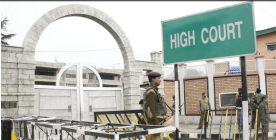
Not a single court under Gram Nyayalayas scheme functional
Wajahat Shabir
SRINAGAR: Jammu and Kashmir’s justice delivery system remains under severe strain, with alarming data pointing to persistent vacancies, sluggish judicial appointments, and a sluggish pace of case disposal, particularly in special and fast-track courts set up to expedite justice.
According to data submitted in the Rajya Sabha, the Jammu & Kashmir High Court is functioning with only 15 judges out of a sanctioned strength of 25, leaving 10 positions vacant. The situation is equally concerning at the district level, where 50 judicial officer posts remain unfilled out of 322.
While the Union Government has emphasized the role of Fast Track Courts (FTCs) in delivering speedy justice, the ground situation in Jammu and Kashmir tells a different story. The region has 8 functional FTCs, which together disposed of just 270 cases between January 2023 and June 2025, but are currently saddled with 1,423 pending cases.
In addition, only 4 Fast Track Special Courts (FTSCs)—including 2 exclusive POCSO courts—are operational in the UT. These FTSCs have disposed of a mere 201 cases over the last three years, while 497 cases remain pending.
Under the Gram Nyayalayas scheme, 20 courts have been notified in J&K, aimed at bringing justice closer to rural citizens. However, not a single one is functional as of June 2025.
The judicial backlog in J&K is not just a result of high case inflow—it is also deeply linked to chronic under-staffing. Despite repeated Supreme Court directions in the Malik Mazhar Sultan case regarding timely appointments in lower judiciary, Jammu & Kashmir continues to fall behind timelines. The systemic delays in judicial appointments—described by the Ministry of Law and Justice as a “collaborative process” between the executive and judiciary—are clearly contributing to the build-up of cases.
Nationwide data shows that over 4.66 crore cases are pending in subordinate courts and over 63 lakh in High Courts. Within this, Jammu and Kashmir’s slow-moving courts contribute a disproportionately high burden due to inadequate staffing and minimal disposal rates.
While the Central Government has disbursed ₹5.38 crore to J&K between FY 2022-23 and FY 2024-25 for FTSC operations, the impact on the ground remains limited. No funds have been released so far in the current financial year, further stalling any progress in operational efficiency.

