



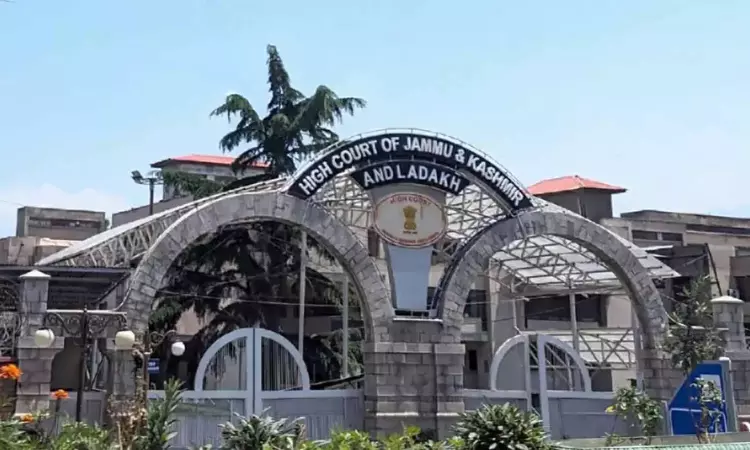
Jammu: Acting on directions of the Supreme Court of India, the High Court of Jammu Kashmir and Ladakh has issued a circular directing all bar associations in the Union Territories to avoid organizing or associating with any vulgar or inappropriate events and to strictly maintain professional decorum. The circular, issued by the Registrar General under directions of the Supreme Court of India, calls for adherence to ethical standards within and outside court premises and warns of legal action in case of violations.
The directive follows a controversial incident during a Holi celebration organized by the Kanpur Bar Association on February 27, where videos circulated on social media allegedly showed cabaret-style performances in revealing attire, with some advocates seen encouraging and recording the acts.
Taking note of the incident, the Chief Justice of India directed that corrective measures be implemented to prevent recurrence of such events, prompting issuance of the circular to bar bodies across J&K and Ladakh. The High Court has directed bar associations to ensure that all events conducted under their banner uphold institutional dignity and professional standards, emphasizing that any non-compliance may invite action in accordance with law.
Lawyers have been asked to strictly follow norms of professional conduct and etiquette prescribed under the Advocates Act, 1961 and the Bar Council of India Rules. The circular further advises advocates to maintain dignity, sobriety, and propriety in both professional and social engagements, and to refrain from participating in or promoting activities that may undermine the image of the legal profession.
It states that advocates must avoid association with any form of entertainment or activity that is unethical, vulgar, or culturally inappropriate, reinforcing the need to preserve the dignity of the profession. Bar associations have also been directed to organize awareness and sensitization programmes to strengthen adherence to ethical standards among members.City& Local Guides
The directive assumes significance as it seeks to reinforce professional discipline and prevent reputational harm to the legal community following recent controversies.
Meanwhile, High Court of Jammu & Kashmir and Ladakh has directed all Bar Associations across the Union Territories of J&K and Ladakh to ensure 30 percent reservation for women advocates in their governing or executive bodies.
The direction has been issued through a circular by the Office of the Registrar General, High Court of J&K and Ladakh, in compliance with the directions passed by the Supreme Court in Deeksha N Amruthesh vs State of Karnataka & Ors, Special Leave to Appeal (C) Nos. 1404 of 2025.
As per the circular dated April 29, all Bar Associations falling within the jurisdiction of the High Court of J&K and Ladakh have been impressed upon to reserve 30 percent of the posts of governing or executive members for women advocates to ensure their adequate representation in Bar bodies.
The circular further provides that where women advocate members are not available or do not contest elections, the shortfall in representation shall be filled through nominations. Such nominations will be made by the concerned Administrative Judge in consultation with the concerned District and Sessions Judge, elected office bearers and the senior-most women members of the respective District Bar Associations.
It has also been clarified that the tenure of nominated women members shall remain co-terminus with that of the elected members, meaning they will continue only for the same term as the elected executive body. The J&K High Court Bar Association Jammu, Kashmir Advocates Association and all District and Tehsil Bar Associations across J&K and Ladakh have been asked to take immediate steps for implementation of the directions.
The High Court has also directed the concerned Bar Associations to submit compliance reports within one week from the date of issuance of the circular. The circular has been issued by order of Registrar General M.K. Sharma and circulated to Principal District and Sessions Judges, Presidents of Bar Associations, Registrars of the High Court, Judicial Academy and other concerned authorities for information and necessary compliance.

