



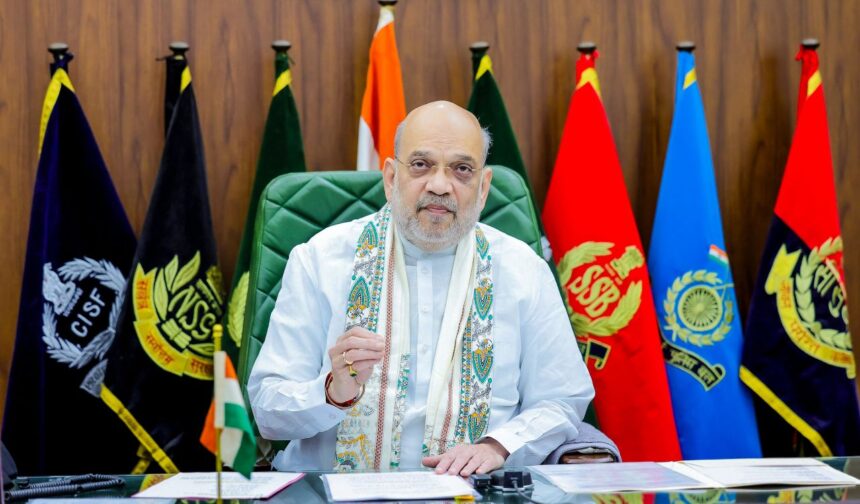
New Delhi: Union Home Minister Amit Shah on Thursday said the government is determined to eliminate the remaining traces of Naxalism and restore Bastar as a peaceful and prosperous region.
He said efforts are being made to improve primary infrastructure and facilities in Chhattisgarh, where the Congress rule had failed to provide even basic amenities for decades.
Outlining the BJP government’s efforts to rebuild Bastar and rehabilitate victims of Left-Wing Extremism (LWE), Shah said eliminating Naxalism was not enough; the government is also addressing the suffering it had caused over five decades, particularly among the region’s poor tribal communities.
Addressing virtually the distribution ceremony of assistive devices for Divyangjans, including those affected by Naxal violence, under the ‘Seva Sankalp Abhiyan’ organised to mark 25 years of Prime Minister Narendra Modi in public service, Shah said the end of Naxalism alone would not erase “five decades of suffering”.
Under the campaign, assistive prosthetic devices are being provided in Chhattisgarh to make life easier for tribal persons with disabilities who have suffered as a result of Naxal violence, a government statement said.
Shah said Naxalism had inflicted immense suffering on the poor tribal communities of Bastar.
Using IEDs to inflict disabilities on innocent civilians in pursuit of political objectives was the gravest violation of human rights, the minister said.
“We must heal the wounds inflicted by this suffering, help victims stand on their feet again, and ensure they can live with dignity and respect,” he said.
Shah said under the NiyadNellanar scheme, significant efforts had also been made to expand basic infrastructure and extend essential services to Bastar, which had remained deprived of such facilities under Congress governments for five decades.
He said the government was determined to eliminate the “remaining traces of Naxalism” and restore Bastar as a peaceful and prosperous region.
Shah said the Modi government is committed to providing every person with a disability and every victim an opportunity for rehabilitation.
Shah said the Centre stood firmly alongside the Chhattisgarh government in supporting these efforts.
“Traditional tribal leadership in the Bastar region had also made a major contribution,” he said.
Shah said by providing persons with disabilities with wheelchairs, tricycles, crutches, hearing aids, smart walking sticks, artificial limbs and other assistive devices, the government could help usher in a new era of hope and happiness in Bastar.
He said the Bastar Olympics has brought people together for sports in places where gunfire and bomb blasts once created an atmosphere of fear.
Through Bastar Pandum, the government seeks to revive tribal art and culture, while the NiyadNellanar scheme will improve basic facilities in remote areas, he said.
He said that in a region where the sounds of gunfire and bomb blasts once prevailed, and fear was widespread, thousands of young people are now participating in sports and keeping their traditions alive.
He said bank accounts have been opened for 7,328 former Naxalites who do not have accounts.
“A total of 1,620 people have received reward money, 7,882 have received incentives, 455 have been provided jobs, and 129 have been allotted land. In addition, under the Pradhan Mantri Awas Yojana, 4014 beneficiaries have received houses, and more than 2308 tribal people have undergone skill development training,” he said.
Shah said 6,763 new ration cards have been issued, 2,808 families have been provided free electricity, and work has begun on 372 new road projects.
“Construction is underway on 670 small bridges, 48,526 people have been issued Aadhaar cards, and 44 gram panchayats have been recognised under the ‘Ilwad Panchayat Awards’,” he said.
The home minister said more than 500 security camps have been established, of which over 200 will be converted into Shaheed Veer Gundadhur Seva Dera.
“Officials of the Government of India and the Chhattisgarh government will now work from the very camps where security personnel once sat to protect the people, laying the foundation for a developed Bastar. These public service centres would help the government realise its vision of a developed Bastar,” he said.
The centres would help address children’s health and education needs, employment concerns among young people and the economic needs of tribal communities, he said.

