



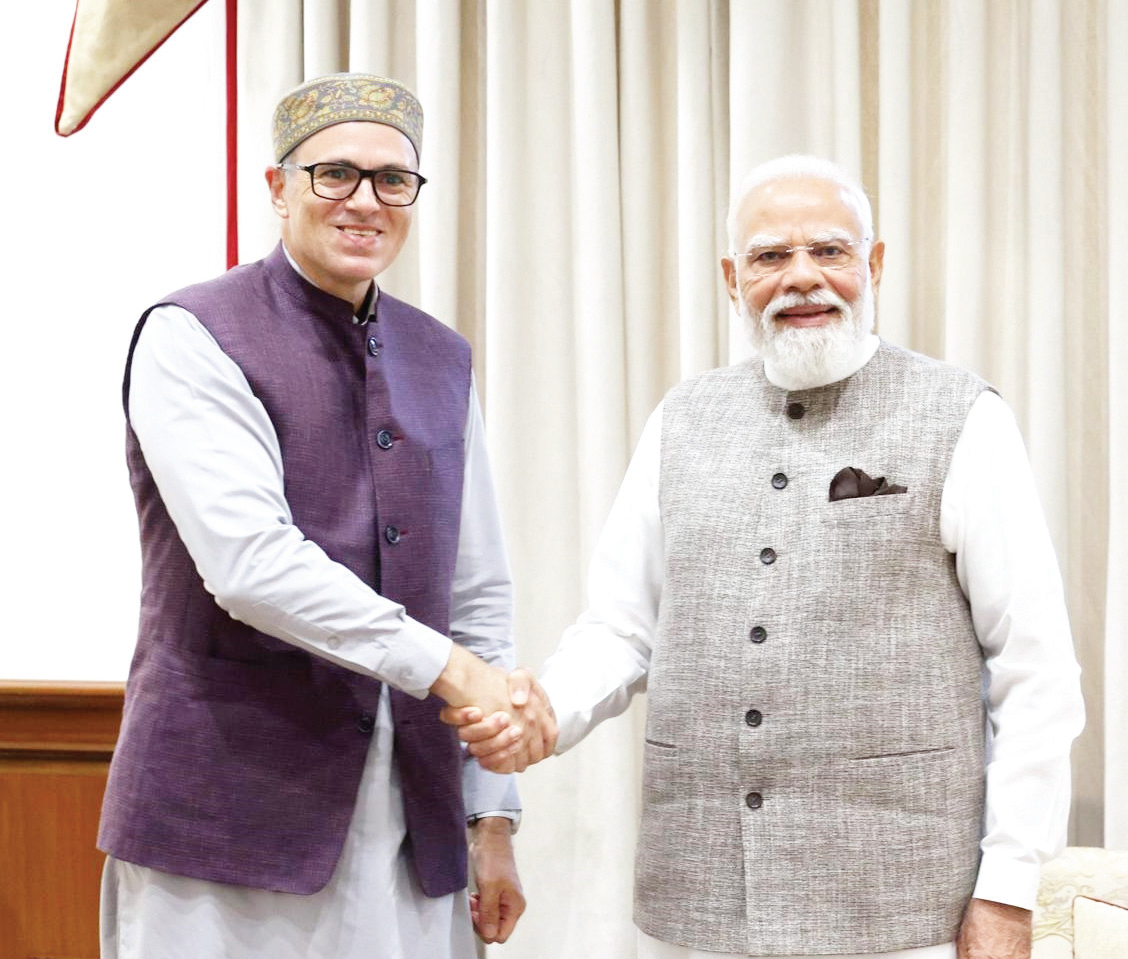
Jammu: Jammu and Kashmir Chief Minister Omar Abdullah met Prime Minister Narendra Modi here on Thursday, strongly pressing for the “early return” of full statehood to the Union Territory and seeking central support to accelerate the region’s economic and infrastructural growth. According to a statement from the J&K government, Abdullah conveyed the deep aspirations of the people, underlining that the return of statehood is a vital step toward strengthening democratic institutions, deepening public participation, and advancing the next phase of the region’s development.
“Jammu and Kashmir is committed to being a full and productive partner in India’s growth story,” the statement said, emphasising that robust central backing, combined with early statehood, would heavily accelerate J&K’s march toward inclusive growth, economic prosperity, and good governance. The meeting took place on the sidelines of the 11th Governing Council meeting of NITI Aayog, which was chaired by the prime minister earlier in the day.
Following the high-profile meeting, the Prime Minister’s Office shared photographs of the two leaders on social media platform X. Later, Abdullah took to X to share details of the discussion, saying that he also congratulated the prime minister on achieving the “landmark” of completing 12 uninterrupted years in office.
“Called on Hon’ble PM @narendramodi ji to discuss issues of importance to J&K including early return of Statehood, the state of the economy, pace of development and promotion of tourism,” Abdullah posted. Restoration of statehood remains a dominant political issue in J&K, with all regional and national parties demanding that the Centre honour its commitment to full statehood without further delay.
Jammu and Kashmir was demoted from a state to a Union Territory on August 5, 2019 and bifurcated by carving out Ladakh as a UT without legislature. Last week, the ruling National Conference (NC) announced plans to launch a protest in New Delhi on the opening day of the upcoming Monsoon session of Parliament to demand immediate statehood and constitutional safeguards for the region.
According to the Thursday’s statement, the chief minister detailed J&K’s current economic trajectory and outlined ongoing development initiatives across key service sectors. While highlighting progress in public infrastructure and welfare delivery, Abdullah pointed out specific critical areas that require sustained central intervention.
In particular, the chief minister drew the prime minister’s attention to the urgent need for boosting rail services on the Udhampur-Srinagar line. The request comes at a critical juncture, with the local apple harvest season approaching and a scheduled 15-day closure of the Srinagar airport looming in October for mandatory runway repairs.
Abdullah also pushed for financial and policy support to fully harness J&K’s vast hydropower potential, develop new eco-tourism circuits, and provide sustained relief for local farmers, traditional artisans, and MSMEs. He also met Defence Minister Rajnath Singh and Civil Aviation Minister K Rammohan Naidu, suggesting the opening of the strategic IAF airport at Awantipora in South Kashmir to civilian traffic in October.
The meetings come amid the scheduled closure of the Srinagar airport from October 1 to October 15. Abdullah met the two Union ministers here separately and raised concerns over the planned closure of the Srinagar airport in October for runway repairs, officials said. During the meetings, Abdullah highlighted that a major inflow of tourists from West Bengal, Gujarat, and Maharashtra occurs during this period. The season is fondly called ‘Golden Kashmir’ because the leaves of the iconic Chinar trees turn golden-yellow.
He suggested that if the closure of the Srinagar airport is absolutely necessary, the alternative airfield at Awantipora should be opened for civilian traffic during that fortnight. The chief minister is in the national capital to attend the 11th Governing Council meeting of NITI Aayog.
Officials said that the Centre will explore options to avoid a total closure of the airport in October. In 2010, the Awantipora airbase, which, like the Srinagar airport, is under the control of the Indian Air Force, was successfully used for civilian flights during previous runway repairs in Srinagar.
Srinagar airport was closed for 14 days, from September 4 to September 17, 2010, and during this period, the Awantipora airport was opened for civilian traffic. Additionally, the Defence Ministry has approved the operation of civilian flights from the Awantipora airfield.
Shripad Naik, the then Minister of State for Defence, had informed the Lok Sabha that the government had given “in-principle approval” for civil flight operations from Awantipora under the Regional Connectivity Scheme (RCS), which was conveyed to the Ministry of Civil Aviation in June 2019. This information was shared in response to a question by Hasnain Masoodi, the then MP from the Anantnag constituency, regarding the steps being taken by the Defence Ministry to transfer Awantipora airport to the Civil Aviation Ministry for civilian air traffic.
According to Srinagar airport officials, a phased maintenance schedule will begin ahead of the total shutdown. Starting next month, air services will be suspended for two days every week, culminating in the full 15-day closure in October. The runway repairs, essential for operational safety, have already led to flight restrictions since April 6 this year, after the Indian Air Force issued a Notice to Airmen (NOTAM) restricting flights between 8 am and 5 pm. While around 25 to 30 flights used to operate daily, only 18 flights are currently landing at the airport.
During the meetings, the chief minister highlighted the difficulties being faced by the tourism industry, which is still recuperating from the impact of last year’s Pahalgam terror attack. He told the Union ministers that hospitality and travel stakeholders have been urging him to press the Centre to reconsider the timeline as cutting off air connectivity during one of the busiest domestic tourism blocks of the year could devastate the local economy.
On Wednesday, Abdullah also met Railway Minister Ashwini Vaishnaw to discuss measures to strengthen rail connectivity in the Union Territory. While appreciating the quality of service and punctuality of the Jammu-Srinagar Vande Bharat Express, he requested a stoppage for the train at Anantnag in South Kashmir. He urged the railway minister to augment train services to the Kashmir Valley, particularly to offset the potential closure of the Srinagar airport in October.

