



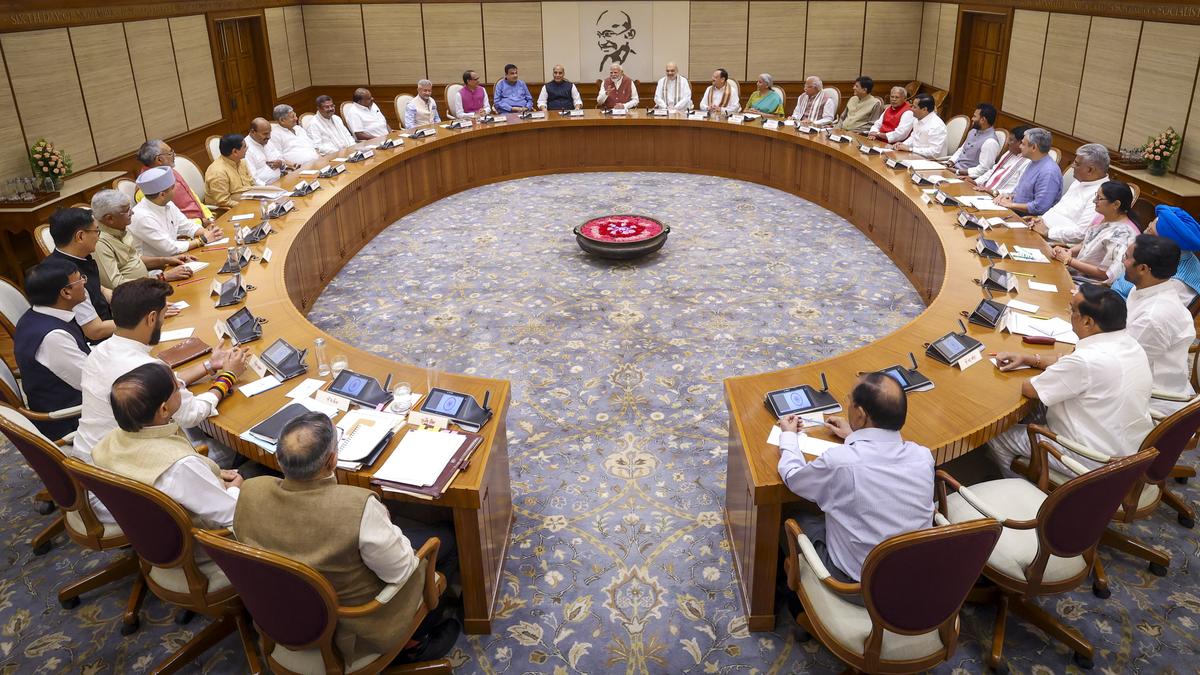
New Delhi: The Union Cabinet, chaired by Prime Minister Narendra Modi, on Wednesday approved two major schemes aimed at boosting manufacturing and clean energy, with a combined outlay exceeding ₹36,000 crore.
In a significant push to industrial growth, the Cabinet cleared the ₹33,660 crore Bharat Audyogik Vikas Yojana (BHAVYA), which will facilitate the development of 100 plug-and-play industrial parks across the country. Briefing the media, Union Minister Ashwini Vaishnaw said the scheme is designed to create world-class industrial infrastructure, unlock manufacturing potential, and accelerate India’s economic growth.
The BHAVYA scheme will be implemented over six years, from FY 2026–27 to 2031–32, with 50 parks planned in the first phase. These parks, spread across 100 to 1,000 acres, will receive central assistance of up to ₹1 crore per acre. The initiative is expected to generate around 15 lakh direct jobs.
The proposed industrial parks will feature core infrastructure such as internal roads, underground utilities, drainage systems, common treatment facilities, and ICT-enabled administrative systems. In addition, value-added facilities including ready-built factory sheds, warehousing, testing labs, and housing for workers will be developed.
The government will also provide support of up to 25 per cent of project cost for external infrastructure to ensure seamless connectivity. Projects will be selected through a challenge-based approach, prioritising investment-ready and reform-oriented proposals.
Officials said the scheme builds on the success of industrial smart cities under the National Industrial Corridor Development Programme and will be implemented in partnership with states and private players. With a focus on ease of doing business, BHAVYA aims to reduce entry barriers for investors through pre-approved land, single-window clearances, and ready-to-use infrastructure.
The parks will be aligned with PM GatiShakti principles for integrated and multimodal connectivity, while also promoting green energy and sustainable resource utilisation. The initiative is expected to strengthen domestic supply chains, encourage regional industrialisation, and benefit MSMEs, startups, and global investors.
Meanwhile, the Cabinet also approved a ₹2,585 crore Small Hydro Power Development Scheme to add around 1,500 MW of clean energy capacity over five years from FY 2026–27 to 2030–31.
Under the scheme, financial assistance of up to 30 per cent of project cost or ₹3.6 crore per MW will be provided for projects in northeastern and border areas, subject to a cap of ₹30 crore per project. In other regions, support will be limited to 20 per cent of project cost or ₹2.4 crore per MW, with a maximum of ₹20 crore per project.
The initiative is expected to attract investments worth ₹15,000 crore and will focus on small hydro projects ranging from 1 to 25 MW, particularly in hilly and remote areas. Officials said the scheme will help tap India’s vast small hydro potential, estimated at over 21,000 MW across more than 7,000 sites.
Apart from boosting clean energy, the programme is projected to generate around 51 lakh person-days of employment during construction, along with long-term jobs in operations and maintenance. It will also promote indigenous manufacturing of plant and machinery, in line with the Atmanirbhar Bharat initiative.
Describing the decision as environmentally significant, Vaishnaw said the projects will largely follow a run-of-river model, avoiding large dams and minimising displacement and ecological impact.
Together, the two schemes signal a strong push by the Centre to drive industrial expansion, enhance infrastructure, and accelerate the transition towards sustainable energy, while creating large-scale employment opportunities across the country.

