



Vadodara: Prime Minister Narendra Modi on Tuesday took a dig at the Opposition over the newly inaugurated dedicated freight corridor, saying critics would still complain like a “narazfufa” (grumpy uncle) and manufacture grievances, while also dismissing Congress leader Rahul Gandhi’s campaign against the government as “jhooth ki goonj” (echo of lies).
Speaking at the inauguration of three key sections of the Western Dedicated Freight Corridor, connecting Jawaharlal Nehru Port in Navi Mumbai with Dadri in Uttar Pradesh, and marking the project’s completion, Modi praised his administration’s pace of execution and called the former Congress-led UPA regime’s working speed sluggish.
“After 2014, with your blessings, when I reached Delhi, and as soon as we arrived there, we began accelerating this project. Work on the dedicated freight corridor has been completed today,” Modi said.
The cultural reference to the fufa (uncle) was apparently used because in several parts of the country the paternal aunt’s husband is often portrayed as a senior person who is easily offended, is hard to please at family events, and perpetually complains about innocuous things.
The “jhooth ki goonj” jibe appeared to mock the “Chhatron Ki Goonj” student dialogue campaign launched by the Congress, under which programmes are being organised in various cities. Through the campaign, the Congress is trying to corner the BJP on issues such as exam question paper leaks, costly education, irregularities in government recruitment and unemployment.
Targeting senior Congress leader Rahul Gandhi without naming him, Modi remarked that opponents would always find fault with major infrastructure milestones such as the newly inaugurated freight corridor.
A double-stack container freight train, where containers are stacked one atop the other, was operated from the JNPT port in Mumbai to Vadodara recently and with the operation of that train volume of cargo equivalent to over 250 trucks was transported between the two cities in a single trip, Modi said.
“Now, the narazfufaji (grumpy uncle) will start shouting: What will happen to the truck drivers? Where will the trucks go? What about the trucks people have purchased? Now, fufaji has found something new to complain about,” Modi quipped, implying that opposition parties would go out of their way to manufacture grievances against national progress.
Modi pointed to rapid modernisation under his decade-long tenure compared to the previous administration’s shortcomings.
“After 2014, India built 50,000 modern rail coaches. The previous regime could not build even 50,000 toilets in 10 years,” he said, reiterating that the nation’s youth would continue to champion reality over political rhetoric.
Taking aim at the Opposition’s youth outreach efforts, specifically Gandhi’s ‘Chhatron Ki Goonj’ campaign in Pune last month, the Prime Minister cautioned the youth against falling for political misdirection.
“Saathiyo, jhooth ki goonj se bharmane wale tohharchaurahe par mil jayenge, lekin Bharat ka naujawansach ki hunkaar se chaltahai… Satya ki hunkaarkeliyechaltahai (At every nook and corner, you will find people who will try to mislead you through lies, but today’s youth will stand with the truth),” Modi said, urging youngsters to align with factual progress over political narrative.
The PM said the youth could see how focused the government was on working across sectors, including solar, wind, hydro and nuclear energy. Describing the dedicated railway freight corridor as the lifeline of a rapidly developing nation, the Prime Minister noted that India’s economic transformation was accelerating due to the modern freight structure.
Earlier, passenger and goods trains were forced to run on the same tracks, which severely hampered both passenger travel and freight movement, but the dedicated corridor altered that dynamic, he explained.
Modi said that the Eastern and Western Freight Corridors are now emerging as the main backbone of the nation’s trade and commercial activities. He said the 2,800-km Dedicated Freight Corridor serves as a testament to how the country’s work culture has been fundamentally transformed over the past 12 years.
Criticising the administrative delays under the previous government, he pointed out that though the concept originated in 2004 and a special purpose vehicle was set up in 2006, files remained stuck without progress until 2014.
“Unfortunately, even these files weren’t fortunate enough to get a dedicated corridor. Files would get stuck, hang around, wander aimlessly,” Modi said.
India is scripting a new saga of manufacturing, spanning “chips to ships”, with components, final products and the supply chain for self-reliance being set up in the country, Modi said.
He said India had emerged as a major manufacturer of railway coaches, metro coaches and locomotives in the last decade.
A 100-km journey that earlier took 6.5 hours for a freight train can now be covered in less than half the time, while a 30-hour journey by truck can be completed in 10-12 hours on the Dedicated Freight Corridor, the PM noted.
He said the corridors had reduced fuel consumption, lowered freight costs, saved time and benefited the environment.
Rail connectivity was also reaching parts of the country where it had been absent for decades, with tribal areas in Gujarat, Madhya Pradesh and Maharashtra being connected through these projects, he said.
The railway budget this year stood at Rs 2.75 lakh crore, several times higher than it was 12 years ago, and railway modernisation was creating thousands of jobs, Modi said.
The future would depend on an electric ecosystem and industries such as data centres and AI, which require large amounts of water and electricity, he said, adding that India was preparing the ecosystem needed to become a global superpower in AI and was signing international agreements regarding uranium and critical minerals.
Earlier, Modi walked on an elevated ramp to arrive on stage, and was greeted by the audience, mostly young people. He reciprocated with folded hands and waved back.
Modi later inaugurated the BJP’s newly built ‘Namo Kamalam’ office in Navsari town of south Gujarat and said the ruling party’s power, positions and organisational strength were entirely meant for public service. The state-of-the-art building will serve as the new BJP office in Navsari district.
“Even an ordinary, grassroots worker of the BJP has never become intoxicated with power. After all these years and so much love, our workers have firmly held onto the path of public service,” Modi said after the inauguration.
Exhorts fintech sector to expand global reach of UPI
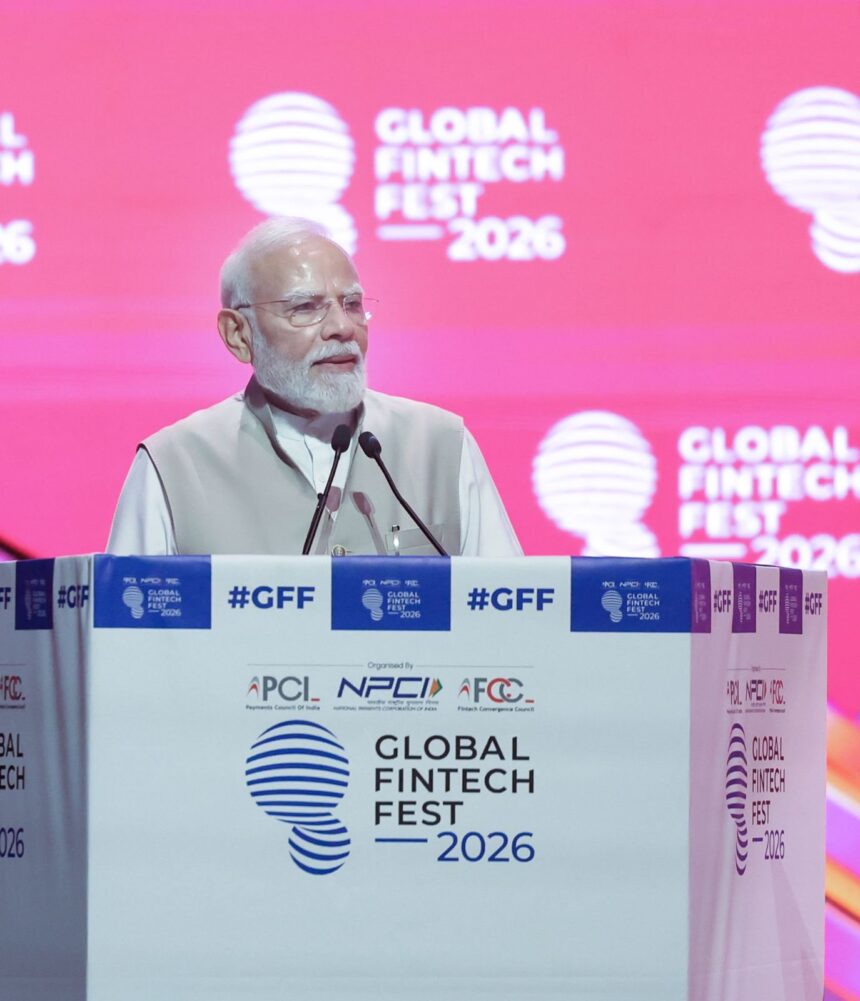
Mumbai: Prime Minister Narendra Modi on Tuesday urged the fintech ecosystem to expand the global reach of the Unified Payments Interface (UPI), connect it with local systems in other countries, and help the diaspora save on remittance costs.
In his address after the inauguration of the 7th edition of the Global Fintech Fest here, Modi said the UPI platform is now live in 11 countries and has also connected with Singapore’s local system.
Urging the ecosystem not to rest on the laurels of the last decade when UPI became a ubiquitous platform for real-time payments across the country, the Prime Minister said the next aim should be to expand UPI’s reach.
He said the focus should be on countries that are home to a large diaspora, have high trade volumes with India, or are willing to partner with us while connecting the systems.
“This is essential because Indians work in large numbers in foreign countries. They are the largest remitters of money. A part of the remittances goes away as transaction costs; UPI can help in saving on these costs and the money can also reach families faster,” he said.
He said global card payments currently run on systems designed in other countries, but underlined that India now has the alternative on the same.
“We can set our own rules and standards and connect them with the world,” Modi said.
Reiterating French President Emmanuel Macron’s words, the Prime Minister said UPI is not only a tech story but also a civilizational one.
He said that after the high number of successes on the payments front over the last many years, the next chapter for the Indian fintech industry should be non-payment transactions.
The Prime Minister also urged the fintech community to develop top-notch cybersecurity solutions, ethical data protection standards, and underlined the need for a fintech regulatory ecosystem and a fintech consumer protection index, which can help rate every company on transparency.

