



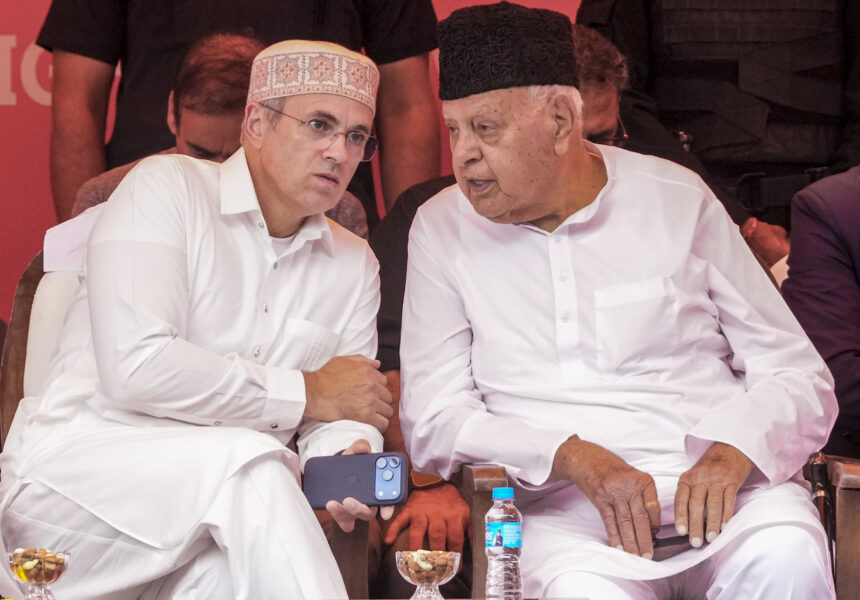
SRINAGAR: Chief Minister Omar Abdullah on Saturday accused the Bharatiya Janata Party (BJP) of attempting to engineer defections within the National Conference (NC) by allegedly offering ₹20 crore to ₹30 crore, a ministerial berth and even restoration of Jammu and Kashmir’s statehood to one of his party MLAs, while asserting that the Centre had failed to honour its promise of restoring statehood after the Assembly elections.
Addressing a gathering of National Conference workers ahead of the party’s proposed July 20 protest at Jantar Mantar in New Delhi, Omar said the NC had exhausted the path of dialogue and had been left with no option but to launch a democratic agitation for the restoration of Jammu and Kashmir’s statehood.
“Do not mistake our patience for weakness. Patience is our strength. Patience is our voice and, God willing, patience will become our victory and our success,” Omar said, adding that the Centre should ask itself why, after one-and-three-quarter years of his government, the National Conference had been compelled to organise a protest in the national capital.
He said that ever since assuming office, he had staked his political future and political credibility on pursuing dialogue with the Centre rather than confrontation, despite knowing that such an approach would come at a heavy political cost in Jammu and Kashmir, particularly in Kashmir, where many expected political parties to constantly remain in conflict with New Delhi.
Omar said he nevertheless believed the Centre deserved an opportunity to fulfil the commitment it had made to the people of Jammu and Kashmir—that the constitutional process would move in three stages: delimitation, Assembly elections and restoration of statehood after the elections.
Referring to the delimitation exercise, Omar alleged that although similar exercises were not carried out across the country except in Assam and Jammu and Kashmir, the exercise in the Union Territory was designed to favour the BJP. He claimed the addition of seven Assembly seats effectively benefited the BJP in six constituencies while only one favoured the National Conference, alleging that democracy had been manipulated to enable one political party to gain power.
He, however, said the people of Jammu and Kashmir defeated that design through their verdict in the Assembly elections.
Omar said BJP leaders, particularly those in the Jammu and Kashmir Assembly, had now begun openly stating that statehood would not be restored to the present dispensation. He questioned why such a stand had never been conveyed before the Supreme Court.
“If the BJP government had intended that statehood would only be restored after a BJP government was formed in Jammu and Kashmir, then it should have had the courage to say so before the Supreme Court,” he said.
He maintained that the Centre had assured the Supreme Court that statehood would follow the completion of delimitation and elections, and questioned why that commitment was now being delayed despite the successful conduct of both processes.
Omar said the verdict delivered by the people should not become a punishment for them.
“How is it our fault that the people of Jammu and Kashmir entrusted us with the responsibility of governance? The BJP and all its proxies—the A team, B team, C team and D team—lagged behind in these elections,” he said.
The Chief Minister remarked that even he had been surprised by certain election results and had not expected some of his own colleagues to win, but said the people’s verdict had to be respected.
Questioning the functioning of the elected government, Omar asked why elections were held if governance was to continue from the Raj Bhavan.
“If Jammu and Kashmir had to be run entirely from the Raj Bhavan, if every decision had to be taken there, if people were to be harassed through the Raj Bhavan, if employees were to be dismissed, bulldozers used and all powers retained there, then what was the need to hold elections?” he asked.
He alleged that his government had effectively been asked to govern with “its hands tied behind its back”, claiming that officers were not implementing decisions taken by the elected government. Despite those limitations, he said his administration continued to work tirelessly for the welfare of the people.
According to Omar, the message now being conveyed by the Centre was that constitutional demands would not be fulfilled without public protests.
Drawing comparisons with Ladakh, Omar questioned why the Centre was willing to negotiate constitutional safeguards there while Jammu and Kashmir continued to wait even for restoration of statehood.
He alleged that while Ladakh was being offered greater authority over appointments of senior officers, performance assessments of the Chief Secretary and budgetary matters, similar powers were being denied to the elected government in Jammu and Kashmir.
Omar said he had never missed an opportunity to raise the issue of statehood before Prime Minister Narendra Modi, Union Home Minister Amit Shah and other senior Union ministers. He said the issue had been raised during meetings with the Prime Minister and every subsequent interaction with the Union leadership.
“In every meeting I am told statehood will be restored. But whenever the issue is raised in Parliament or before the media, the answer is that it will happen at the appropriate time,” he said.
Questioning what constituted the “appropriate time”, Omar asked the Centre to spell out the conditions required for restoring statehood.
“If your appropriate time is only when a BJP government is formed in Jammu and Kashmir, then at least have the courage to say so publicly—in Parliament or from a public platform. Tell the people that until the BJP forms the government here, Jammu and Kashmir will not get its statehood back. At least then the people will not remain under the illusion that you intend to honour your promise,” he said.
Omar further questioned how many more elections the Centre intended to hold while continuing to defer restoration of statehood.
He noted that Parliamentary and Assembly elections had already been conducted on the assurance that statehood would follow and said the Centre was now speaking about Panchayat and Urban Local Body elections while continuing to postpone its commitment.
“We also want Panchayat and local body elections. But if everything is to happen at the ‘appropriate time’, then the people also have the right to decide what that appropriate time is,” he said, accusing the Centre of making “a mockery” of the patience, dignity and silence of the people of Jammu and Kashmir.
He warned that such an approach risked pushing the situation in the Union Territory in the wrong direction and asked whether the Centre had learnt nothing from the past.
Making a serious allegation against the BJP, Omar claimed attempts were once again being made to split the National Conference.
He alleged that after political inducements failed, efforts were now being made behind closed doors to persuade National Conference legislators to defect.
“God is my witness,” Omar said, “one of my MLAs from Jammu came to my room and told me that a BJP office-bearer, who is also a Supreme Court lawyer, had told him: ‘Come with us. We will give you ₹20 crore to ₹30 crore, a ministry and statehood. Just walk with us.'”
He said the BJP believed that elected representatives could be bought with money, but asserted that none of the leaders present on the National Conference stage would sell their conscience for ₹20 crore, ₹30 crore or even ₹100 crore.
Invoking National Conference president Dr. Farooq Abdullah, Omar said the party had always believed that every individual would one day be answerable before Almighty Allah for his actions.
Addressing the BJP directly, he said the party should not expect to enter power in Jammu and Kashmir “through the back door”, adding that the people had placed it in the Opposition and that was where it would remain.
Referring to criticism over the July 20 Jantar Mantar programme, Omar rejected allegations that the National Conference had failed to consult other political parties.
He said the demand for restoration of statehood belonged to the entire people of Jammu and Kashmir and not merely to the National Conference or the Abdullah family.
Explaining why leaders across the political spectrum had been invited, Omar said invitations had been extended to Ghulam Nabi Azad, Altaf Bukhari, Hakim Mohammad Yaseen and several other political parties, including parties not represented in the Assembly, because the issue transcended electoral politics.
“This fight is not ours alone. This statehood does not belong only to the National Conference. It belongs to every citizen of Jammu and Kashmir,” he said.
Making a fresh appeal to political parties, Omar urged them to set aside electoral rivalries and join the July 20 protest, saying elections were still more than three years away.
Drawing parallels with Ladakh, he said political parties there—including Congress, National Conference, BJP, Buddhists and Muslims from both Leh and Kargil—had united for a common cause.
“If parties in Jammu and Kashmir stay away because of fear, pressure or apprehension, it will be a great injustice to the people of Jammu and Kashmir,” he said.
Recognising that many party workers would be unable to travel to New Delhi, Omar directed the National Conference organisation to hold simultaneous demonstrations at district headquarters across Jammu and Kashmir on July 20.
He instructed party workers that the protests should focus exclusively on one demand.
“There should be no slogans about organisations, no election slogans and no other issues. Only one slogan should echo everywhere—Restore the statehood of Jammu and Kashmir.”
Omar described the July 20 programme as only the beginning of a larger democratic movement, saying the future course of the agitation would depend on whether the Central Government showed any willingness to engage with the demand for restoration of statehood.

