



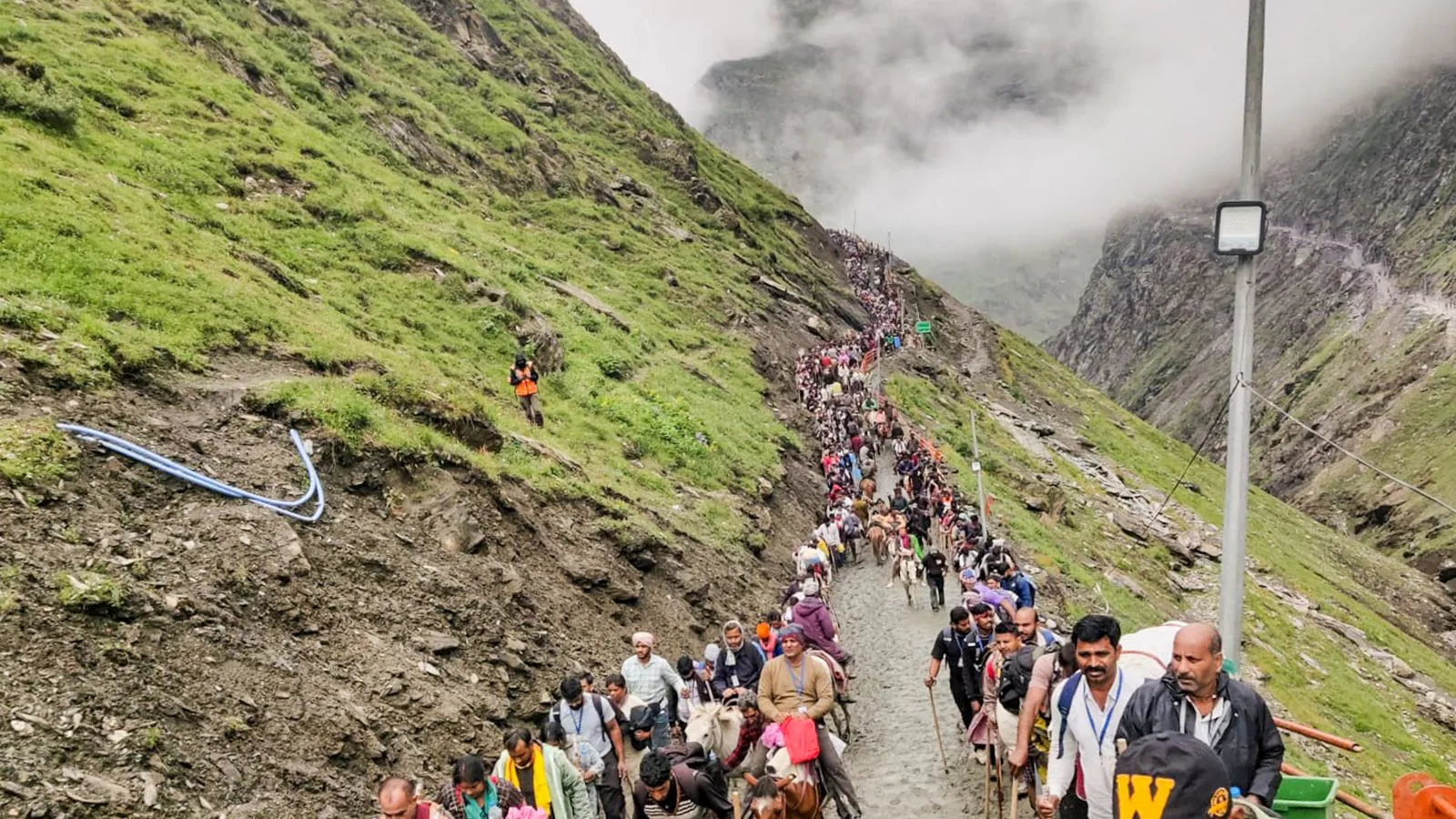
Jammu: With the annual Shri Amarnath Yatra set to commence on July 3, devotees planning to visit the holy cave shrine this year may face travel challenges as Vande Bharat trains on the Jammu–Srinagar route are witnessing heavy demand while helicopter services will remain suspended throughout the pilgrimage period.
Railway reservation data indicates a long waiting list for Vande Bharat trains up to July 15, making it difficult for pilgrims to secure confirmed tickets.
The high-speed train has emerged as the preferred mode of travel for devotees as it reduces the travel time between Jammu and Srinagar to about five hours, compared to nearly ten hours by road through the Jammu-Srinagar National Highway.
The train also offers a safer and more comfortable alternative, sparing passengers from risks associated with landslides, traffic congestion and adverse weather conditions.
Since the launch of the 20-coach Vande Bharat service on May 2, nearly 1,500 passengers can travel in a single trip, while two pairs of trains operating daily in both directions cater to around 3,000 passengers.
For pilgrims heading to the Amarnath cave shrine, the train significantly cuts travel time and offers an opportunity to experience the world’s highest railway arch bridge over the Chenab River.
However, with seats filling rapidly, many devotees may have to rely on road transport.
There is also growing demand for the restoration of the earlier eight-coach Vande Bharat service between Katra and Srinagar, which was suspended after the inauguration of the Jammu-Srinagar service.
Railway officials believe its revival could provide relief to hundreds of additional passengers during the pilgrimage season.
Meanwhile, the Shri Amarnath Shrine Board has officially informed devotees that helicopter services will not be available for this year’s pilgrimage. Citing security considerations and an order issued by the Home Department, both the Pahalgam and Baltal routes have been declared no-flying zones from July 1 until the conclusion of the Yatra on August 28.
As a result, pilgrims will have to undertake the journey on foot or use ponies and palkis from the base camps. The helicopter service, introduced in 2003 and used by around eight percent of pilgrims annually, was also suspended last year.
Despite the restrictions, enthusiasm among devotees remains high. More than 3.5 lakh pilgrims have already completed advance registration for the 57-day pilgrimage, which will conclude on Raksha Bandhan, August 28.
Preparations for the Yatra are progressing rapidly, with the Shrine Board granting permission to 122 langar organisations to set up community kitchens along the Pahalgam and Baltal routes. Most of these organisations are expected to begin moving equipment and supplies to Kashmir after June 15.
In a related development, Indian Railways will operate a special summer train from Jammu Tawi to Chhatrapati Shivaji Maharaj Terminus, Mumbai, on June 7 to accommodate the increased passenger rush. The train will consist of 21 coaches and halt at major stations including Pathankot, Jalandhar, Ludhiana, Delhi, Agra, Jhansi, Bhopal, Itarsi, Bhusawal, Nashik Road and Kalyan before reaching Mumbai.
With registrations crossing the 3.5-lakh mark and travel demand rising steadily, authorities have advised pilgrims to make travel arrangements well in advance to avoid last-minute inconvenience during one of the country’s most significant religious pilgrimages.

