



Jammu: Jammu and Kashmir is witnessing a strong revenue growth with excise revenue expected to rise by 4% to ₹2,000 crore in FY 2024-25.
This increase comes due to the government’s improved e-Abgari platform, a new excise policy, and transparent liquor vending auctions.
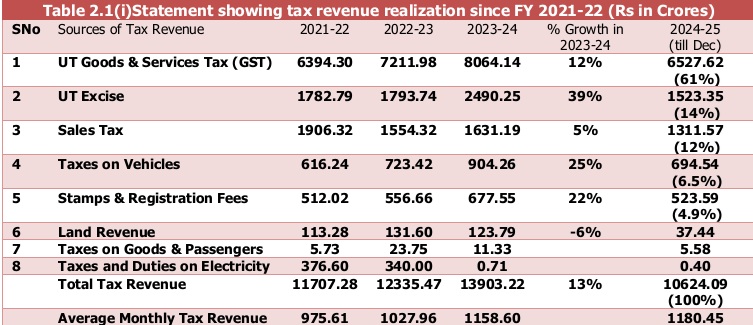
“Due to a number of revenue enhancement measures, J&K’s overall tax collection went up from ₹12,335.47 crore in FY23 to ₹13,903.22 crore in FY24, showing an increase of 13% on a year-on-year basis. Till the third quarter of FY25, the tax collection was ₹10,624.09 crore, which was 76% of last year’s total collection.”. Interestingly, GST contributed 61% of tax revenue generated up to Q3 of FY25, followed by excise (14%), sales tax (12%), vehicle tax (6.5%), and land registration charges (4.9%),” says the Economic Report by Jammu and Kashmir Chief Minister Omar Abdullah.
Aside from tax collections, J&K has been working towards non-tax collections, especially in the power area. Expansion of the consumer base, online billing, and the deployment of 6.84 lakh smart meters have resulted in a considerable decline in T&D losses. All these efforts have resulted in a 27% growth in annual tariff collections for FY24, with further improvements in FY25.
Revenue from land leases in industrial zones has also been a major contributor, going past ₹400 crore over the last four years. Further, non-tax revenue went up from ₹5,147.55 crore in 2022-23 to ₹6,430.33 crore in 2023-24, a 25% increase. This is seen reaching ₹7,200 crore in FY25 with an additional ₹800 crore coming through continuing reforms.
The six largest sources of revenue—GST, power tariff, excise, sales tax, water charges, and vehicle tax—have increased remarkably, with their total share in revenue increasing from 86% in FY22 to 93% in FY25. Importantly, collections from vehicle tax increased by 96%, power tariff revenue increased by 67%, GST increased by 36%, water charges increased by 33%, and excise collections increased by 14%. Sales tax, however, fell by 8%, and other smaller revenue items decreased by 30%.
Despite this progress, J&K’s fiscal situation remains challenging due to high committed expenditures. Salaries, pensions, and debt servicing account for over 70% of total expenditure, with power purchase under-recovery being a major financial burden. The UT government has undertaken corporatization of the power sector and implemented cost-cutting measures to manage expenditure effectively.
In order to further boost revenues, J&K has launched asset monetization schemes, involving auction of prized assets like Centaur Hotel, Pahalgam Club, and Tatoo Ground. Auction of Centaur Hotel, Srinagar, through forward auction will yield ₹44 crore per year, 60% over the reserve price. Also, auction of a lithium block at Salal, Reasi, with an area of 317 hectares, is likely to contribute ₹100 crore per year to the exchequer.
With the UT facing financial constraints, the central government remains a key player in filling the resource gap. J&K gets substantial financial support in the form of Union Budget allocations (Demand 58), Finance Commission grants, and centrally sponsored schemes (CSS). Central transfers account for almost 70% of J&K’s revenue receipts, which is much higher than the national average of 43%.

