



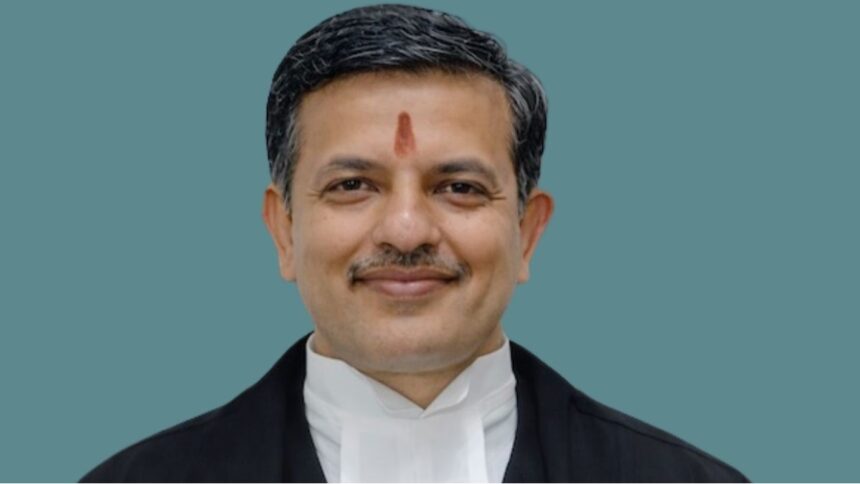
Jammu: The Central Government has cleared the appointment of Justice Pushpendra Singh Bhati as the Chief Justice of the High Court of Jammu & Kashmir and Ladakh, succeeding Justice Sanjeev Kumar, who has been serving as the Acting Chief Justice since June 2.
Justice Bhati is currently serving as a judge of the Rajasthan High Court. His appointment was cleared by the Centre after the Supreme Court Collegium recommended his name for the post on August 31.
Justice Bhati will assume charge of the High Court of Jammu & Kashmir and Ladakh following the formal notification of his appointment.
The appointment comes after Justice Sanjeev Kumar took over as Acting Chief Justice of the High Court on June 2. Justice Bhati’s elevation will provide a full-time Chief Justice to the High Court, which exercises jurisdiction over both the Union Territories of Jammu & Kashmir and Ladakh.
The Supreme Court Collegium, headed by Chief Justice of India Justice B R Gavai, had recommended Justice Bhati’s appointment on August 31 as part of a series of recommendations concerning the leadership of various High Courts.
Justice Bhati, who has been serving on the Rajasthan High Court, will now take over the administrative and judicial responsibilities of the J&K and Ladakh High Court.
The Central Government’s approval is the latest step in the appointment process, following the recommendation of the Supreme Court Collegium.
Meanwhile, as many as 25 names recommended by the Supreme Court Collegium for appointment as judges of various High Courts are currently pending with the Central Government, according to sources familiar with the judicial appointments process.
The recommendations are largely spread across the Delhi, Calcutta, Madras, Punjab and Haryana and Gujarat High Courts, among others. Sources said the number of pending recommendations has declined considerably compared with the recent past.
The oldest pending recommendation is that of advocate Saurabh Kirpal, whose name was first recommended by the Delhi High Court Collegium in October 2017 for elevation as a High Court judge.
Kirpal, son of former Chief Justice of India B N Kirpal, has been awaiting a final decision for several years. The Supreme Court Collegium is learnt to have deferred consideration of his name on three occasions before the Collegium headed by then CJI N V Ramana recommended him in November 2021.
The government subsequently returned the file to the Supreme Court Collegium for reconsideration in November 2022. After the Collegium reiterated its recommendation, the file has remained pending with the government.
Sources said most of the other 25 recommendations pending with the Centre are relatively recent, with only two other names besides Kirpal’s having been pending for a longer period.
Under the judicial appointments process, High Court Collegiums recommend judicial officers and advocates for appointment as judges to the Department of Justice under the Union Law Ministry. The department obtains and adds relevant inputs, including Intelligence Bureau reports, before forwarding the files to the Supreme Court Collegium.
The Supreme Court Collegium then considers the recommendations and either recommends the names for appointment or returns the files to the concerned High Court Collegiums for reconsideration.
The 25 pending recommendations come against the backdrop of continuing vacancies across the country’s High Courts. The combined sanctioned strength of the 25 High Courts stands at 1,122 judges, while 304 posts are currently vacant. Their working strength is 818 judges, leaving around 27 per cent of the sanctioned posts vacant.

