



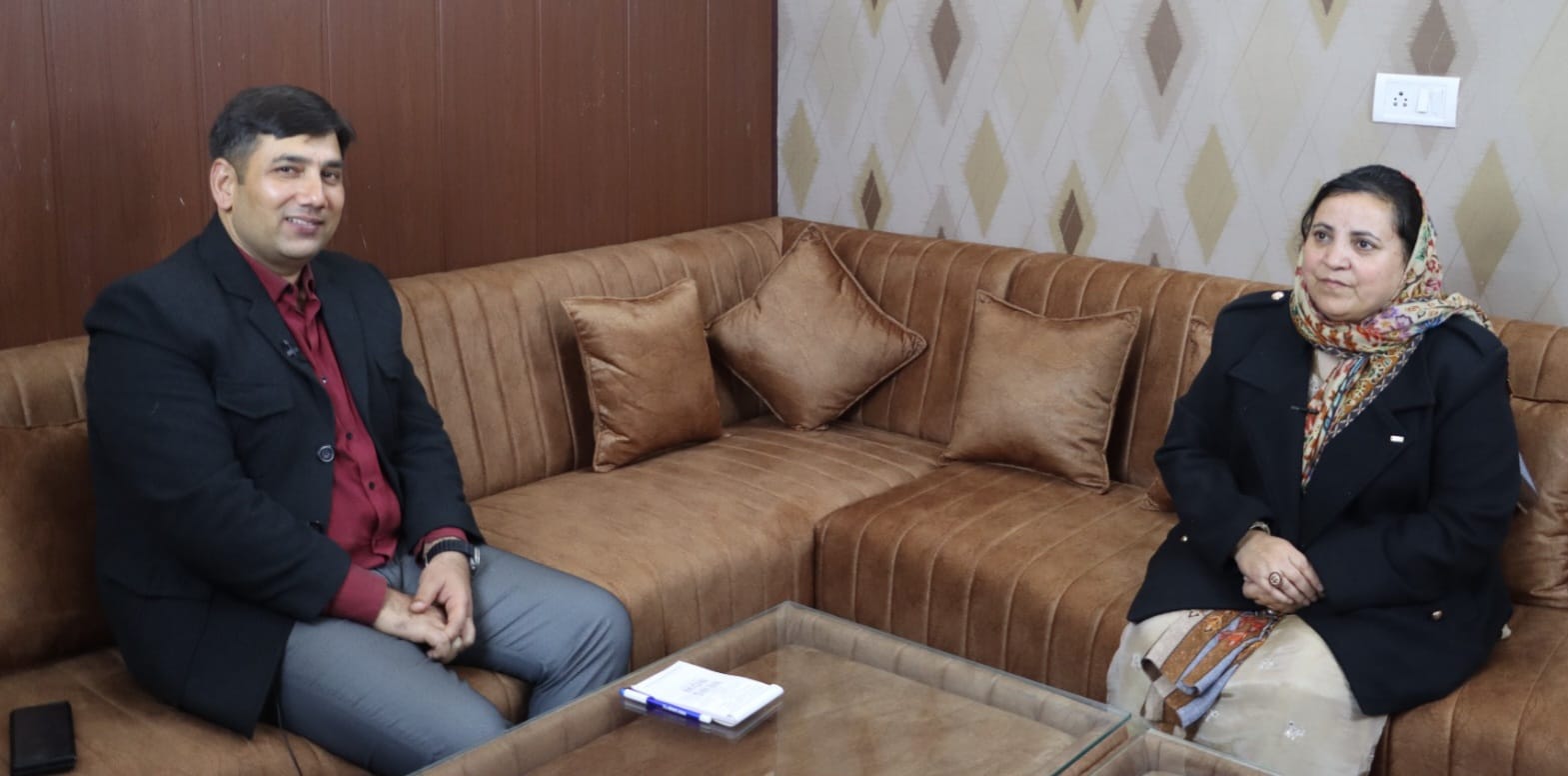
In an exclusive interview on The News Now’s Spotlight Programme, Faheem Tak engages with Sakina Itoo, the esteemed Minister of School/Higher Education, Health & Medical Education & Social Welfare for the Government of Jammu and Kashmir. The discussion delves into the challenges and strides being made in the region’s healthcare, education, and social welfare sectors, particularly in rural areas. Minister Itoo shares insights on the recent health crisis in Budhal, efforts to improve school infrastructure, and initiatives to ensure better healthcare accessibility for every citizen.
Watch full interview here
Q1: Can you share your thoughts on the situation in Budhal, where the government completed 100 days and what happened there?
Answer: The loss of innocent lives, particularly children and elderly people, was heartbreaking. It’s important to note that the Health Department immediately acted upon receiving information about the incident. The first reported death occurred on December 15, and I personally visited the area. The initial concerns were about a bacterial or viral infection, but after health checks for over 3,000 people, it was found that the issue was isolated within three families. I commend the health team that worked tirelessly, and fortunately, there have been no deaths in the last week.
Q2: Was this situation a surprise to you, considering the Health Department’s response?
Answer: Yes, this was an unexpected situation. Initially, we thought it could be a viral or bacterial disease affecting a larger area. However, after conducting health check-ups and tests, including food and water tests, it was clear that the problem was confined. The investigation led us to understand that it was related to meningitis, which causes brain swelling. We conducted extensive tests, and though there were delays in receiving the final reports, I believe the department responded promptly.
Q3: What steps did the Health Department take to control the situation in Budhal?
Answer: The Health Department took immediate action, with doctors, nurses, and health workers going door to door to check up on over 3,000 people. There was no delay in initiating this process. The department also tested food grains, water, and medicines used by the affected families. Although the reports came later, I must give credit to the department for acting quickly and efficiently to prevent the spread of the illness.
Q4: Could you shed light on the Health Department’s approach to rural areas, especially in terms of the availability of doctors and hospital infrastructure?
Answer: Indeed, rural areas are a priority for the government. While cities like Jammu have some private hospitals, rural areas face significant challenges with healthcare infrastructure and the availability of medical staff. There are difficulties with doctors not wanting to work in remote areas, and hospital buildings often lack functional equipment. In my role, I’ve visited areas like Rajouri, Poonch, and Anantnag, and I understand the importance of ensuring that healthcare services reach every corner of the region. The government has made efforts to address these challenges, though there’s still a long way to go.
Q5: What are the key initiatives you’ve undertaken to improve healthcare in remote areas of Jammu and Kashmir?
Answer: The government has focused on improving healthcare services, especially in remote areas. For example, we’ve launched dialysis facilities in sub-district hospitals, which were previously unavailable in such locations. We’ve also taken steps to ensure that essential equipment, such as MRI and CT scan machines, are functional in the region. Hospitals in areas like Baramulla and Anantnag now have more diagnostic facilities, reducing the need for people to travel to cities for treatment. The Chief Minister himself has taken a very active role in ensuring these improvements are made swiftly.
Q6: What are the challenges faced by the healthcare system in terms of infrastructure and medical staff?
Answer: One of the major challenges is the lack of medical staff in rural areas. While we’ve made progress in improving infrastructure, such as building new hospitals, these buildings often lack doctors, paramedical staff, and medical equipment. It’s essential that we not only focus on constructing buildings but also ensure that these facilities are fully equipped and staffed. We are working towards addressing this issue by hiring more medical professionals and ensuring that the equipment is functional.
Q7: Can you elaborate on the government’s efforts to enhance diagnostic facilities in the region?
Answer: In the last three months, we’ve made significant strides in improving diagnostic facilities. One of the major challenges faced by people in rural areas was the unavailability of advanced diagnostic equipment like MRI and CT scan machines. To address this, we’ve introduced CT scan facilities in Jammu and have worked on improving access to diagnostic equipment in other districts. Additionally, we are working to set up more MRI machines in remote areas. This ensures that people don’t have to travel long distances for essential tests.
Q8: With healthcare improvements in mind, how is the government tackling the rising issue of cancer in Jammu and Kashmir?
Answer: Cancer is becoming a significant concern in Jammu and Kashmir, and we are fully aware of the growing number of cancer patients. The government is focused on detecting cancer early through the use of advanced equipment like the CAT lab and other diagnostic tools. We are investigating the root causes, including possible dietary factors, and are working on improving early detection to prevent late-stage diagnoses. Additionally, we are ensuring that cancer treatment is accessible within the region, preventing patients from needing to travel outside the state for care.
Q9: What are your thoughts on the future of healthcare in Jammu and Kashmir, especially in terms of infrastructure and services in rural areas?
Answer: We are committed to ensuring that healthcare infrastructure and services improve significantly, especially in rural areas. While we’ve made some progress in the last 100 days, there’s still much work to be done. The focus will remain on building functional healthcare facilities, recruiting more medical staff, and ensuring that essential equipment is available in every hospital. Our goal is to make healthcare accessible to every citizen, regardless of where they live in Jammu and Kashmir.
Q: What do you say about the shortage of medical professionals in remote areas?
Answer: Yes, there is a shortage of doctors and paramedical staff. We initially recruited 300 doctors with the hope that they would serve in remote areas, but many have hesitated to go. It’s a difficult situation, and it will take time to address the staff shortages. However, the work we’ve done in just the last three months is far more than what has been accomplished in the last 10 years. When there were no public representatives after 2014, people didn’t have a direct way to reach the Secretariat. Today, thousands come to express their concerns, and we try to listen to them.
Q: You have also worked as a minister before in Jammu and Kashmir. What differences have you observed in governance between the past and now under the Union Territory?
Answer: The experience of working as a minister in a state was different because we had a different structure and authority. But now, as a Union Territory, the situation is different. Jammu and Kashmir has a unique identity that cannot be compared to other states. It was once a beautiful and prosperous region, and the transition to a Union Territory is hard to digest for many, including politicians and citizens. Despite the challenges, we are working with the hope that one day Jammu and Kashmir will regain its status as a state.
Q: There have been many challenges since the Union Territory status was granted. What are your thoughts on this?
Answer: The change to a Union Territory was not easy, and it still feels challenging to accept. Jammu and Kashmir was a historically important and beautiful state, and the transition has left many people feeling disconnected. However, we are adjusting to the situation, and even though it is hard, we must keep working. The hope is that the statehood status will be restored soon, and people will get relief from their issues.
Q: Have you felt the impatience of the people as some promises take time to fulfill?
Answer: We have already fulfilled many promises from our manifesto. For example, we passed a resolution to restore Jammu and Kashmir’s statehood and brought forward the resolution regarding the special status. We are also addressing issues like unemployment by recruiting thousands through recruitment boards. However, as you know, such processes take time, and the work done in just three months may seem less, but it’s a significant start. We will continue to work on fulfilling the rest of our promises.
Q: You mentioned the academic calendar and significant reforms in school education since 2019. What about the transfer policy for teachers and the infrastructure needs in schools? Will you be making any changes to the transfer policy?
Answer:: We’ve already made improvements in school infrastructure. When talking about education, it’s essential to focus on building better facilities. We’ve begun collecting data on where we need new buildings, additional accommodations, or where there are existing facilities that need improvement. The money for this was already allocated but unfortunately not spent properly. We are ensuring that funds are now being used appropriately for school infrastructure.
Regarding the transfer policy, it’s important to note that this is a government policy designed to serve the people. We’ve seen the impact of these transfers on teachers and employees, and we understand that these policies can be difficult, especially when employees are far from home. We’re considering each case individually, and we are willing to accommodate genuine issues like health, family problems, or other concerns. We are committed to creating a fair transfer policy and will make adjustments where necessary.
Q: You mentioned that the lack of infrastructure in schools has been a significant issue in recent years. How do you plan to address this issue in the coming years?
Answer:: The infrastructure of schools is a priority. We need to ensure that schools are well-equipped, have proper buildings, and that children have a safe and conducive learning environment. We’ve already started working on this and are getting feedback from both the Directorates and elected representatives. We want to ensure that children receive quality education in schools with all the necessary facilities, such as playgrounds and mental wellness programs. This is a continuous effort, and I’m hopeful that it will improve in the coming years.
Q: You talked about challenges faced by government employees, especially teachers who are posted far from home. How will you address their concerns?
Answer:: I understand the difficulties faced by employees who are posted in remote areas, especially when they are far from their families. I’ve had cases where employees were mentally stressed due to distance and work pressures. We’ve been actively looking into these issues and are making adjustments where necessary. If someone is in a situation that is difficult due to health or family concerns, we will consider their requests and make efforts to ensure that they are relocated closer to home. We are trying to balance the system while considering the well-being of our employees.
Q: There is often a concern about the transfer of doctors, teachers, and other professionals. What is your message to them and what steps are you taking to ensure smooth transfers and fairness in the system?
Answer:: Transfers are an essential part of the system, but we understand that they can be difficult for those affected. I encourage everyone to approach us with their genuine issues, whether it’s health-related, family-related, or any other valid reason. We are ready to consider such concerns and will do our best to help. I urge everyone to understand that the system is designed to ensure fairness, but we are willing to make exceptions in deserving cases. I want to ensure that our workforce remains motivated and able to contribute to the betterment of society.
Q: You mentioned that you had aspirations to be a doctor but became the Health Minister instead. How do you feel about this change in your career?
Answer:: Yes, my original ambition was to become a doctor, but I understand that Allah had a different plan for me. Instead of being a doctor, He made me the Minister of Health, allowing me to contribute at a broader level. While being a doctor would have been fulfilling, I now have the opportunity to work on a much larger scale, ensuring that healthcare services reach everyone. I assure the people that I am here to support them and will always stand by their side, wherever and whenever needed.
Q: Any final message for the people of Jammu and Kashmir?
Answer:: I want to assure the people of Jammu and Kashmir that I am here for you. I will do my best to address the challenges we face, whether in healthcare, education, or social welfare. But I also request your cooperation. The government can only do so much, and together, we can achieve much more. Please support us in our efforts, and I promise you, change will come. We will continue to work for the betterment of everyone, and I will always be there to help you.

