



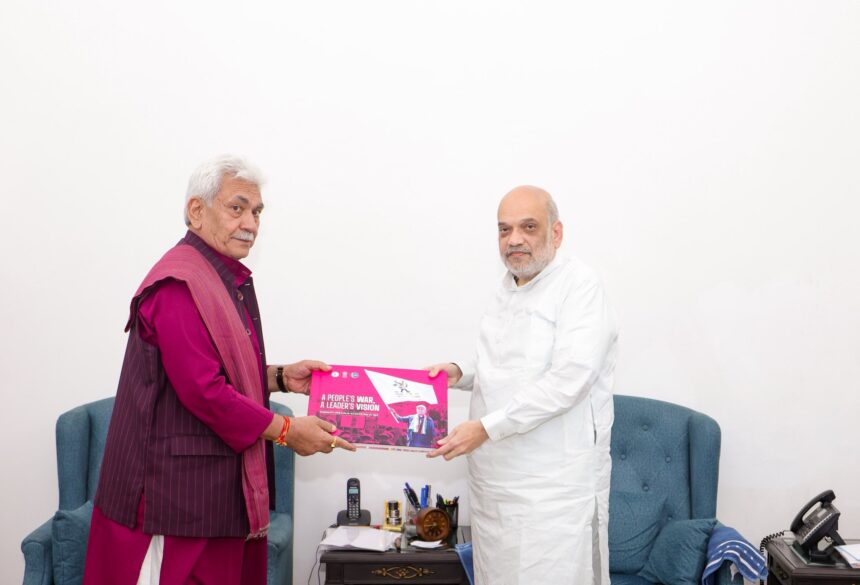
Jammu: Jammu and Kashmir Lieutenant Governor Manoj Sinha on Sunday called on Union Home Minister Amit Shah and briefed him on the security, administrative and developmental situation in the Union Territory, with the ongoing Shri Amarnath Ji Yatra and its concluding phase figuring prominently in the discussions.
Ladakh Lieutenant Governor Vinai Kumar Saxena also met Shah and discussed key issues concerning the Union Territory, including development and administrative priorities.
Sinha’s meeting with Shah came a day after he met Prime Minister Narendra Modi in New Delhi and briefed him on the security, administrative and developmental situation in Jammu and Kashmir.
During his meeting with the Prime Minister on Saturday, Sinha also presented him with the coffee table book documenting the Nasha Mukt Jammu Kashmir Abhiyan – 100 Days Campaign.
The back-to-back meetings with the Prime Minister and Home Minister come at an important juncture for Jammu and Kashmir, with the annual Amarnath Yatra entering its final phase and the administration maintaining heightened focus on security and arrangements for pilgrims.
Amarnath Yatra security in focus
More than five lakh pilgrims have undertaken the Shri Amarnath Ji Yatra since it began on July 3.
The traditional Chhari Mubarak, the holy mace of Lord Shiva, left the Dashnami Akhara in Srinagar on Saturday for Pahalgam, marking the beginning of the final traditional phase of the pilgrimage.
The holy mace is scheduled to reach the cave shrine for the main Pujan and Darshan on August 28, coinciding with Shravan Purnima. The traditional rituals will continue thereafter, culminating with the Visarjan of the holy mace.
Against this backdrop, security arrangements, the overall law-and-order situation and the smooth conduct of the remaining pilgrimage are understood to have been among the issues discussed during Sinha’s meeting with Shah.
The Lieutenant Governor also apprised the Home Minister of the latest administrative and developmental initiatives being undertaken across Jammu and Kashmir.
Jammu and Kashmir continues to witness large-scale religious activity alongside sustained efforts to promote tourism, infrastructure and economic development.
The administration has been focusing on maintaining a secure environment while ensuring that development and public welfare programmes continue across the Union Territory.
Sinha’s discussions with the Centre’s top leadership in two consecutive days assume significance in this context, coming as the Amarnath Yatra approaches its conclusion.
The J&K administration’s campaign against drug abuse was also highlighted during Sinha’s recent interaction with Prime Minister Modi.
The Nasha Mukt Jammu Kashmir Abhiyan – 100 Days Campaign was spearheaded by Sinha across all 20 districts, with government departments, educational institutions, youth organisations, civil society groups and local communities participating in awareness and prevention programmes.
According to figures shared by the administration, authorities registered 20,292 FIRs, dismantled 92 drug networks and identified 4,474 drug hotspots during the campaign.
Properties worth Rs 188.9 crore linked to the narcotics trade were also attached, while action under the PIT-NDPS Act was initiated against drug traffickers.
The administration additionally recommended suspension or cancellation of 884 driving licences and 687 vehicle registration certificates in eligible drug-related cases.
The campaign sought to combine enforcement with awareness, prevention and rehabilitation in tackling drug abuse, particularly among the youth.
Saxena discusses Ladakh priorities
Meanwhile, Ladakh LG Vinai Kumar Saxena held discussions with Home Minister Amit Shah on key issues concerning the Union Territory.
The meeting comes as the Ladakh administration continues to focus on water security, agriculture, infrastructure, tourism and other development priorities suited to the region’s difficult terrain and climatic conditions.
The UT has recently pushed several water conservation and irrigation initiatives, including Project Him Sarovar, Himalayan Rock Check Dams and canal projects, aimed at strengthening long-term water and agricultural security.
Saxena’s interaction with Shah provided an opportunity to take up these and other administrative and developmental priorities of Ladakh with the Union government.
Back-to-back meetings underscore Centre-UT coordination
The meetings of the two Lieutenant Governors with the Home Minister come amid continued Centre-UT coordination on security, administration and development in Jammu and Kashmir and Ladakh.
For J&K, the immediate focus remains the safe completion of the Amarnath Yatra and maintaining the prevailing security environment, while development and public welfare remain key elements of the administration’s broader agenda.
Sinha’s meeting with Shah, coming a day after his meeting with Prime Minister Modi, also places the latest assessment of Jammu and Kashmir’s security and development directly before the Union government’s top leadership as the pilgrimage enters its final phase.
Tap J&K’s potential in hydropower, tourism, horticulture: LG to industry
New Delhi: Lieutenant Governor Manoj Sinha on Saturday highlighted the transformation taking place in Jammu and Kashmir and called upon industry leaders to actively invest in the Union Territory, saying its vast potential in sectors such as hydropower, horticulture, tourism and handicrafts must be harnessed to make it a significant contributor to India’s development story.
Addressing the World Wisdom Forum, organised by the IIT Alumni Council in New Delhi, the Lieutenant Governor said Jammu and Kashmir possesses immense potential in its youth power, natural resources, tourism, horticulture, handicrafts and hydropower sectors.
“Hon’ble Prime Minister Shri Narendra Modi has created confidence and opened new avenues for the youth in Jammu Kashmir. It is the collective responsibility of Industry now to make Jammu Kashmir a subject of constructive action,” Sinha said.
The Lieutenant Governor said Jammu and Kashmir’s hydropower potential needs to be recognised, while its horticulture, tourism and handicrafts sectors should be connected with global markets.
“We must recognise its hydropower potential. Connect its horticulture, tourism and handicrafts with global markets. The intervention of industry leaders in every sector of Jammu Kashmir will be an investment in India’s future,” he said.
Earlier in his keynote address, Sinha congratulated the IIT Alumni Council for bringing together eminent personalities from different fields to deliberate on the theme of Viksit Bharat and India’s collective future.
He said India’s journey towards becoming a developed nation must be inclusive, rooted in tradition while remaining forward-looking, and should maintain a balance between technological strength and human sensitivity.
Reflecting on the country’s aspirations under the leadership of Prime Minister Narendra Modi, the Lieutenant Governor said the seed of Viksit Bharat had already sprouted and that historic milestones had been achieved over the past 12 years.
“With international agencies predicting India’s rise as one of the world’s three largest economies well before 2047, the nation must also define the character of its civilisation, spirituality, and cultural framework,” he said, adding that history remembers civilisations not only for their economies but also for how they use the resources and prosperity generated by them.
Sinha also identified five major challenges that, he said, eminent personalities, industries, business leaders and engineers must address collectively to realise the vision of Viksit Bharat.
These include transforming India’s vast young population into a skilled workforce equipped for emerging technologies, ensuring sustainable development while balancing progress with environmental responsibility, strengthening institutions to make them transparent, accountable, efficient and responsive to citizens’ needs, and ensuring balanced regional development by bridging the gap between advanced cities and underserved regions.
He also stressed the need for India to emerge as a global creator of technologies, innovations and ideas.
“We must create the future rather than purchase it by becoming not just a consumer but a global creator of technologies, innovations, and ideas. We must resolve that we will not merely use artificial intelligence; we will also contribute to the future of artificial intelligence. We must resolve that we will not import innovation; we will export innovation,” the Lieutenant Governor said.
Sinha further said that the vision of Viksit Bharat was not limited to economic growth, but envisaged the creation of an inclusive and prosperous nation where development is the right of every citizen.
Calling upon industry leaders, policymakers, educators and citizens to reflect on the impact of their contributions, he urged the younger generation to prepare for the responsibilities that await them in 2047, when India will complete 100 years of independence.
“The new generation, which will be at the peak of its careers and energy in 2047, must ask itself today—When India becomes a developed nation, what will you be creating? What impact will my creation have on society, and how will it affect people’s lives?” he said.
“Although eminent personalities are engaged in different activities, I strongly believe that together they are creating one common thing—the future of India. We must contribute to the welfare of our country, society and humanity as a whole,” the Lieutenant Governor added.
During the event, Sinha also felicitated achievers from diverse sectors.
Shri Shashank Mani Tripathi, Member of Parliament; Shri Ravi Sharma, President, IIT Alumni Council; Dr. Ashish Chauhan, MD and CEO of the National Stock Exchange (NSE); eminent IIT alumni and prominent citizens from different walks of life were present.

