



Leh: Ladakh Lt Governor V K Saxena on Sunday disbursed Rs 1.10 crore to more than 1,200 Pashmina goat herders as production-based incentive, hailing the move as a milestone towards strengthening the Pashmina sector and empowering nomadic herders.
The 25 per cent production-based incentive was announced following the first meeting of Ladakh Pashmina Development Board last month.
L-G Saxena, who was attending the Changthang Nomadic Festival on the banks of the Tso (Lake) Moriri in Korzok on Sunday, said the incentive — introduced for the first time — would increase the income of nomadic Pashmina herders, boosting profitability and sustainability of the sector.
He said the incentive has already resulted in higher collection of raw Pashmina, with 19 tonne gathered till July this year, compared to 16 tonne in the entire 2025.
Under the scheme, Rs 1.10 crore has been transferred through direct benefit transfer (DBT) to over 1,200 Pashmina herders mostly belonging to Samad, Kharnak and Korzok villages in Changthang district — known to be the largest producers of Pashmina wool.
Among these villages, herders in Samad received around Rs 44 lakh, while those in Kharnak and Korzok villages got Rs 28 lakh and Rs 23 lakh, respectively, accounting for the largest share of the incentive.
The L-G said 60 per cent of the incentive, received by the beneficiaries, would be reinvested in scientific breeding of Pashmina goats, the other 20 per cent in procuring modern combing equipment and other infrastructure, while the remaining 20 per cent could be utilised by the beneficiaries for household and personal needs, thereby, ensuring financial sustainability of the herders.
The L-G also announced that a revolving fund of Rs 8 crore has been provided to the All Changthang Pashmina Growers Marketing Cooperative Society, which runs a Pashmina dehairing plant in Leh, to ensure timely payments to growers for produce.
Using this fund, 50 per cent of the Pashmina cost will be paid immediately to producers, with the balance to be paid within two months, eliminating payment delays of 8-10 months which were prevalent earlier.
Calling for greater adoption of scientific practices, Saxena urged Pashmina herders to work towards increasing average fibre production from 200 grams per goat at present, to at least 350 grams per goat.
He encouraged raising the Pashmina goat population from around 2 lakh at present, to at least 4 lakh within the next three years, through scientific breeding.
He also stressed the need to improve the cleanliness and quality of raw Pashmina to reduce wastage and secure better prices.
The L-G termed Pashmina a “timeless heritage” of Ladakh and its Changpa nomadic community, who have mastered goat rearing over the centuries. He said the Changpa community is a live example of resilience, sustainability and harmonious coexistence with nature.
“Pashmina is not merely a product; it is part of Ladakh’s cultural identity and the livelihood of thousands of our pastoral families. Our objective is to ensure that those who have preserved this heritage for generations, receive a greater share of its economic value,” Saxena asserted.
“The Ladakh administration’s decision of 25 per cent production-based incentive and the Rs 8-crore revolving fund is strengthening the Pashmina value chain and improving returns to nomadic pastoral communities,” the L-G said.
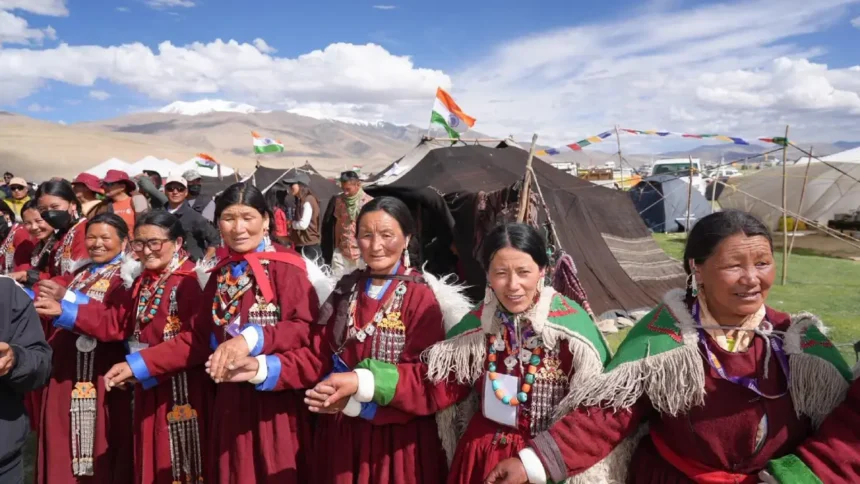
On the day, the Changthang Nomadic Festival saw a huge turnout of more than 10,000 people, including a large number of foreign tourists.
The festival, which started as a local celebration a few years back, has now emerged as an international event, drawing visitors from across India and abroad.
The L-G said the festival has emerged as an important platform for showcasing Changpa culture, traditional pastoral practices, handicrafts, music, dance, cuisine and way of life to audiences at the national and international level.

