



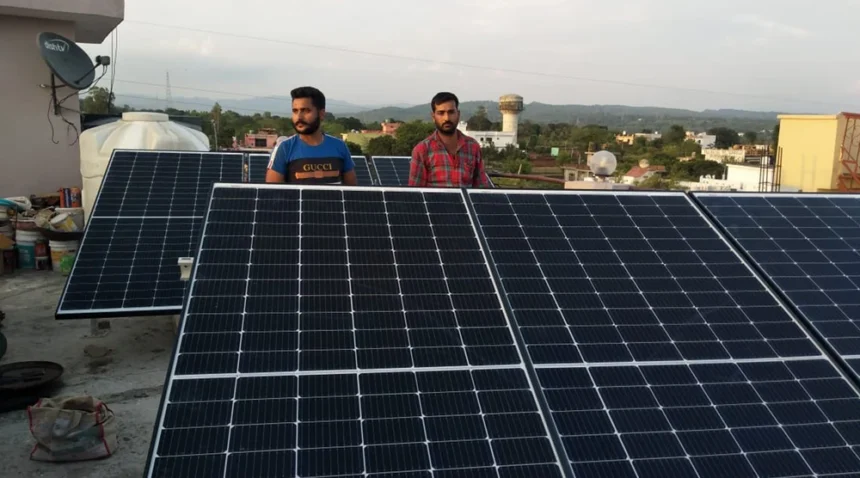
Jammu: Jammu and Kashmir has recorded significant progress in renewable energy adoption with 39,160 rooftop solar systems installed under the Pradhan Mantri Surya Ghar-Muft Bijli Yojana (PMSGMBY) and 4,876 solar pumps installed under the PM-KUSUM Scheme, the Central Government informed the Rajya Sabha on Tuesday.
Replying to separate questions in the Rajya Sabha, Minister of State for New and Renewable Energy and Power Shripad Yesso Naik said the Ministry is regularly reviewing the implementation of renewable energy programmes across the country, including Jammu and Kashmir, to ensure timely execution and wider access to clean energy.
The Ministry informed Parliament that the PM Surya Ghar: Muft Bijli Yojana, launched in February 2024 with a financial outlay of ₹75,021 crore, aims to install rooftop solar systems in one crore residential households across the country by the end of 2026-27.
The scheme is demand-driven, allowing all residential consumers with grid-connected electricity connections to apply through the national portal.
As of July 28, 2026, 85,908 households in Jammu and Kashmir had applied under the scheme, while 39,160 rooftop solar systems had already been installed across the Union Territory. Srinagar leads the list with 6,518 installations, followed by Jammu (5,520) and Kupwara (3,863).
Other districts with substantial installations include Anantnag (2,560), Baramulla (2,487), Kathua (2,364), Budgam (2,137), Pulwama (2,057), Shopian (1,511), Doda (1,494), Samba (1,221), Udhampur (1,192), Kulgam (1,078), Rajouri (1,074), Ganderbal (1,050), Bandipora (1,010), Ramban (559), Reasi (549), Kishtwar (500) and Poonch (416).
The Government also noted that 4,888 rooftop solar systems had earlier been installed under the Grid Connected Rooftop Solar Programme (Phase-II), which has now been merged with the PM Surya Ghar scheme.
The Ministry stated that ₹278.55 crore has been released for rooftop solar programmes in Jammu and Kashmir during the last five years.
It further informed Parliament that banks have sanctioned thousands of loans to facilitate installations in the Union Territory, reflecting increasing public participation in the scheme.
At the national level, the Government said 40.07 lakh rooftop solar systems have been installed, benefiting 48.21 lakh households as of July 24, 2026.
More than 21.31 lakh loan applications worth ₹39,930 crore have been sanctioned, while loans amounting to ₹31,652 crore have already been disbursed.
Responding to another question regarding subsidy enhancement, the Ministry clarified that there is no proposal at present to increase the subsidy under the PM Surya Ghar scheme.
However, the existing financial assistance continues to provide support of up to 60 per cent of the benchmark cost, with Central Financial Assistance of ₹30,000 per kW for the first 2 kW of rooftop solar capacity and ₹18,000 per kW for the next 1 kW for residential consumers.
The Government also clarified that there is no state-wise allocation of funds, as the scheme operates entirely on a demand-driven basis.
The Government also shared the latest progress under the PM-KUSUM Scheme in Jammu and Kashmir.
It informed Parliament that 4,876 solar-powered irrigation pumps have been installed under Component-B against an allocation of 4,891 pumps.
The highest number of installations has been recorded in Pulwama (1,542 pumps), followed by Anantnag (1,189), Kathua (478), Jammu (342), Shopian (266), Baramulla (259), Samba (219) and Budgam (214).
Smaller numbers of installations were reported from districts such as Bandipora, Ganderbal, Rajouri, Kupwara, Srinagar, Udhampur, Kishtwar, Poonch and Reasi, while Doda and Ramban had no allocation under the component.
The Ministry revealed that Jammu and Kashmir had initially received a sanction for 20 MW of solar capacity under PM-KUSUM Component-A and 4,000 pumps under Component-C, but these allocations were cancelled due to no reported progress by the Union Territory.
It added that ₹34.11 crore has been released under PM-KUSUM to Jammu and Kashmir during the last five years.
The Government further informed the House that no projects have been sanctioned in Jammu and Kashmir under the National Green Hydrogen Mission or the Bioenergy Programme during the last five years.
It also stated that no Central financial assistance scheme for Small Hydro Power projects has been operational during this period.
The Ministry said the renewable energy programmes are expected to deliver multiple long-term benefits, including lower electricity bills for households, reliable daytime power supply, reduced dependence on diesel for irrigation, savings for power distribution companies, employment generation, improved electricity access in remote and tribal regions, and enhanced energy security.
The replies also contained information relating to Ladakh. As of July 24, 2026, the Union Territory has recorded 2,015 rooftop solar installations under the PM Surya Ghar scheme, including 2 installations up to 2 kW, 8 installations in the 2–3 kW category and 2,005 installations above 3 kW.
The Ministry also informed Parliament that loan sanctions and disbursements for rooftop solar installations have begun in Ladakh, while no projects have been sanctioned under the National Green Hydrogen Mission or the Bioenergy Programme in the Union Territory during the last five years.

