



WAJAHAT SHABIR
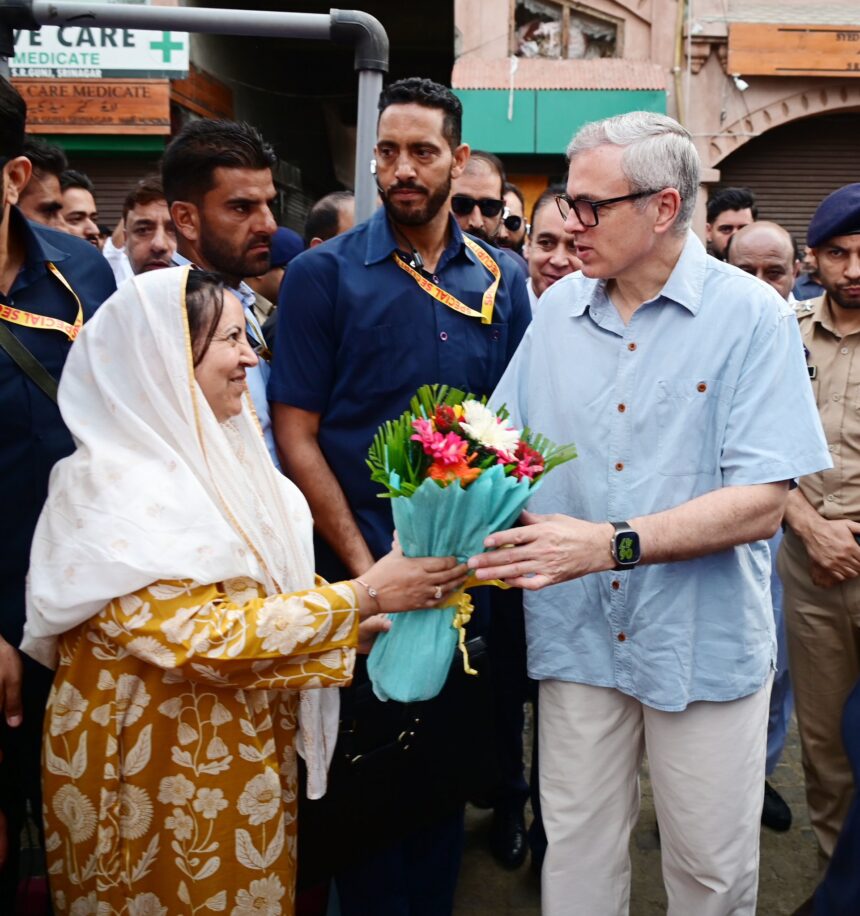
SRINAGAR: Jammu and Kashmir Chief Minister Omar Abdullah on Wednesday said he would not take complaints about Jammu and Kashmir to foreign governments, asserting that the responsibility for resolving the region’s issues rests with the Government of India.
Speaking to media after conducting extensive tour of Srinagar city, Omar said Srinagar city is the identity of Jammu and Kashmir. It is now the only region in the country that has two capitals—Srinagar in summer and Jammu in winter—and naturally, both cities require special attention.
To inspect several key projects in Srinagar city, we have been out since 6:30 AM today. From Downtown (Shehr-e-Khaas) to Uptown, around 10 to 12 projects across the entire city were reviewed. The progress on most projects is satisfactory; one or two need a slight push, which we will provide, he said.
The advantage of such field visits is that it gives us an opportunity to compare ground realities with what we are told in the Civil Secretariat. I want to assure the residents of Srinagar that more such projects will be undertaken, and we will address the city’s major demands. In particular, concrete steps are needed regarding de-congestion and traffic management. Parking remains a major issue in Shehr-e-Khaas, and we will have to find a solution for it. The rest of the matters will be addressed as we move forward.”, Omar told reporters.
Asked about the promises made during manifesto, Omar said, “Five years? Was I asleep for three years somewhere? It hasn’t even been two full years yet. I told you from day one—the National Conference did not present its manifesto for a single day, a week, a month, or a year. It was a five-year roadmap.
Ask me this question after five years, and I will give you a detailed answer. But none of you can claim that we have ignored our manifesto so far. Every single point has been touched upon in some way, and whatever remains to be done moving forward, we will accomplish it, he said.
Asked about the problems faced by people Omar said, “There is no area among the three key departments you pointed to—whether electricity, roads, or water—where work is not underway, more in some places and less in others. There isn’t a single assembly constituency where work is not going on to supply water, provide electricity, and repair roads.
This year, there was a slight delay in the blacktopping of roads because the supply of bitumen we were supposed to receive was disrupted due to the war. Now that supply has resumed, and the blacktopping process has started again, CM said.
Regarding the water issue, the fault did not lie with us; the central government’s Jal Jeevan Mission had come to a halt. The Union Cabinet has now re-approved it, and funds have started to arrive, so the Jal Jeevan Mission projects will proceed, he said.
Admittedly, we are currently unable to provide 24-hour electricity everywhere, but power cuts have been significantly reduced, and we will improve this further moving forward, Omar said.
On FIR in Kargil, CM said now, I don’t know much about this, but regardless, no one should use objectionable words against any religious leader. Everyone has feelings, no matter which religion they belong to. So, if there is someone who has made such remarks, which hurt the sentiments not only of the people of Kargil but also of the Shia community—who live not just in Kargil, but across the entire world—that shouldn’t happen. And whatever action the police need to take in this matter, they should take it.”
Asked about the meeting with US Ambassador he said, “After a very long time, the US Ambassador is visiting Jammu and Kashmir, and for me personally, it has been an exceptionally long time since I last met any American ambassador. We will sit down and talk. I would prefer to listen to them more, but they are also coming to listen. Let’s see how the conversation unfolds; they are coming to meet this afternoon.
Whether they wish to hear it or not, our problems have no particular relevance to them, nor has it ever been my habit to voice complaints to an ambassador of another country. The solution to our issues is not going to come from Washington; the solution lies with our central government. Therefore, I believe it would be completely wrong of me to complain about my own country, especially to another nation’s representative—that is simply not my style, he told reporters.
I will certainly discuss Jammu and Kashmir and our prevailing situation, but I will neither lodge complaints nor attempt to seek solutions to those grievances from them, he said.
On BJP’s protest, Omar said, “Even if we assume for a second that what they are saying is correct, we do not even have the power in our hands to cover it up. Tell me, which investigative agency is under my control? Not a single one. I don’t control the police, I don’t control the Crime Branch, and I don’t control the ACB (Anti-Corruption Bureau)—leave aside the central agencies, which are far beyond my reach.
Tell me, where has any agency stated that, ‘Yes, corruption has occurred in this matter’? The control over these agencies lies with the BJP. Go ahead and get an investigation done. If corruption has actually taken place, file a case and take action against it. But these baseless allegations are being made completely unnecessarily, he said.
“Waterlogging in parts of Srinagar—how did these settlements come up, where did they come from, who granted permission to build them, and how were they constructed? Neither you know nor do I. When these colonies were built, the developers made no provision for drainage. Now, whenever it rains, people turn to the government and say, ‘Clear our water.’ Why wasn’t a proper drainage system put in place while the colony was being developed?, he said.
Now, we have to arrange drainage for these colonies retrospectively, which we are currently doing, but this cannot happen overnight. The black spots and the most problematic areas have been identified. On an emergency basis, whenever we receive rain warnings from the department, we will arrange additional dewatering pumps at those locations, Omar said.
However, for a long-term solution, the necessary drainage projects are being processed by the Housing Department. As funding becomes available, we will retrospectively establish proper drainage infrastructure across these areas, he said.
Srinagar wakes up to CM’s visit to review key development works
Srinagar: As a small number of early risers queued outside Srinagar’s bakeries to get their fill of ‘tchout’ and ‘nun chai’ (bread loaf and salt tea) on Wednesday, perhaps the last person they expected to see was Jammu and Kashmir Chief Minister Omar Abdullah.
And yet, known to be up early for his morning walks, Abdullah was seen with his cavalcade at 6.30 am, traversing narrow lanes of a city just stumbling out of slumber. He was on a tour with an entourage of ministers and senior officials — spanning north and south of Srinagar — to inspect ongoing development projects, assess public facilities and review the progress of key civic works aimed at improving urban infrastructure and public services.
Officials said the idea behind the early excursion was to gain a perspective on the ground reality, rather than solely relying on department briefings, and cause minimal disruption for citizens.
The chief minister visited several places, from Downtown, comprising the interior areas popularly called ‘Shehar-e-Khaas’, to the Civil Lines areas.
He inspected a site for the proposed bridge at Barbar Shah; laid foundation stone for the comprehensive beautification, upgradation and junction improvement at Mirza Kamil Chowk in Hawal; inspected the ongoing conservation and restoration work at the historic Aali Masjid in Eidgah; and carried out inspection at the site for the proposed Mominabad Vehicle Underpass (VUP) to reduce traffic congestion.
Abdullah also visited the construction site of the new building at Sub District Hospital (SDH) Hazratbal, the new building of the Maharaj Gunj Urban Primary Health Centre, and the proposed site for the Parimpora-Shalteng Flyover, which is aimed at ensuring smooth, uninterrupted transit along the NH-44 route, and the new Hospital Block being built at SKIMS Medical College, Bemina.
Speaking to reporters after concluding the tour, the chief minister described Srinagar city as an “identity” of Jammu and Kashmir.
“We are the only region in this country that has two capitals — Srinagar in the summer and Jammu in the winter. Naturally, both cities require special attention,” he asserted.
Abdullah said the tour aimed to assess the city’s developmental scenario. “We set out around 6.30 am to inspect some key projects in Srinagar city. Covering areas from ‘Shehr-e-Khaas’ to uptown, we reviewed about 10 to 12 projects across the entire city. For most, the progress on these projects is quite satisfactory. One or two need a bit of a push, which we will provide,” he said.
He said such tours allow for the comparison between what briefings at the Civil Secretariat say and what the ground reality is.
Reassuring the residents that more developmental projects will be undertaken by the government in the city and that its major demands would be addressed, the chief minister said his government is particularly keen to decongest the city and get rid of the persistent traffic jams.
“Several steps need to be taken for that. In Downtown, parking is a major issue; we will have to find a solution for that. As for other matters, we will resolve them as they come up,” he asserted.
Abdullah said there is not a single area among the three key sectors — electricity, roads and water — where work is not actively underway.
“Some places have more, some less, but there isn’t a single assembly constituency where work isn’t happening to improve water, electricity, and roads,” he said.
He rued the “slight delay” in the macadamisation (blacktopping) of roads due to the temporary non-availability of bitumen in the wake of the war in West Asia.
“Now that supply has resumed, the road macadamization has restarted. Regarding water issues, the problem wasn’t from our end; the central government’s Jal Jeevan Mission had stalled. The Union Cabinet has now re-approved it, funds have started flowing, and those Jal Jeevan Mission projects will proceed,” he told reporters.
Speaking about electricity, the chief minister said that while currently, the government may not be able to provide 24-hour electricity everywhere, the power curtailments have significantly reduced.
“Moving forward, we will improve it even further,” he asserted.
In response to a question about dealing with waterlogging and flood-like situation in the wake of incessant rains, Abdullah said waterlogging in parts of Srinagar is a legacy issue, and not the creation of the last two or five years.
“Residential colonies were built. Where did they come from, who authorised them, how they were developed — neither you nor I know. When these colonies were constructed, the developers made no provision for proper drainage. Now, whenever it rains, people turn to the government saying, ‘come and drain our water’. Why wasn’t a drainage system planned when the colony was being built?” he asked.
Abdullah said the government has to arrange drainage retrospectively in such colonies.
“We are doing that. But this cannot happen overnight. The major ‘black spots’ and most problematic areas have been identified. On an emergency basis, whenever (wet) weather alerts are issued by the Meteorological Department, we arrange additional dewatering pumps at those locations,” he said.
For the long term, he added that drainage projects handled by the Housing Department were being implemented.

